Database Validation Rules for AI Pipelines
Extend validation beyond format checks to catch distribution shift and temporal inconsistencies.

Database validation rules for AI pipelines must test more than whether fields are complete and correctly formatted. They must also test statistical thresholds, temporal consistency, and cross-dataset relationships. Without these tests, bad data can pass every local check and still lead a model to make wrong decisions. Existing validation must be extended, enforced where failures first become visible, and grounded in governed business definitions.
Why AI pipelines break in ways traditional validation never anticipated
A schema inconsistency at ingestion can silently corrupt features, contaminate training data, and produce a model that fails only at inference. By then, significant time and cost have already been spent. The damage compounds as data moves downstream. When a check misses the first inconsistency, later stages work from data that is wrong, even if their own processing works as it should.
Human workflows offer a brake that automated pipelines lack. A person working through a list may notice something odd and slow down, while a pipeline takes the fields it is given as ground truth. When some of a database is wrong, a pipeline can make wrong predictions, personalization, and routing thousands of times, each with full confidence. Traditional validation was built to check one field or record at a time. Model behavior also depends on relationships and the shape of data over time, so those checks leave important failures invisible.
What traditional validation rules actually cover, and where they stop
Standard validation covers six dimensions, namely accuracy, completeness, consistency and referential integrity, validity, timeliness and freshness, and uniqueness. These remain necessary groundwork for AI pipelines. Completeness checks catch required values that are missing, such as a marketing profile with neither an email address nor a phone number. Missing attributes can skew analytics and bias automated systems, while accuracy checks whether the data that was supplied is correct.
Consistency checks catch a customer marked “Active” in the CRM but “Inactive” in billing. Referential integrity checks make sure that every transaction points to an account ID that exists. Validity rules filter out incorrectly formed or impossible values, including a ZIP code that contains something other than digits or a birth date in the future. Uniqueness rules keep duplicate records out, such as two users who share the same Social Security Number.
Freshness checks add a time boundary by measuring the lag between an event and its availability, or flagging assets that have not been updated within a defined window. But passing these checks does not establish model readiness. Their focus is the correctness, presence, and availability of individual records at a point in time.
The validation categories AI pipelines require that traditional rules do not cover
Statistical threshold rules catch distribution shift, which occurs when data reaching a model differs from the distribution it was trained on. Every individual value may still look valid. These rules examine measures such as mean, variance, skew, and percentile bands across a feature over a rolling window. A revenue table can pass its null and format checks while its values shift enough to undermine model accuracy. Learned baselines help expose departures that no one anticipated in a fixed rule, especially for rolling averages and ratios where a small upstream change compounds through the derivation.
Temporal consistency rules check whether events make sense in the order they happened. A cancellation cannot precede its order. A discharge date cannot precede admission, even if both dates are valid on their own. Temporal checks also need to reflect the use case, because a snapshot suitable for monthly reporting may already be stale for inference. Without such a rule, a model can treat an eighteen-month-old job title as current and act on it with full confidence.
Streaming makes this timing problem more urgent. Batch freshness checks arrive after the decision has been made. Inline temporal validation instead runs within stream processing and sends failed records to dead-letter queues while clean data moves on. This changes validation from a later finding into a control on what enters the pipeline.
Cross-dataset relationship rules address failures that appear only when sources meet. Two locally valid tables can produce an invalid feature. Company size in one source may contradict revenue range in another, or a CRM job title may not align with seniority in an enrichment feed. Referential integrity must also extend across these relationships, including whether a product ID has a matching record in the SKU catalog used for training. The join introduces another risk as well, because individually permissible datasets can form a combination that violates privacy or compliance requirements.
Pattern matching and business logic validation go beyond a value’s format to test its meaning. An “active customer” needs a business definition. So do “reported revenue” and “current inventory,” because an agent can read a schema without understanding the intent behind it. Without encoded definitions, the column can exist, the type can match, and the query can run while the answer is wrong.
How tiered enforcement turns validation rules from observations into pipeline controls
A validation finding needs a policy for what happens next. Tiered enforcement separates failures that make data invalid from those that need to be looked into or watched over time. The response depends on the consequence of a rule firing.
The block tier stops records that would corrupt downstream features or training data. Examples include a broken reference, a value outside any statistically plausible range, or a contradiction that invalidates a join. The warn tier lets data pass but calls for someone to follow up. It fits a freshness threshold exceeded, a statistical drift flag, or a soft business logic mismatch when the issue reduces quality without invalidating the record outright.
Record-level validation makes those choices operational by identifying which records failed, which rules they violated, and why. Clean records need not wait for a failed batch. The log tier records issues that do not require immediate flow control, preserving what fired, when, and on which data. That history supplies the signal anomaly detection needs to learn normal behavior and recognize departures.
Where in the pipeline each validation category should be enforced
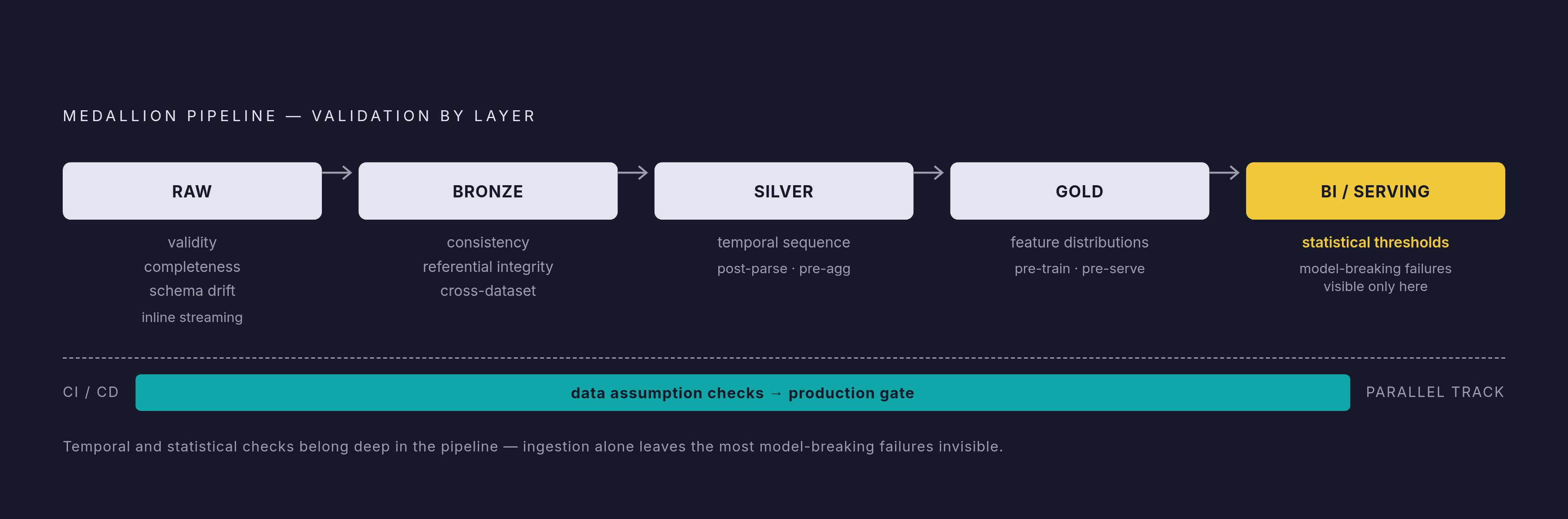
Where a failure can first be caught determines validation placement. The Medallion Architecture gives that question a useful structure across Raw, Bronze, Silver, Gold, and BI layers. At ingestion, the Raw-to-Bronze boundary is the primary filter for validity and completeness. Schema drift detection belongs there too, because a renamed column, changed type, or new nullable field can introduce silent errors into downstream transformations. Streaming checks need to execute inline at this boundary, before a later batch assessment.
Transformation creates failures that ingestion cannot yet reveal. As data moves from Bronze through Silver to Gold, joins and derivations need consistency, referential integrity, and cross-dataset checks. Business logic must be tested when a transformation first turns “active customer” into an operational feature. Temporal sequence checks belong at Silver, after parsing but before aggregation, while out-of-order events are still correctable.
The feature and serving layer is the last chance to catch distribution shift before it changes how a model behaves. Statistical thresholds belong on feature distributions before training and serving. A feature store’s staleness threshold should reflect the model’s decision latency. Validation also belongs in CI/CD, where deployment tests can check data assumptions as well as code correctness before violations reach production data.
Why AI-generated validation rules are becoming necessary at production scale
Evolving schemas, arriving sources, and the validation work added by every metric, column, and pipeline stage strain hand-maintained rule libraries. Coverage grows faster than engineering capacity to maintain it. Rules must stay aligned with transformations as those transformations change.
AI-generated rules address this gap by deriving expected checks from mapping specifications, SQL, or Python code. The USPTO patent “Automatic expected validation definition generation for data correctness in AI/ML pipelines” covers automatic generation of expected validation definitions. The practical benefit is alignment with transformation intent. A rule derived from a specification can test whether the transformation did what it was supposed to do, rather than only whether its output has the right format.
Anomaly detection complements that mechanism by learning historical behavior and flagging unexpected departures. A variable expected range is particularly useful for distribution shift, where a hand-authored rule may never have described the emerging failure. But generated rules still need someone to take ownership of them, along with versioning and an audit trail. A production rule must be traceable to its mapping document, SQL, or generating model, or automation adds findings that no one can reliably explain.
Why validation rules alone cannot solve the problem without semantic context and governed access
Traceable rules still need an agreed meaning to enforce. Validation needs institutional memory to establish which revenue figure is the reported one, what a column means, or whether last night’s pipeline actually ran. An agent needs that context to distinguish a technically valid answer from one the business can use.
A semantic layer supplies table descriptions, metric definitions, and relationship context as governed metadata that travels with each query. For “active customers,” it provides the business’s ratified definition rather than leaving the agent to infer one from a column name. Meaning becomes part of the query’s context. Business logic validation can then test against a maintained definition instead of a separate assumption that drifts as the business changes.
Permissions evaluated at query time can use the actual end user’s identity. Audit logs need to capture identity, intent, and lineage together, showing who acted, what the query touched, and why. Sensitivity also needs evaluation when datasets combine, because separate access approvals do not establish that a joined result is permissible. Prompt instructions on their own cannot put those data-layer controls in place.
Writes need stricter governance than reads because a stale read gives a wrong answer, while a stale write changes production state. The risks are not equivalent. The resulting architecture places a semantic layer with governance in every query over existing warehouses, SaaS tools, and operational systems. It need not require migration or replacement. One interface can bring together the context for validation, the definitions of metrics, and permissions that are enforced.
A practical starting sequence for teams adding AI-specific validation to existing pipelines
For teams adding these controls, the first step is to audit what existing rules actually cover. Check which of the six traditional dimensions they cover, then find stages that lack statistical, temporal, or cross-dataset checks. Those gaps reveal where failures remain invisible. Pay close attention to statistical thresholds and cross-dataset relationships because local checks cannot tell whether features built from that data are safe.
Next, instrument the feature layer with statistical thresholds before training and serving, where distribution shift is still correctable and model accuracy is directly exposed. Then add schema drift detection at ingestion. It costs less to catch a renamed column or changed type at Raw-to-Bronze than to trace the model failure it causes back through every transformation. Automated rule generation from incoming data profiles offers a way to scale that coverage.
Before deploying the new rules, define their enforcement policies. Decide which violations call for block, warn, or log, and send failed records where those choices require them to go. Then connect business logic rules to governed definitions in a semantic layer, so the meaning of “active customer” or “reported revenue” is maintained with the rule that enforces it. Otherwise, a rule can remain technically functional after its business meaning has changed.
The workload can look larger than a team can absorb. That does not require an all-at-once implementation. Implementation should begin at the layer where failures are currently invisible and most expensive. Existing validation stays in place while AI-specific controls close the gaps it was never designed to cover.