Semantic Layer Architecture for AI Workloads
Semantic layers double AI accuracy by enforcing consistent data definitions.

A semantic layer sits between raw data infrastructure and whatever consumes that data: a BI tool, a dashboard, an AI agent. It translates technical schema into terms the business actually uses, things like what revenue means, how churn gets calculated, which entities relate to which. MIT CISR, in research published in May 2026 drawing on interviews with forty-one organizations, describes it as a system of technologies and techniques that produces one consistent representation of data, readable by humans and machines alike.
Think of it this way. A warehouse stores data. A catalog documents it. A semantic layer gives that data meaning at the moment someone (or something) queries it, and it does that without moving a single row anywhere. It sits above the infrastructure you already built and enforces one shared definition every time anyone asks it a question.
I used to call this a "helpful abstraction." Nice to have, not required. I don't think that framing survives contact with where things are now. GigaOm's 2025 semantic layer research classified the category as mature for the first time, which tells you it stopped being emerging infrastructure a while back. Gartner moved it into the essential tier of its 2025 Hype Cycle for BI and Analytics. And MIT CISR's research found leaders feel real pressure to invest in semantic technology specifically so data is usable by AI models and agents, not just by the one analyst who already knows where the bodies are buried.
Here's why that shift actually matters. The old semantic layer assumed a human on the other end, someone who could look at a weird number, raise an eyebrow, and ask a follow-up before doing anything with it. An agent doesn't do that. It takes the schema as given and produces an answer whether or not that schema means anything at all.
How a semantic layer changes what an AI agent can do with enterprise data
Point an agent at bare tables and watch it guess. It infers business logic from column names, from table structure, from whatever pattern happens to be lying around. It has no way of knowing how the business defines revenue, what filter makes a user "active," or which of three "customer_id" columns is the one that actually matters. So it guesses, differently on different runs, and hands back SQL that reads clean and means nothing.
A governed semantic layer changes what the agent sees before it writes a single query. Metric definitions, table relationships, entity descriptions, access rules, all of that arrives ahead of query generation. The agent resolves against something already decided instead of inventing it fresh every time.
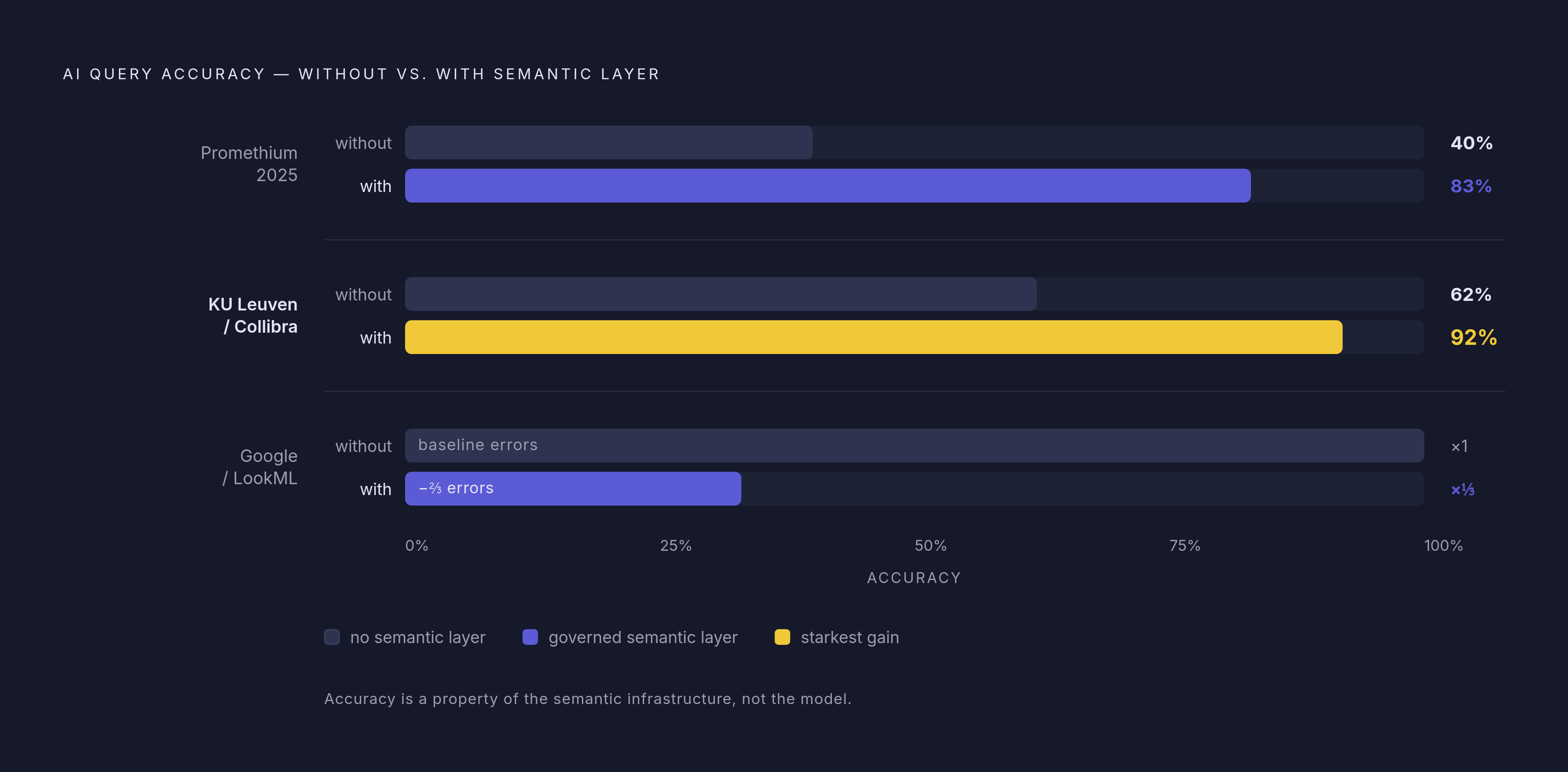
The accuracy numbers are worth sitting with, though I'll say upfront most of them come from vendors or internal testing rather than independent audits, so take them as directional rather than gospel. Promethium's internal testing in 2026 showed LLM accuracy on business questions climbing from around 40% with no semantic layer to over 83% once governed definitions were in the loop. A test from KU Leuven, cited by Collibra, found the same model on the same data go from 62% accuracy to 92% once a governed context layer got added. Google's own testing found LookML cuts data errors in generative AI natural language queries by as much as two-thirds. Three different tests, three different vendors, same direction. That's not nothing.
None of that improvement came from a better model. Same model, same underlying data, different context layer, and accuracy nearly doubled in some cases. Accuracy is turning out to be a property of the semantic infrastructure sitting around the model, not a property of which model version you happen to be running that week. MIT Sloan's 2026 framing gets at this well: giving an AI system access to data isn't the same as giving it the context to understand that data.
The architectural components a semantic layer needs to serve AI workloads reliably
Start with the metric and definition layer, because everything downstream leans on it. Every metric the business runs on, revenue, churn, active users, needs one canonical definition, stored once, applied everywhere. That logic can't live scattered across a dozen dashboards or buried in someone's prompt text. It sits in the semantic layer and gets inherited by every consumer that touches it. McKinsey's 2025 State of AI research found that only about a third of companies using AI have managed to scale past pilot stage. Define the metric once, enforce it everywhere. That's the actual fix, not a nicer dashboard.
Relationship and entity mapping comes next. Joins, foreign keys, how entities connect: all of it needs to be declared explicitly rather than left for an agent to guess from schema shape. Skip this and a query like "revenue by customer segment by region" produces fan-out errors, or worse, aggregations that are silently wrong and nobody notices for a quarter.
Metadata has to be written for AI, not for the engineer who built the table three years ago and switched teams since. Table and column descriptions need to actually explain themselves, because an agent can't turn around and ask what "arr_adj_fx" stands for. It has no institutional memory, no hallway conversation to fall back on. The semantic layer answers that question before a query ever gets generated, or nobody does. MIT CISR frames this as a machine-readable representation of enterprise knowledge, something an AI tool can reason with instead of just parse.
Governance needs enforcement at the moment a query runs, not an assumption baked in at the perimeter based on broad service-account permissions. Access should scope to the actual person the agent is acting on behalf of. A service account's permissions don't automatically shrink to match the least-privileged human standing behind it. Sensitivity checks need to happen where data actually gets combined; a join that creates a sensitive combination has to get caught before the SQL runs, not after someone notices in a postmortem.
Lineage and audit logging matter more here than they ever did for dashboards. Every query needs a record of who ran it, which semantic definition it resolved against, which source it traced back to. At the volume agents generate queries, a log that just says "a query ran" isn't an audit trail. It's noise. Identity, intent, and lineage have to travel together, or the business can't answer a basic question six months from now: which downstream AI output depended on this metric, and was that metric's definition even correct at the time?
One more thing, easy to skip past: it all has to run against live or near-live data. A snapshot that's fine for a Monday morning dashboard can be stale by the time an agent uses it to make a decision that same afternoon.
Why a platform-native semantic layer is not the same as a governed one
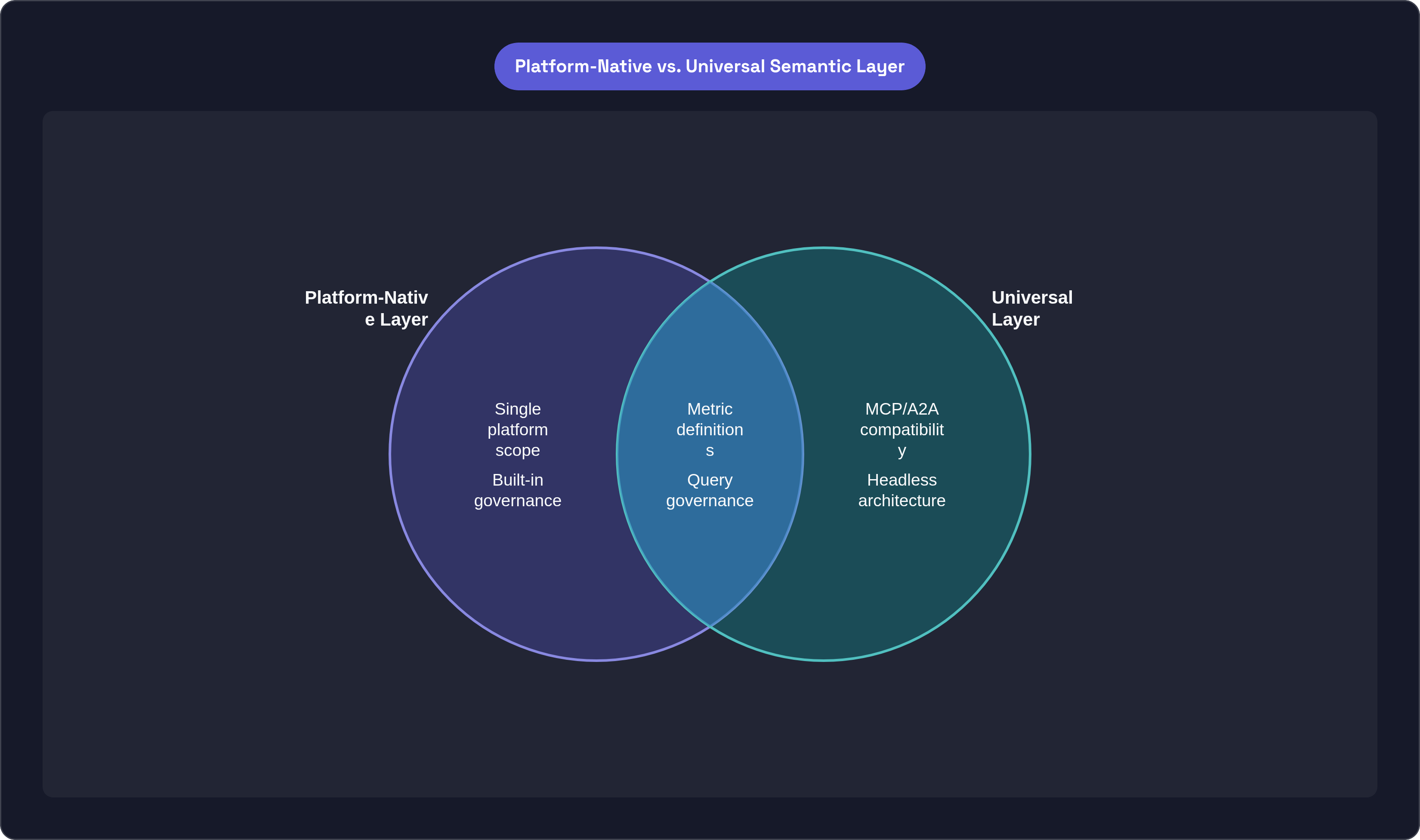
Almost no large organization runs on one platform. It's Databricks for ML workloads, Snowflake or Redshift for analytics, some legacy warehouse finance refuses to retire, and half a dozen BI tools pulling from all of it at once. A semantic layer built into one of those platforms governs that platform. Full stop. Everything else keeps operating on its own definition of revenue, its own definition of an active user, its own access rules. An agent querying across that whole landscape ends up resolving the same metric differently depending on which platform it happened to hit first.
That's the argument for what's usually called a headless or universal semantic layer: one that sits above every platform instead of living inside any single one. Every consumer, a dashboard, an LLM, an autonomous agent, queries the same governed definitions through the same interface, regardless of where the data physically sits. This pattern has shown up consistently across modern tools built to serve both AI and BI: one governed layer, headless, serving many consumers from a single set of definitions.
The governance implication follows pretty directly from there. Governance built into the platform layer only governs that platform; it doesn't travel with the query when an agent crosses into a different system. A universal layer enforces the same access rules, the same metric logic, the same audit trail, no matter which system actually holds the data.
I don't think this is a vendor preference question, honestly. It's a question of where governance physically lives in the architecture. Platform-native makes governance a feature of the store. Universal makes governance a property of the query path itself, wherever that path happens to lead.
How open standards and agent protocols are reshaping what the semantic layer must expose
Something shifted in 2025 and 2026, and it happened fast. Major platform vendors moved to publish open metric standards meant to work across vendors, not just inside their own walls. GigaOm's 2025 semantic layer research identified open standards and interoperability as core factors separating the leading approaches in this category from everyone else. Metric definitions are becoming portable, artifacts you can move around, instead of proprietary configuration locked to whichever vendor happened to build your layer.
Model Context Protocol matters here for a specific reason: it gives an LLM a standard way to query governed semantic definitions directly, instead of querying raw schema and hoping. Enterprises running multiple models at once can use MCP to ensure every model shares the same semantic ground no matter which one actually runs the query. The real contribution is accountability, traceability and consistency in a process that had neither before.
Multi-agent systems raise the stakes further. An orchestrating agent hands off sub-tasks to specialized agents, and every one of them needs to work from the same semantic ground as the orchestrator. Skip that and a sub-agent returns results built on different metric logic than the orchestrator expected, and the whole chain produces something that reads coherent but is quietly contradictory underneath. Emerging agent-to-agent protocols define how agents hand task requirements to each other. A semantic layer that exposes definitions through standardized APIs plugs into that naturally, so every agent in the chain resolves the same metric the same way.
Here's the blunt version: a semantic layer built only with BI tools in mind might expose its definitions through proprietary APIs that MCP-compliant or A2A-compliant agents simply can't read. Protocol compatibility stopped being an integration detail somewhere in the last year. It's an architectural requirement now, whether or not the roadmap says so.
How the design requirements differ from what served human analysts
The old semantic layer was built for a person who could read a label, notice something looked off, and ask a follow-up before acting on it. Descriptions were written like UI labels: short, assuming context the reader already had walking in. Governance sat at the perimeter, controlling who could log in and trusting whatever they did once inside. Refresh cycles were tuned to how fast a dashboard needed to feel, not to any deeper standard of freshness.
Every one of those choices breaks under an AI workload. An agent can't pause and think something looks off. It just produces the answer, and ambiguous metadata produces a wrong answer instead of a paused one. Perimeter governance doesn't follow an agent across a platform boundary, and it doesn't catch a join that creates a sensitive combination on the fly. A refresh cycle that felt current enough for a human analyst checking yesterday's numbers can be too stale for an agent about to act right now, this minute. Agent-initiated writes carry a risk profile the old layers were never built to think about, because those layers were designed to govern reads, full stop.
So the shifts required now are specific, not aspirational. Metadata has to be written for a machine: complete, unambiguous, no assumed context, instead of a shorthand label meant for someone who already knew the system cold. Governance has to move out of the perimeter and into the query path itself, evaluated the moment a question gets asked rather than assumed the moment someone logs in. Build the layer for the reader it actually has now, not the one it used to have.