Semantic Layer Tools and Platforms Evaluation
Most AI projects fail because data definitions are fragmented, not because models are weak.

GigaOm's 2025 Radar classified the semantic layer category as established for the first time. The money agrees: analysts put it at $2.71 billion in 2025, heading to $7.73 billion by 2030. That's real, budgeted growth, not speculation.
But here's what nags at me. The Modern Data Company surveyed over 500 data practitioners in 2026 and found 80% of them rank a unified semantic layer as the biggest thing standing between them and real AI value, ahead of better models, ahead of more tools. And yet 84% of those same teams still run into conflicting versions of the same metric on a regular basis. So the category gets its "mature" stamp, and the actual problem is still sitting there, mostly unsolved, on the ground floor of most companies. I've watched this play out enough times to know it's worth taking apart.
Why AI projects stall at the data layer, not the model layer
The pattern repeats itself so often it's almost boring. Model works great in the demo. Falls apart in production. And it's never the model's fault.
Ask three departments what "customer" means and you'll get three different answers. Same with "order." Same with "revenue." A human analyst notices when a number looks off and walks over to someone's desk to ask. An AI agent writing SQL against raw tables has no way to know gross revenue from net revenue unless something tells it up front. Old records carry gaps and formatting quirks that look, to a model, exactly like clean data. There's no visible seam where the bad data starts.
Once you look at the numbers, the scale of this gets hard to ignore. MIT's Project NANDA found in July 2025 that 95% of organizations deploying generative AI saw zero measurable return. Not low return, zero. Gartner surveyed 248 data management leaders in Q3 2024 and found 63% either lack the data management practices AI needs or aren't sure they have them, and Gartner projects that through 2026, enterprises will scrap 60% of AI projects because the data underneath isn't AI-ready. None of that is about model quality. It's about what the model's standing on.
Separately, 62% of organizations get stuck in pilot purgatory, not because the idea was bad but because the data can't hold up once it leaves the sandbox. Every one of these failures traces back to the same missing thing: shared meaning. A semantic layer exists to supply exactly that.
What a semantic layer actually does for an AI consumer versus a human analyst
A semantic layer is a central definition of business metrics, dimensions, and logic. It sits between the warehouse and everything downstream, dashboards, AI agents, APIs, notebooks. One definition, feeding a lot of different consumers.
For a human analyst, "monthly revenue" is a dropdown filter. If the number looks off, she asks someone and moves on with her day. An agent doesn't get that luxury. It needs machine-readable context sitting right there at query time, table descriptions, metric definitions, join paths, because it can't lean over and ask a coworker what a vague column name means. A wrong answer comes out looking exactly as confident as a right one, which is the scary part. MIT's Center for Information Systems Research said it plainly in a May 2026 report: without machine-readable enterprise knowledge, AI tools have no way to reason over data or produce output anyone should trust.
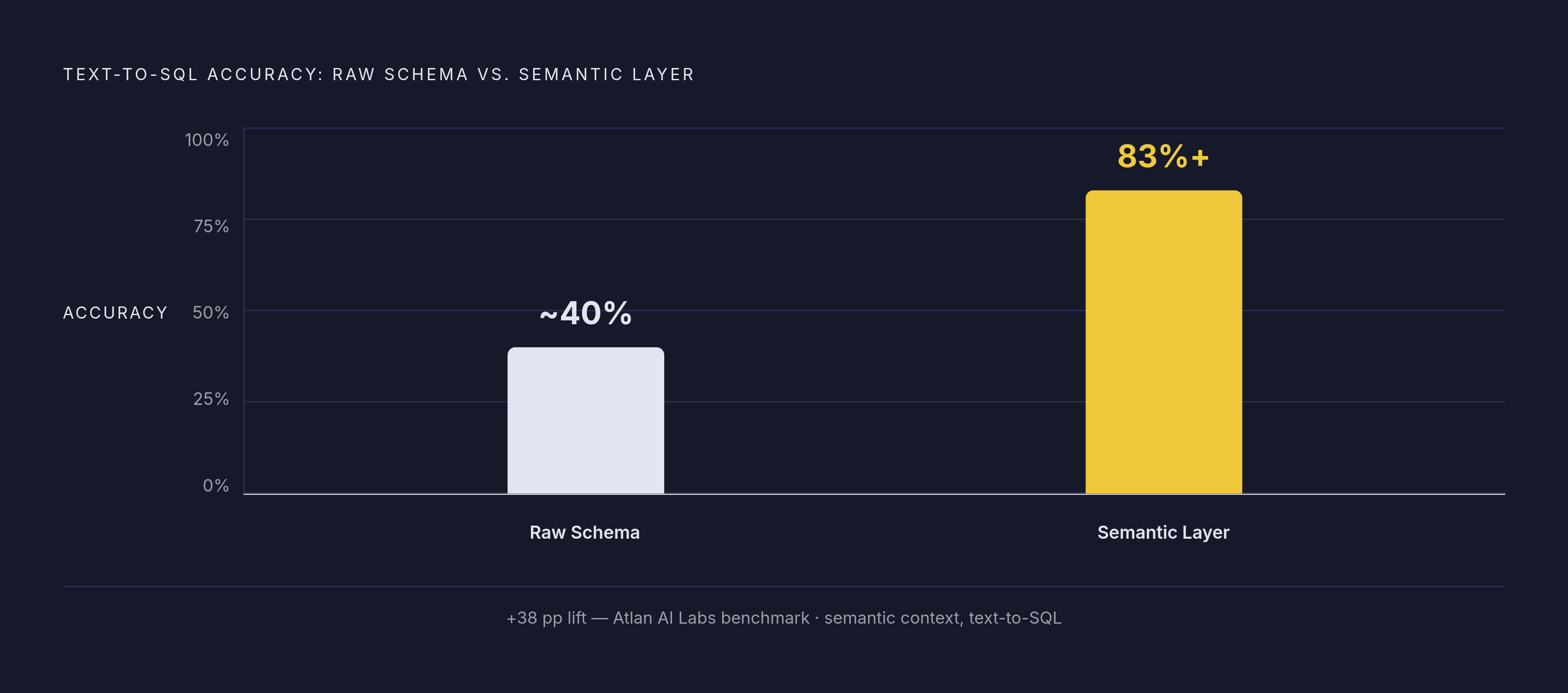
The gap is measurable. LLM accuracy on data questions sits around 40% against raw schemas and climbs past 83% once the same model is grounded in a governed semantic layer. Atlan's AI Labs benchmark found semantic context improved text-to-SQL accuracy by 38%. Google's internal testing on LookML cut data errors in generative AI natural language queries by roughly two-thirds. Gartner predicts that by 2027, companies prioritizing semantics in their AI-ready data will see GenAI accuracy climb by up to 80%, with costs down by up to 60%.
This is the part buyers keep missing. A tool that serves human BI users beautifully can be flat-out unfit for an AI agent. Different job, different rubric, and grading one against the standards of the other is how teams end up surprised in production.
The three architectural categories and what each one trades away
Three ways to build this, and each one costs you something.
BI-native semantic layers, things like Looker's LookML, Power BI, ThoughtSpot, Holistics, keep definitions locked inside the BI tool itself. Great for keeping a team of analysts aligned on one number. But the meaning lives inside the vendor's own consumption layer and rarely gets exposed to outside AI agents in any structured way.
Standalone, or headless, semantic layers expose definitions through an API instead. Vendor-agnostic by design, built to serve more than one kind of consumer at once. Of the three, this is the category actually built for AI agents from the ground up.
Warehouse-native semantic layers, Snowflake's Semantic Views, Databricks' Metric Views, wire deep into the warehouse's own governance and compute. Strong fit if a team lives entirely inside one warehouse. But the meaning stops exactly where the warehouse ends; these tools federate tables, not meaning. They don't read Salesforce data, crawl Confluence, or parse the schemas of whatever operational system sits outside the warehouse walls.
That limit isn't small, either. The average enterprise runs on a vast sprawl of applications, and data silos are a widely reported barrier to workflow. A layer that only sees inside one warehouse is covering a sliver of that surface. Architecture comes before features here. No amount of AI-readiness polish saves a layer that literally cannot see where most of a company's data actually lives.
How the standalone tools compare on the dimensions that matter for AI
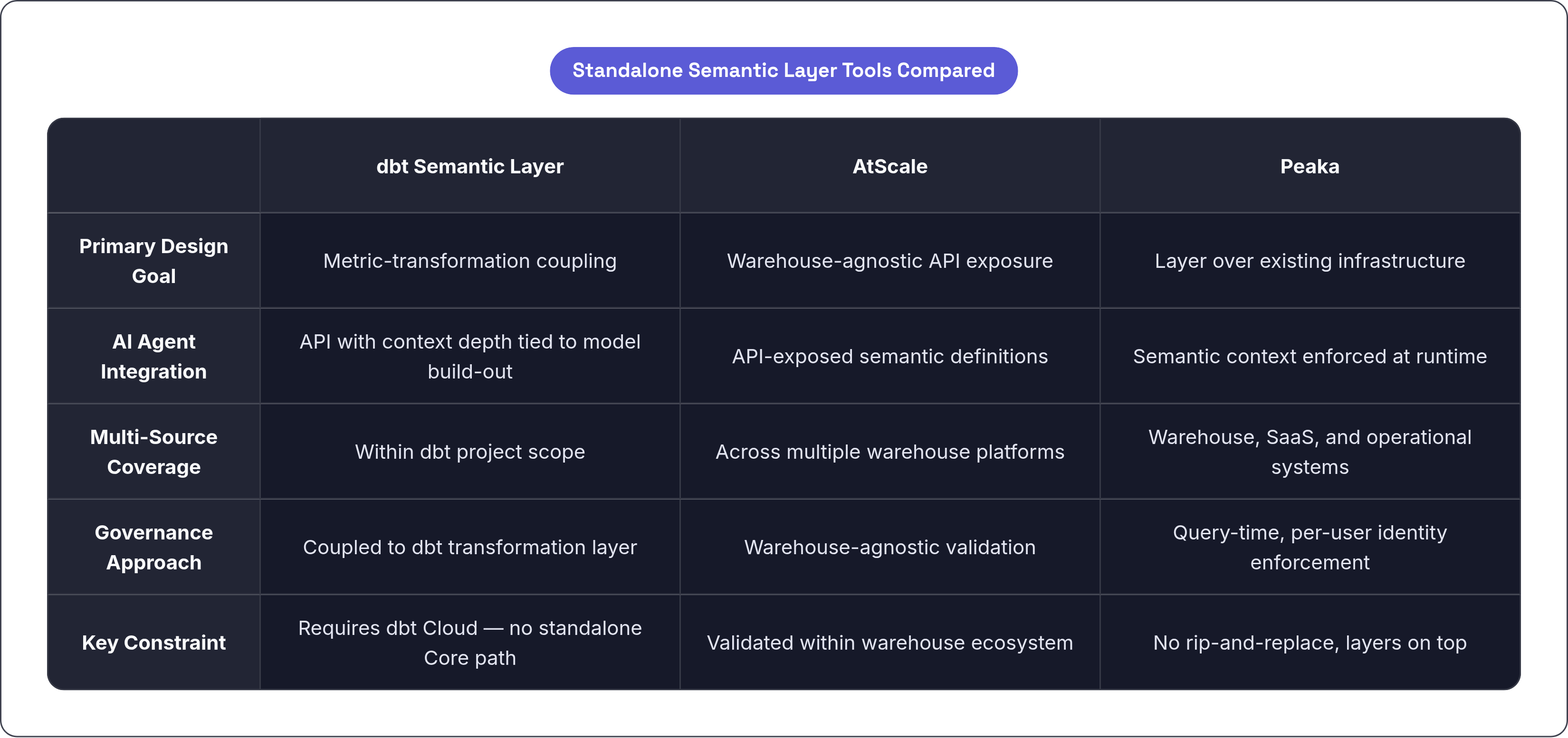
Five things matter when judging these for AI use: how much context rides along with a query, how the tool plugs into AI systems, how governance actually gets enforced, how well it pulls together multiple sources, and how battle-tested it is in production.
dbt Semantic Layer (MetricFlow) keeps metric definitions tightly coupled to the transformation layer. Context and transformation live in the same place, which cuts down on drift between what a metric's supposed to mean and what the data shows. It kills duplicate metric coding and handles joins automatically inside a dbt project. The catch: it needs dbt Cloud. dbt Core users don't get it standalone, which is a real wall for anyone on the open-source path. Definitions reach agents through an API, but how much context an agent actually gets depends on how carefully the team has built out their models.
AtScale landed as a leader in the 2025 GigaOm Radar. It's warehouse-agnostic, designed to work across multiple warehouse platforms. It exposes semantic definitions through an API so agents can query semantic models. Its warehouse-agnostic design offers vendor validation without locking teams into a single warehouse.
Peaka starts from a different place entirely. It sits on top of whatever infrastructure already exists, warehouse, SaaS tools, operational systems, without asking anyone to migrate anything. Semantic context and governance get built into queries at runtime rather than bolted on afterward. Permissions get enforced at query time under the actual user's identity, not a broad shared service account, which closes a governance gap that tends to blow up agent deployments once they scale past a handful of users. Detailed audit logging becomes critical once agent query volume turns a plain log into unreadable noise. And since there's no rip-and-replace requirement, it fits the reality that most enterprises simply can't migrate warehouses just to get a semantic layer.
Where warehouse-native layers earn their place and where they hit a wall
Snowflake Semantic Views moved to general availability for standard SQL querying, no longer experimental. It integrates with Snowflake's own analytics tooling, keeping natural language querying inside the Snowflake ecosystem. Snowflake has also invested in AI-assisted model generation features aimed at reducing the manual setup burden for teams already living in Snowflake. This earns its keep with teams that have already consolidated in Snowflake, run mature Snowflake governance, and mostly serve BI consumers inside the Cortex surface.
Databricks Metric Views leans on Unity Catalog for governance of metric access. It's the strongest native governance story of any warehouse-native tool here. Unity Catalog's continued investment in business semantics suggests Databricks is committed to this space for the long haul. It earns its place with teams running heavy ML and data engineering work on Databricks who want semantic consistency without bringing in a separate vendor.
Both hit the same ceiling, though. Federation features and Iceberg support pull tables together, not meaning, and with the average enterprise running roughly 900 applications, a warehouse-native layer governs whatever sits inside the warehouse, which for most companies is a fraction of what agents will eventually need to touch. Once an agent has to reason across CRM data, operational systems, SaaS tools, and the warehouse in a single query, a warehouse-native layer draws a line the agent can't cross.
The governance questions that separate AI-ready tools from BI-ready tools
Governance needs shift entirely once the consumer stops being a person and starts being an agent.
A human analyst who spots a weird number asks a question before touching anything. An agent just acts on it, and that action might trigger a downstream write nobody ever reviewed. Query volume from agents runs far higher than anything a human produces by hand, so an audit log that just confirms "a query ran," with no identity and no lineage attached, is worthless once volume climbs. And the old habit of one service account with broad permissions, fine for a dashboard, turns into a real liability the moment an agent inherits that same access.
Four things separate a tool that's genuinely AI-ready from one that's just BI-ready with an API bolted on. Query-time permission enforcement tied to the actual end user's identity, not assumed from a shared account. Sensitivity checked at the point where fields get joined, not just at the individual field level, since combining two fields that are each fine alone can produce a result neither field's policy ever anticipated. Audit logs that tie identity, intent, and lineage into one record, not just proof a query happened. And the ability to cut off one agent's access without breaking everything else sharing its credentials.
Databricks Metric Views comes closest to this bar among the warehouse-native tools, row-level security, column masking, and audit logging all built into Unity Catalog, but it still stops dead at the warehouse boundary. Most BI-native tools enforce governance at the display layer instead: permissions control what shows up on a dashboard, not what a query can actually pull at runtime. Sounds like a small distinction. For AI consumers, it's the whole ballgame.
The payoff for getting this right shows up in the numbers. Typedef.ai tracked over 200 enterprise deployments in 2025 and found metric consistency improved by up to 4x, with time-to-insight speeding up by 45%, once a governed semantic layer went in. Consistency isn't a side effect of good modeling here. It's a governance outcome, full stop.
An evaluation framework for buyers choosing between these tools in 2025–2026
Before you start comparing feature lists, sit with four questions first.
Who's actually going to use this thing? Human analysts at a BI layer, AI agents acting on their own, or both at once. That answer changes how much weight everything else carries.
Where does the data actually live? Fully consolidated in one warehouse, a warehouse-native tool is a reasonable, even obvious, pick. Spread across a warehouse, a dozen SaaS tools, and operational systems nobody's touched in years, a warehouse-native tool is an architectural mismatch no feature list fixes.
What level of governance does the job actually demand? Row-level security is fine for a dashboard. Query-time identity enforcement, full lineage, revocable access at the workload level, that's what agents need, and it's a different category of tool.
Last question: how much of what's already running are you willing to touch? A tool that demands migration is asking for commitment most companies can't spare just to get semantic consistency. A tool that layers on top of the existing setup asks for a lot less, and for most enterprises, that's the difference between having a semantic layer this year and still talking about getting one in 2027.