Semantic Layer vs Vector Database for AI Querying
Choosing between them determines whether your AI gets reliable answers or confident wrong numbers.

AI querying failures almost never come down to the model itself. They come down to what the model's being asked, and whether the data underneath was ever built to answer that kind of question. Semantic layers and vector databases solve two different problems, and most AI systems that quietly underperform in production got there by grabbing one when they actually needed the other.
I've watched this happen enough times that the shape of it feels familiar. A demo works fine in the conference room, everyone nods, budget gets approved. Then production rolls out and things start breaking within a quarter, usually quietly at first. Enterprise AI spend crossed $684 billion in 2025, and most of it failed to deliver the value it promised. S&P Global surveyed over 1,000 enterprises and found 42% abandoned most of their AI initiatives last year, a sharp rise from 17% the year before. Cost, privacy, and security failures got blamed, not model quality. McKinsey's research points the same direction from the other side: companies actually seeing returns had usually redesigned their data workflows before they picked a model at all.
Most of this traces back to one habit, repeated across a lot of teams: reaching for whatever retrieval tool is trending without stopping to ask what kind of question the AI needs to answer. Vector database or semantic layer isn't a preference, it's a question about the job. Get it backwards and the deployment rots slowly enough that nobody notices until the wrong number's already shaped a decision.
What vector databases actually do and what kind of questions they were built for
A vector database takes unstructured content, text, images, audio, and turns it into numerical embeddings. Retrieval happens by similarity, measured through embedding proximity rather than exact match or business logic. The question you're really asking is: what sits closest to this in that space?
Under the hood, indexing methods like HNSW, IVF, and Product Quantization let you run approximate nearest-neighbor search across huge sets of embeddings, fast enough to feel instant. The classic use case is RAG: embed a document corpus, store the vectors, pull the closest chunks at query time, hand them to an LLM to ground its answer.
This works well for a specific handful of jobs. Customer support, surfacing the closest matching policy for a complaint. Internal knowledge bases, finding a prior case that resembles the current one. Semantic search, where the result needs to match intent even when the keywords don't line up at all. Recommendations, matching by proximity in that embedding space rather than by rule.
The category's gone from niche to genuinely large. An August 2025 survey of 300 US engineers by HostingAdvice.com found adoption pushing toward a majority, with most of the remainder actively exploring one. Vendors have bolted on filtered search, combining semantic queries with metadata conditions, plus role-based access and encryption around the core engine. Worth noticing, though: that governance gets added on top. It isn't native to how retrieval actually works underneath.
So the tool answers one question well: what's most similar to this? Whether a business answer is correct is a separate question, and mixing the two up is where a lot of these projects start to slide.
Where vector search breaks down when business questions are structural, not semantic
Vector search lives in a flat space, no context attached. It finds what's nearby based on proximity, not what's definitionally right, and for plenty of business questions, that gap is the whole problem.
Take something that needs chained reasoning: customer to contract to renewal date to revenue segment. That's multi-hop, and flat similarity search just isn't built for chains like that. It hands back scattered chunks that might each look relevant on their own but don't hold together once you try to stitch them into an answer.
Accuracy drops further the more specialized the domain gets. A 2025 study in medical technology found general embedding models drifted badly when applied to structured clinical documentation, losing out to lexical models built specifically for that content. Research has put a meaningful ceiling on RAG accuracy without structured entity context, since the approach misses the relationships and constraints living between documents rather than inside any single one.
The hallucination problem here isn't really a bug. It's structural. Hand an LLM some retrieved chunks with no governed definition of what "revenue" means, or what counts as a "region," and it'll fill that gap with something plausible-sounding. Vector search on its own can't tell the model how a metric gets officially calculated, which table is the source of truth for a given KPI, what access controls apply to this particular user, or whether two same-named columns in two different systems actually mean the same thing.
And the failure stays quiet. A vector-only setup rarely raises a flag. It just hands back a confident, well-formed, wrong number. In a business setting, that's worse than an obvious error, because nobody thinks to double-check something that sounds right.
What a semantic layer is and why its job is fundamentally different
A semantic layer is a standing set of definitions mapping raw tables and columns to business concepts, customers, revenue, churn, risk, and it encodes how those concepts relate to each other. Think of it as institutional memory sitting between the raw warehouse and whoever's asking it a question.
What it actually holds: metric definitions (the exact math behind something like monthly recurring revenue), table relationships (which joins are valid, which aren't), business rules (what counts as an active customer, which fiscal calendar applies), and access policies (who sees which rows, what gets masked for whom).
For an AI agent, this matters in a pretty concrete way. A column called "region" could mean sales territory, shipping zone, or reporting geography, and the schema alone won't tell you which one. The semantic layer supplies context the model has no way to guess on its own.
The retrieval mechanism is different in kind, too, not just degree. A semantic layer turns a natural-language business question into governed, precise SQL. It's built for correctness, not for ranking by similarity.
The market's caught up to this. Recent research has called the semantic layer category mature, framing it as essential infrastructure for BI and Analytics. A few architectural flavors are worth knowing: BI-native layers baked into tools like Tableau or Power BI, platform-native options like Snowflake's Cortex Analyst, and universal or headless layers serving multiple consumers, human and AI both, off one shared set of definitions.
Governance here isn't a report you run afterward. It's the mechanism itself, enforced the moment a question gets asked: access controls, lineage, certified definitions, all live at query time.
The accuracy gap that opens when you query structured data without a semantic layer
Ask an LLM "what was regional revenue last quarter?" with nothing but raw schema, and it has to guess three things at once: what "regional" means, which table holds revenue, how that revenue should roll up. Each guess stacks error on top of the last one.
The numbers here are pretty stark, honestly. Paired testing has shown text-to-SQL accuracy climbing sharply once a semantic layer is added in, with models that previously missed a meaningful share of queries reaching near-perfect scores. What stands out just as much as the numbers, though, is the shape of the failures. With a semantic layer, errors tend to be refusals, the model saying it can't answer. Without one, errors tend to be confident, specific, and wrong. When an answer's about to drive a real decision, that difference is everything.
Internal BI benchmarks have shown roughly double the SQL accuracy when a semantic model is used versus a single-shot LLM query with no semantic layer at all. AtScale reports jumps from near zero substantially higher on high-complexity questions once a semantic layer enters the pipeline. And in a real test against pharmaceutical internal data, GPT-4 scored in the single digits across dozens of domain queries using schema alone, then hit a much higher score once it had a business-context document to work with.
That last one's worth sitting with for a second. The model didn't get any smarter between those two runs. The context around it did. Model capability's more or less a fixed input at this point; the semantic layer is what decides whether that capability shows up as a right answer or a confident wrong one.
How to tell which tool a given AI query actually needs
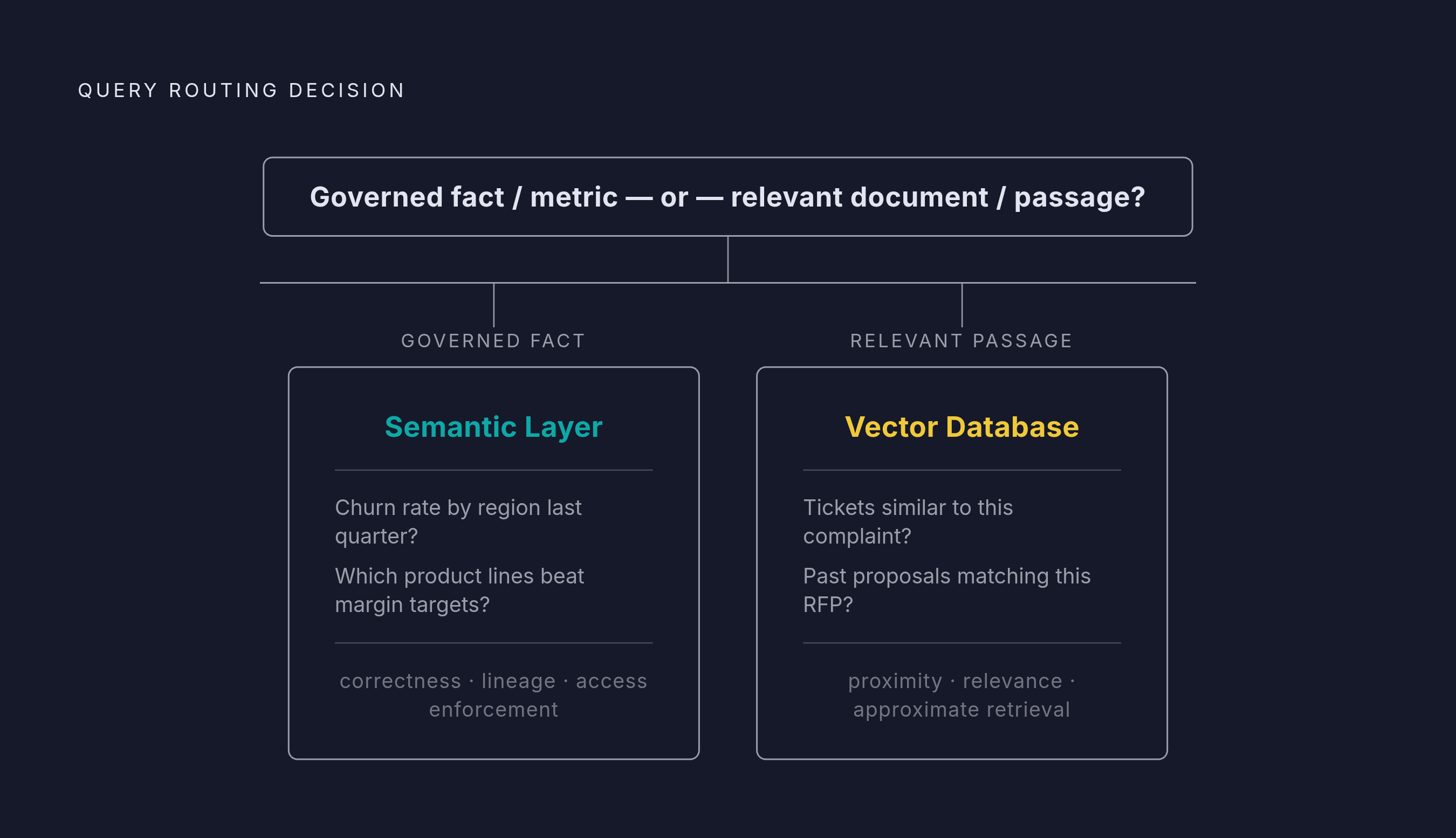
One question does most of the sorting: is the answer a number, a metric, a governed fact, or is it the most relevant passage, document, or similar item? Everything else follows from that.
Semantic layer territory looks like: "What was churn rate by region last quarter?" "Which product lines beat their margin targets?" "Show me pipeline coverage for Q3 by rep." Anywhere a wrong answer would drive a wrong decision, and "wrong" has a checkable definition, belongs here.
Vector database territory looks different: "Find support tickets similar to this complaint." "What does our onboarding docs say about this feature?" "Which past proposals are closest to this new RFP?" Anywhere relevance and proximity matter more than precision belongs over here instead.
A few other checks help with the rest. Data type: unstructured stuff, documents, emails, transcripts, images, points to a vector database; structured business data, tables, metrics, KPIs, points to a semantic layer. Auditability: if a human's going to review the output, or it triggers some downstream action, it needs lineage, and only the semantic layer gives you that natively. Governance: if access depends on who's asking, enforcement has to live in the query path itself, not get assumed from some broad service account's permissions.
A significant share of enterprise leaders point to missing semantic context as a major blocker to getting AI running operationally. That's a lot of organizations sending structured questions through a tool that was never meant to answer them.
Why these tools are complementary in a mature architecture, and where the boundary sits
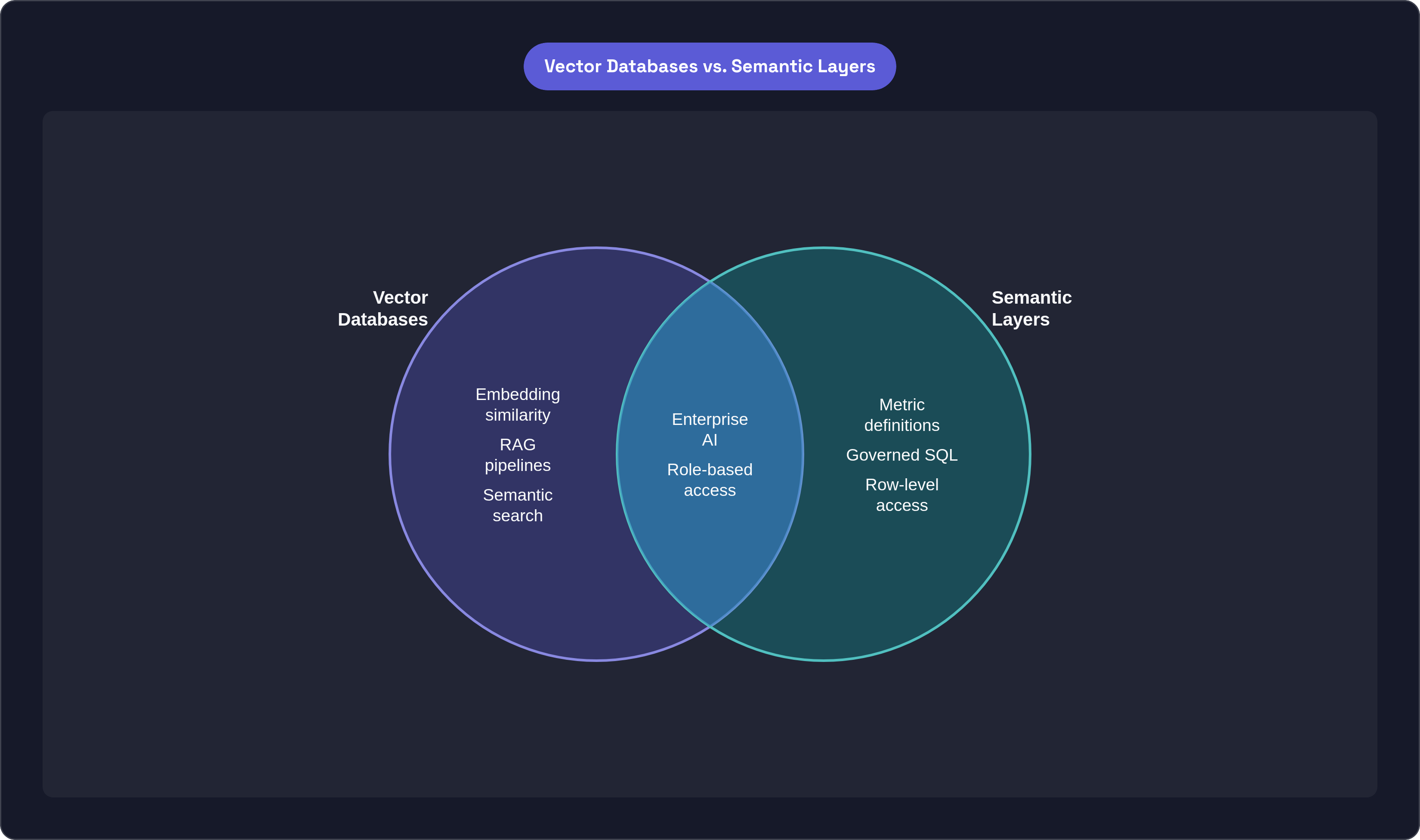
Enterprise architects seem to be settling on a shared view here: these tools complement each other rather than compete. RAG pulls document context, knowledge graphs structure entity relationships, semantic layers govern structured sources, and all three sit in the same system without much friction, provided each one stays in its own lane.
Picture a customer-facing AI agent working a billing dispute. It pulls the relevant contract clauses through vector search over document embeddings; that's the unstructured half. Then it queries the semantic layer for the actual invoiced amounts, payment terms, account status, governed and scoped to that specific user's permissions. The LLM stitches both halves into a response that's grounded and, importantly, auditable after the fact.
Graph RAG, pairing knowledge graphs with vector retrieval, is picking up steam for situations that need multi-hop reasoning but where the context window's too small to just dump everything in at once. It sits in the middle, functioning almost like a structural memory layer between the two.
Here's the boundary that actually matters: document retrieval can afford to be approximate. Business metric retrieval can't. That decides which tool owns which slice of a given query. There's a governance wrinkle worth flagging, too. Even in a combined setup, the semantic layer has to own access enforcement for the structured half, because governance split across two systems with different enforcement models isn't really enforced by either one. And once an agent starts taking write actions, not just answering but triggering downstream processes, the bar climbs again. Query-time enforcement and full lineage logging aren't nice-to-haves anymore at that point.
What "AI-ready" structured data actually requires beyond having a warehouse
Owning a data warehouse and being ready for AI to query it are two different things. A 2026 report from Cloudera and Harvard Business Review Analytic Services found only a small slice of enterprises call their data fully AI-ready, even though most of them already sit on mature warehouse infrastructure.
The bar for AI-ready data is higher than most teams expect going in: data aligned to specific use cases, governed asset by asset, backed by automated pipelines with quality gates, reassessed continuously rather than cleaned once and left alone.
There's a documentation trap a lot of organizations fall into here. For years, governance lived in wikis and data dictionaries written for human analysts who could read intent between the lines. AI agents don't read intent. They read schema, and schema rarely carries the meaning documentation was supposed to supply in the first place. That gap doesn't close on its own.
A few things have to change structurally to close it. Metric definitions need to be machine-readable, not stuck in a Confluence page nobody's touched since spring. Table relationships need to be declared outright, not left for the model to infer from column names. Freshness needs to match the use case; a snapshot fine for a weekly dashboard might already be stale for an agent making a call in real time. Sensitivity needs checking at the point where data gets combined, not just field by field in isolation.
A semantic layer operationalizes all of this, but only if someone keeps the definitions, policies, and lineage maintained at the pace AI development moves, not on an annual audit cycle. Research projects most organizations will miss the value they expect from their AI use cases by 2027, and the reason they cite is incohesive data governance, not the model or the infrastructure underneath it. The architecture can be exactly right and still fail if the operating model around it can't keep pace.
How to evaluate semantic layer options for an AI querying use case
Evaluating a semantic layer for AI querying is a different exercise than evaluating one for BI reporting, and a lot of teams don't realize that until it costs them something. A handful of questions cut through most of the noise.
Does it enforce access controls at query time, scoped to the actual end-user, not assumed off some broad service account? Does it carry table descriptions, metric definitions, and relationship context an LLM can use directly, without guessing? Does it log identity, intent, and lineage together, rather than just logging whatever SQL got run? Does it work across the sources you already have, without forcing a full migration first? Does it serve AI agents and human BI tools off one shared set of definitions, or does each need its own separate model?
The dbt Semantic Layer, powered by MetricFlow, has become the most widely adopted vendor-neutral option among data teams already working in dbt as of 2026. Metric definitions live in version-controlled YAML right alongside the transformation models, which suits teams that already own that part of the stack. AtScale leans more enterprise-focused and has reported real accuracy gains specifically on complex analytical questions, the kind that trip up text-to-SQL with no semantic context at all.
None of these tools replace judgment about which problem you're actually solving. But picking a semantic layer without checking whether it enforces access at query time, or whether it can feed an AI agent the same definitions a human analyst relies on, is how a well-intentioned architecture ends up back in that 80% that underdelivers.