Metadata Management for AI-Consumable Data
AI projects fail at the data layer before models ever see a query.

The metadata management tools market hit $11.69 billion in 2024, headed for $36.44 billion by 2030, according to Grand View Research. That's real money, and most of it goes toward a version of the problem built for humans clicking through a catalog UI, when what's actually needed is something an AI agent can use to query data and trust what comes back. I've watched teams pour budget into exactly that mismatch, and it's why so many AI projects stall right before they hit production.
Legacy metadata management gives you discovery and lineage, built for people browsing a UI. AI-ready metadata has to give you machine-executable meaning, relationships, and governance signals at the moment of query. Your catalog still has a job to do, but it was never built for this particular job, and that gap now shows up as a blown deployment instead of a minor inconvenience.
How the AI deployment crisis traces back to a metadata problem
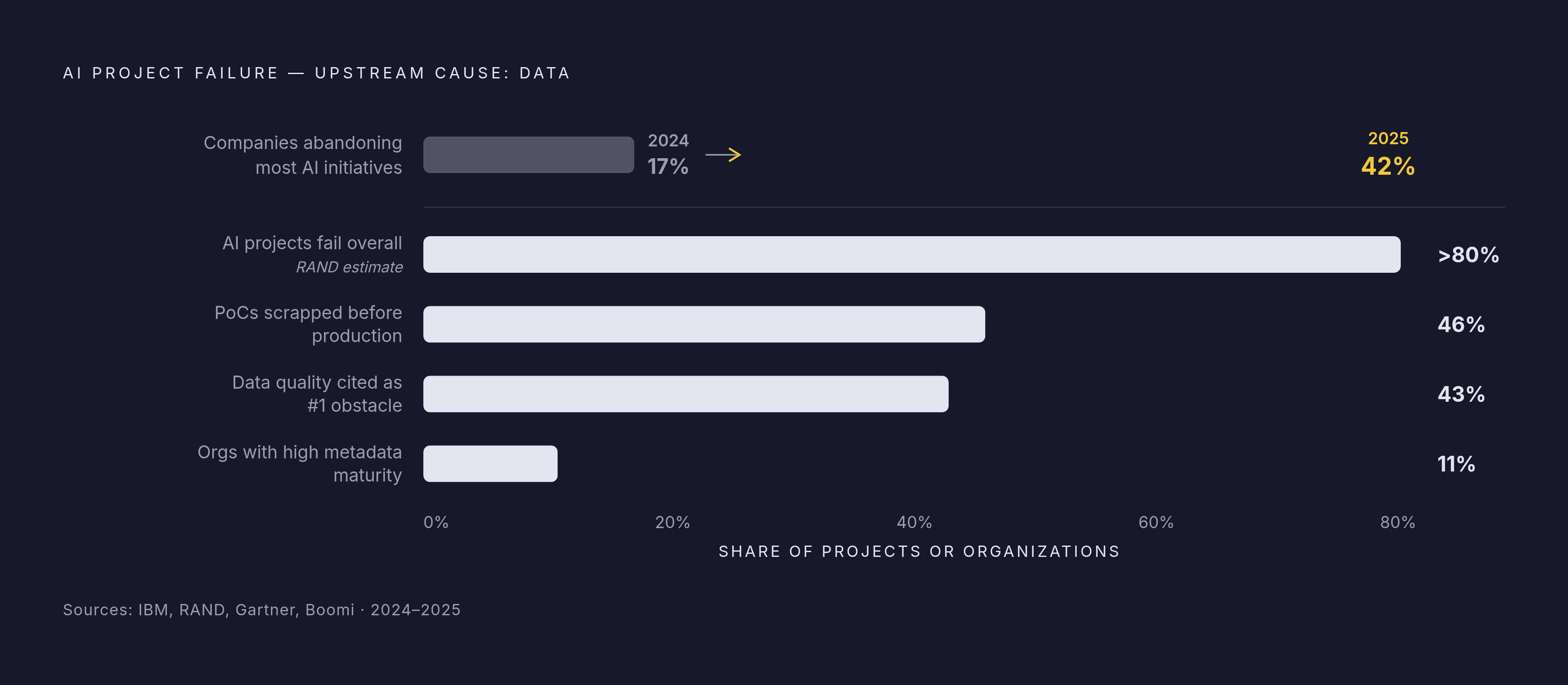
Start with the failure rate. S&P Global Market Intelligence surveyed over 1,000 enterprises in 2025 and found 42% of companies abandoned most of their AI initiatives that year, up from 17% in 2024. The average org scrapped 46% of its AI proof-of-concepts before they ever reached production. RAND Corporation puts the broader AI project failure rate above 80%, roughly double the rate for ordinary tech projects.
So what's going wrong? Informatica's global CDO Insights 2025 survey asked data leaders what the biggest obstacle was, and 43% said data quality and readiness, more than any other answer, well ahead of model choice or compute constraints. Qlik ran a survey in February 2025 covering 500 U.S. data professionals at companies with at least $500 million in revenue: 81% said their company still has real data quality problems, and 85% said leadership isn't doing enough about it.
Data quality failures and metadata failures are the same failure wearing different clothes. Data without context, without provenance, without an enforced definition of what a field actually means, will always show up as a quality problem the second an AI system tries to consume it. Gartner predicts 60% of AI projects unsupported by AI-ready data get abandoned through 2026. This is a description of what's already happening in IT departments right now, this week, at companies you've heard of.
Swapping models, tuning prompts, throwing more GPUs at it: none of that touches the actual problem. The fix sits upstream, at the data layer, before the agent ever sees a query.
What "AI-ready metadata" actually means, and how it differs from catalog metadata
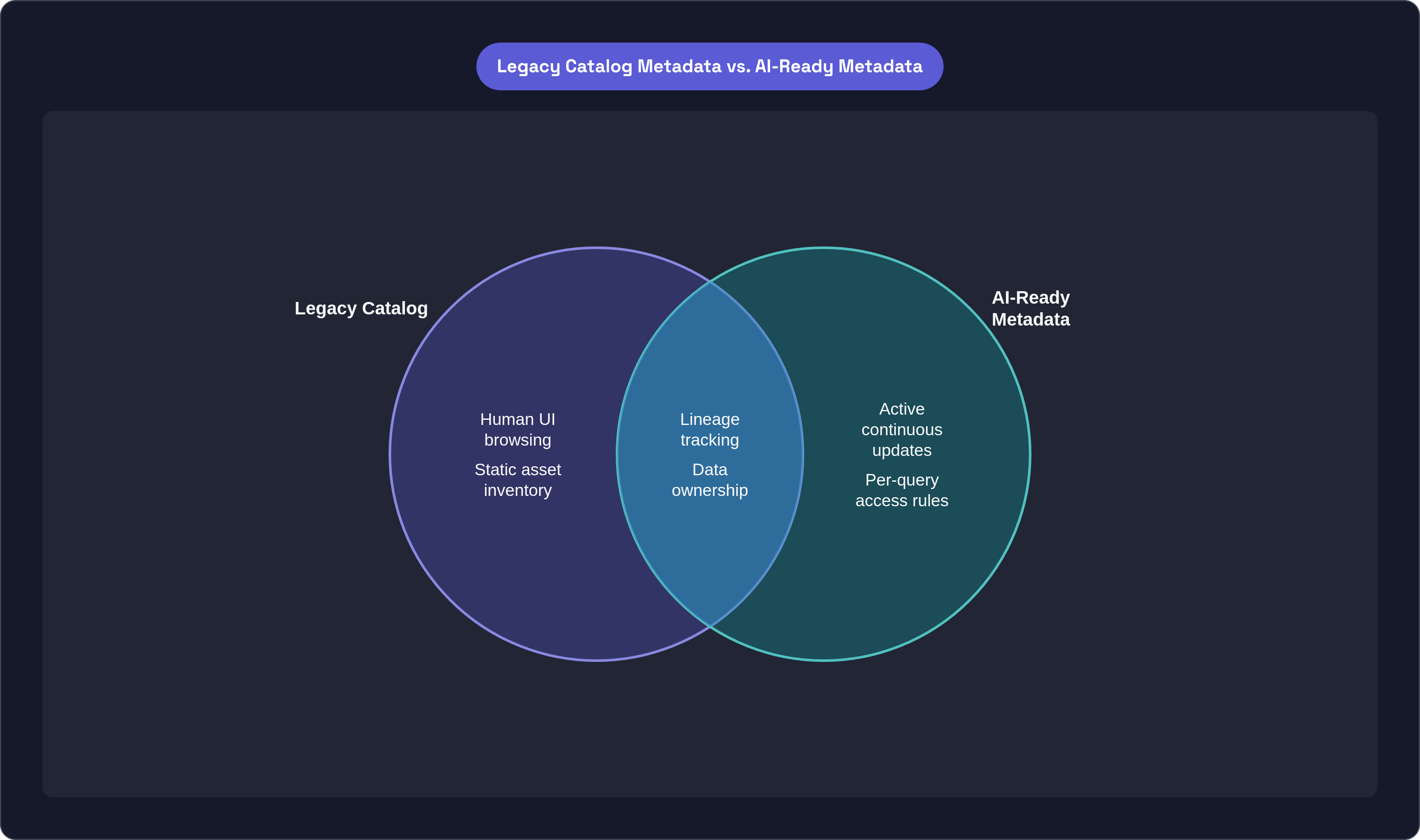
A traditional metadata catalog is a passive inventory. Asset names, owners, lineage diagrams, tags: useful stuff, built so a person can open a UI and find the dataset they need. That's the whole job, and most catalogs do it fine.
AI-ready metadata serves a different purpose. It's active and machine-consumable: semantic definitions, relationship mappings, metric logic, access rules, freshness signals, all delivered in a form an agent can act on without a human stepping in to translate. Qlik breaks AI data suitability into six dimensions: accuracy, diversity, timeliness, security, discoverability, and readiness. Run through that list honestly and most organizations are solid on maybe two of the six. I'd guess accuracy and security, if I had to bet, and shaky everywhere else.
Gartner's 2025 definition of AI-ready data sharpens the point further: aligned to the use case, governed at the asset level, backed by automated quality gates, continuously quality-assured. Continuously is the word that matters. Governance used to mean an annual audit. Now it has to run as a live system, all the time, or it's already stale.
Think about what an agent doesn't have that a human analyst does. An analyst carries institutional memory: they know "revenue" in this dashboard means something slightly different than "revenue" in that report, because someone explained the discrepancy over coffee three years ago. An agent gets none of that history. Metadata has to spell out all of it, explicitly, every single time, or the agent guesses.
That means field descriptions written for a machine to parse, not a human to skim. Metric definitions with grain, scope, and business logic laid out in full. Relationship maps between entities that go past a simple foreign key. Sensitivity classification at the field level and at the combination level, because two harmless fields joined together can turn into something you really didn't mean to expose. Freshness indicators tied to what the specific use case needs, not just a pipeline timestamp nobody checks. Access rules written as conditions a system can evaluate on its own, not static role assignments buried in a spreadsheet somewhere.
DATAVERSITY's 2025 Total Data Management survey found only 11% of organizations have high metadata management maturity. That's the honest starting line for most of you reading this.
The semantic layer as the mechanism that turns metadata into agent-usable context
A semantic layer sits between raw data and whatever's consuming it, a BI tool, an AI agent, an LLM, doesn't matter. It encodes business concepts, metrics, dimensions, join paths, grain, access rules as governed logic, so every consumer gets the same answer to the same question, asked twice, three times, a hundred times.
Why does this matter more for AI than it ever did for BI? A human analyst who sees a number that looks wrong pauses and digs in. An agent usually doesn't. It hands back the confidently wrong answer and moves on, and somebody downstream acts on it before anyone notices the number was never right to begin with.
McKinsey's 2025 State of AI report found 88% of companies use AI in at least one business function, though scaling it consistently across the organization remains the harder problem. Inconsistent business logic is a big reason why. Conflicting metric definitions and undocumented join logic that BI teams shrugged off for years suddenly turn into breaking failures the moment generative AI moves from a demo into production.
Research into AI adoption has found real pressure building to invest in semantic technologies that make data instantly interpretable to models and agents. The practical benefit is straightforward: a well-built semantic layer lets you add AI use cases one at a time without rebuilding governance from zero each time.
For an AI consumer, the semantic layer has to expose named business concepts with definitions that leave zero room for interpretation, canonical join paths so the agent isn't guessing at relationships on its own, metric logic that's version-controlled and auditable, and access rules evaluated per query and per user identity, not inherited wholesale from whatever service account is running the pipeline.
The broader market has been moving in the same direction. A 2025 global report found 38.3% of organizations now name governance frameworks and semantic layers as a top investment area, reflecting how broadly this has moved into mainstream planning. This stopped being niche plumbing a while back. It's a board-level line item now.
Where active metadata fits: keeping context current as data and agents evolve
Here's the failure mode nobody talks about enough: metadata gets defined once, at onboarding, and then just sits there gathering dust. Schemas change. Pipelines shift. Agents start generating brand-new data assets nobody documented because nobody knew to. Most catalogs have no way to notice any of that drift, let alone flag it for someone.
Active metadata fixes this by design. It updates continuously, triggered by events in the data environment itself, a pipeline run, a schema change, a query pattern, a quality check, instead of waiting for someone to sit down and re-document the world by hand.
Atlan's analysis of the metadata layer for AI names three pieces this requires. A knowledge graph that encodes relationships and meaning across assets in a structure an agent can actually walk through. An event-stream engine that pushes metadata updates out in real time as the underlying data moves. And vector storage built for AI workloads specifically, so an agent can run semantic search over the metadata itself, not just the raw data underneath it.
There's a sneakier problem buried in freshness. A pipeline timestamp tells you when data was last written. It tells you nothing about whether that's fresh enough for the specific decision an agent is about to make with it right now. Metadata has to carry freshness requirements tied to the use case, not just to whenever the last job happened to run.
AI also brings requirements legacy metadata systems were never built for: extreme versioning across models, prompts, and training data; metadata about the metadata itself, meaning lineage for the semantic definitions; and entirely new asset types like embeddings, fine-tuned models, and agent outputs with no clean analog in a traditional catalog. Gartner's 2025 Magic Quadrant for Metadata Management Solutions calls out active metadata and AI readiness as the traits separating the leaders from the pack. The market's splitting into passive catalogs on one side and active systems on the other, and the split is only getting wider.
Active metadata can't be a bolt-on tool running on its own schedule somewhere off to the side. It has to live inside the query-time architecture itself, so every agent interaction gets context reflecting the current state of the data, not whatever the catalog looked like at its last refresh three weeks ago.
Governance signals that metadata must carry for safe agent access
Governance can't get patched on at the model layer. An LLM with broad data access and a few prompt-level guardrails is a service account with instructions taped to it, and that arrangement leaves the real governance work undone. Real governance means permissions get checked at query time, under the actual user's identity, every single time, no exceptions carved out for convenience.
There's a combination problem too, and it trips people up constantly. Individual fields can look perfectly harmless on their own and turn sensitive the moment they get joined together. Metadata has to encode sensitivity at that combination level, not stop at the individual field and call it done.
DATAVERSITY's 2025 survey found only 11% of teams have a mature governance program, which means most organizations are trying to hand agents access without the governance foundation that access actually needs underneath it.
Governance metadata for AI workloads needs per-user, per-query access rules instead of blanket service-account grants. Sensitivity tags at the column, join, and output level. The ability to revoke one agent's access without knocking out every other workload sharing the same data. Stricter controls on agent writes specifically, since a write carries more risk than a read and needs to be treated that way. And audit logs that tie identity, intent, and lineage together, because a log full of bare query strings at agent-scale volume tells you nothing useful when something goes wrong.
Regulatory pressure is adding to that urgency. Deloitte's 2025 survey found data governance was the top priority for 51% of CDOs. Governance moved out of the compliance back office a while ago. It's sitting in the critical path now, right next to the stuff that actually ships.
How to sequence building a metadata foundation that serves AI agents
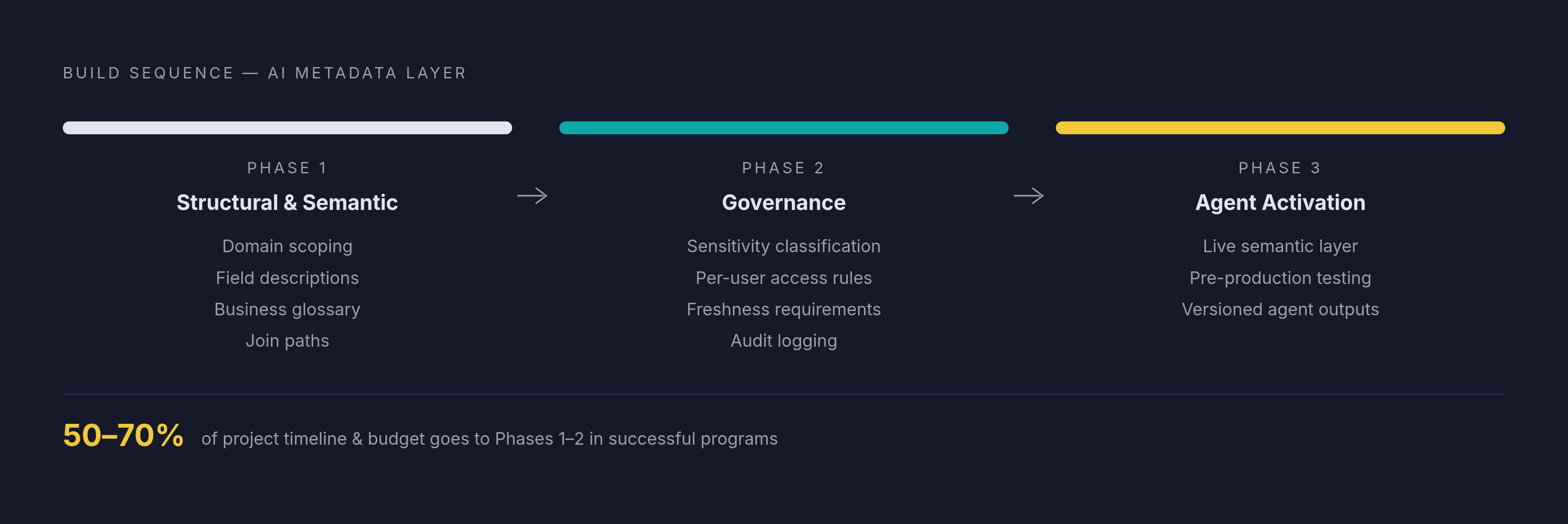
Atlan lays out a sequence worth following closely: structural context and semantic definitions first, governance instrumentation second, agent activation third. Flip that order and you've made the single most common, most expensive mistake I see enterprises make over and over.
Organizations that already have a data catalog, a documented business glossary, and clear data ownership can usually get to a production-ready metadata layer in eight to fourteen weeks, at least for the first domains their agents will touch. Starting from nothing takes a lot longer, and there's no shortcut around that math.
Phase 1 builds structural and semantic context. Pick the first-priority domains an agent will actually query. Don't try to cover the whole estate before you've proven out one use case, that's how these projects die. Write field and table descriptions for machine interpretation, not for a human skimming a UI. Formalize the business glossary so there's one canonical definition per metric, with grain, scope, and an owner attached to it. Map join paths explicitly instead of hoping the agent infers them correctly from the schema alone, because it won't, not reliably.
Phase 2 builds the governance instrumentation. Classify sensitivity at the combination level, not just the field level. Move off service-account grants and put in per-user, per-query access rules. Attach freshness requirements to each dataset's metadata based on the use case, not guessed from a pipeline schedule. Build audit logging that captures identity, intent, and lineage together from day one, not bolted on after the first incident forces your hand.
Phase 3 activates the agent. Expose the semantic layer through a live, queryable interface, not a static export or a nightly snapshot that's already out of date by morning. Test agent queries against it before anything touches production, and check that the business logic in the result is actually right, not just that the SQL parsed without erroring out. Treat every agent output as a new data asset in its own right, one that needs its own version, lineage, and sensitivity classification.
Analysis of successful enterprise AI deployments finds the winning programs put 50 to 70% of their entire project timeline and budget into data readiness: extraction, normalization, governance metadata, quality dashboards, retention controls. That's a heavier lift than most budget plans account for, and it's usually the line item that gets cut first when someone's trying to hit a launch date.
Most organizations can't rip out their warehouses and pipelines and start fresh, nor should they try. The realistic path is a metadata and semantic layer sitting on top of what already exists, exposing a governed interface to AI consumers without forcing a migration nobody has time for.
What a production-ready metadata layer looks like in practice
Here's the actual test: an AI agent queries a governed dataset and gets back more than just data. It gets the semantic context, the access enforcement, and the lineage record it needs to make that answer trustworthy, not just plausible-looking.
A few concrete signs you're there. Every query runs under the real user's identity, never a service account, with permissions checked at query time instead of assumed at connection time. Metric definitions and join paths resolve out of the semantic layer instead of out of the agent's own guesswork, so the same question asked twice gets the same answer both times, not two slightly different ones. Sensitivity gets evaluated at the output level, catching the case where two harmless fields get joined into something that shouldn't leave the building. Audit logs capture who asked, what business concept got queried, what data got touched, and what came back, detailed enough to hold up as documentation under something like the EU AI Act. Freshness gets checked against the use case's actual requirement at the moment of the query, so a stale dataset feeding a real-time decision shows up as a flagged metadata failure instead of a quiet, confidently wrong answer nobody catches until it's too late.
That's the bar. Most organizations aren't there yet, and the numbers throughout this piece show exactly how far the gap runs. Closing it takes sequencing, discipline, and a willingness to treat metadata as the thing that actually decides whether an AI agent is useful, or just fast and wrong.