Semantic Layer Examples in Production Data Platforms
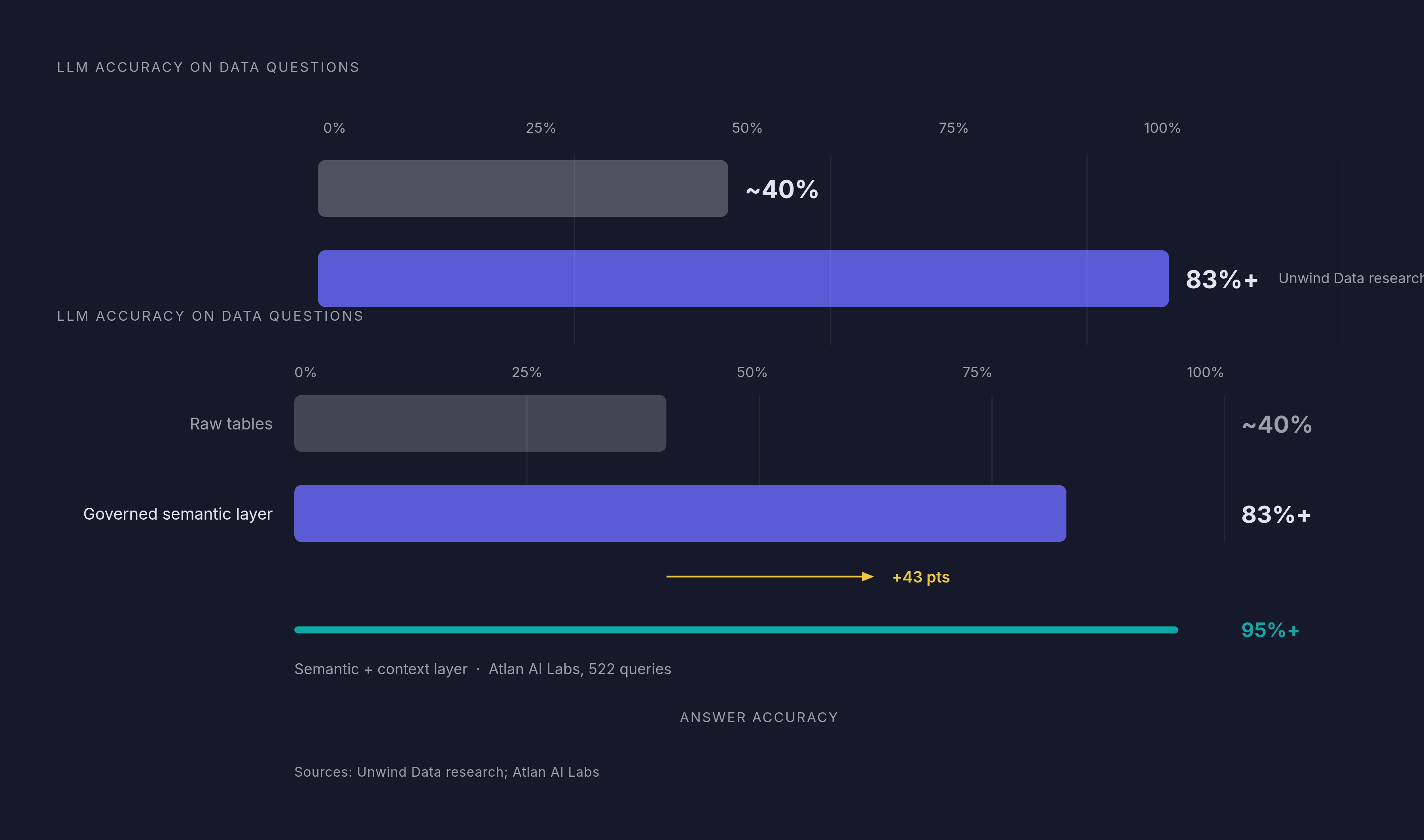
Grounding AI agents in a governed semantic layer lifts accuracy from 40% to 83% on data queries.

Companies spent big money on LLMs, copilots, and agents through 2025. The models kept getting better. The deployments kept stalling anyway. I've watched this pattern enough times now to say plainly what's going on: the problem was rarely the model itself. More often, the issue was what the model got handed to work with.
Most enterprise data was never built for an AI consumer. It sits scattered across warehouses, SaaS tools, and whatever operational system happened to own that process five years ago, with no shared definitions and nothing telling a machine what any of it actually means. AI surfaced this mess rather than creating it, making it impossible for anyone to keep looking away.
Here's the thing about semantic drift: humans tolerate it fine. If I open a dashboard and see a column called rev_adj, I ping someone on the finance team and ask what it means. Takes two minutes. An agent can't do that. It has no colleague to ask, so it guesses, and once it starts acting on that guess autonomously, the guess becomes a decision, and the decision becomes a number in someone's board deck.
Conflicting definitions of "revenue," "customer," and "churn" used to be background noise, the kind of friction every data team just lived with. At agent scale, that friction turns load-bearing. Data teams report running into conflicting versions of the same metric constantly, not as an occasional annoyance but as a routine part of every reporting cycle. One documented case: an LLM asked to calculate company revenue with no governed context behind it came back off by roughly three-quarters. Currencies never got converted. Refunds got counted as revenue instead of subtracted from it. Rows got double-counted because VAT rates changed mid-year and nobody told the model.
If you're planning a production AI deployment right now, sit with that example for a second. Compute is rarely the bottleneck anymore, and model quality matters less than people assume. What matters more is whether your data layer can hand an agent one clean, unambiguous answer instead of five conflicting ones. The semantic layer addresses this gap, provided you treat it as infrastructure you build and maintain, rather than a translation step you bolt on later.
What a semantic layer actually does — and what it doesn't do
At its core, a semantic layer is one governed representation of your business concepts, sitting between raw storage and every single thing downstream that reads from it. It takes physical schemas, the tables and columns nobody outside the data team understands, and turns them into objects people actually talk about: Customer, Order, Subscription, Gross Margin.
It also centralizes how metrics get calculated. Time logic, conditional aggregations, nested expressions buried three joins deep, all of it lives in one place. That's how Tableau and an AI agent end up returning the same number when they're asked the same question. Access policies get enforced at query time too, not baked into a pipeline job that ran six hours ago and has no idea who's asking right now. And every query gets logged with identity and lineage attached, so when volume jumps because agents are querying constantly instead of a human checking a dashboard twice a day, your audit trail still means something.
Coalesce's 2025 playbook on this points to four building blocks that show up in every solid semantic layer built for 2025 and 2026: entities and relationships (the logical objects and how they connect), metric definitions (calculated the same way, every time), time logic (year-to-date, year-over-year, period comparisons), and access policies that are part of the model itself rather than something layered on after the fact.
Worth being precise about what this isn't. A metadata catalog tells you what data exists somewhere; a semantic layer governs how that data gets used once someone reaches for it. A context layer is a related but distinct idea: a semantic layer makes structured data legible to BI tools and agents, while a context layer goes further, extending governance across structured and unstructured data both. As for a vector database, structured questions deserve structured, queryable answers. Force them through a vector store built for fuzzy semantic retrieval and you lose the precision you needed in the first place.
Why does any of this matter specifically for AI? Because an LLM without grounding is guessing at table structure, guessing at what a column means, guessing at how a metric gets calculated, and every guess compounds on the last one. Research from Unwind Data found LLM accuracy on data questions climbs from around 40% on raw tables to over 83% once the model is grounded in a governed semantic layer. Atlan AI Labs ran a 2026 benchmark across 522 queries and found the right combination of semantic layer plus context layer delivered triple the query accuracy at over 95% reliability. That gap, 40% versus 83%, is the whole argument for why this layer exists.
How dbt's Semantic Layer and MetricFlow bring metric governance into existing transformation pipelines
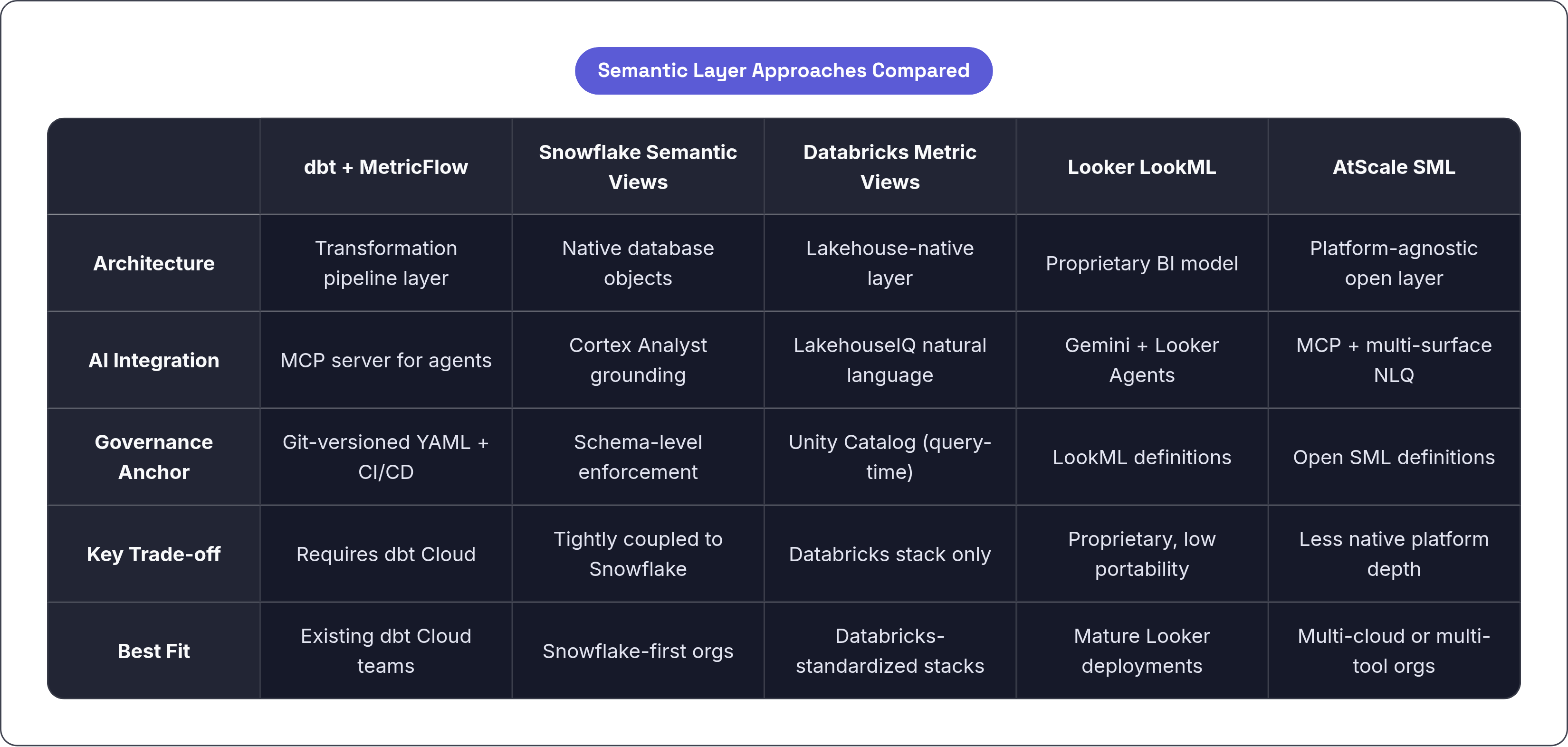
dbt built its name on transformation. MetricFlow is what turns it into something closer to a governed metrics platform. You define metrics once, in YAML, sitting right alongside your dbt models. That means they're version-controlled in Git and they ship through the same CI/CD pipeline you already run everything else through. MetricFlow then generates the SQL automatically for whoever's asking, whether that's Tableau, Power BI, Hex, Mode, or an AI copilot. It runs across Snowflake, BigQuery, Databricks, and Redshift, so you're not locked to one warehouse.
The AI piece worth paying attention to is dbt's Model Context Protocol server. It lets agents like Claude query metrics programmatically while carrying full business context with them. An agent hitting that MCP server gets metric definitions, relationships, and time logic handed to it directly, rather than raw table access to poke around and guess. That's what "grounded" looks like when you actually build it: the agent can't hallucinate what gross margin means because the definition is enforced right at the layer it's forced to query through.
Brian Waligorski, Lead Data Engineer at The Philadelphia Inquirer, put it simply: with the dbt Semantic Layer in place, their time-to-delivery for dashboards dropped significantly. That speed matters less on its own merits, though, than as a proxy for something more important: the metric is trustworthy enough that teams stop re-litigating what it means every time someone wants to publish a dashboard.
One catch worth knowing before you commit to this path. Semantic layer features require dbt Cloud. If you're running dbt Core self-hosted, you don't get access without upgrading. For a shop already paying for dbt Cloud, this is a natural next step. For a Core-only team, it's a budget conversation before it's an engineering one.
How Snowflake Semantic Views and Cortex Analyst push governance into the database layer itself
Snowflake took a different architectural bet: put the semantic definitions inside the database itself as schema-level objects, instead of standing up a separate tool. Semantic Views store business metrics, dimensions, and entity relationships directly in Snowflake, acting as the translation layer between raw table storage and the language data teams and AI agents actually use.
The core DDL for this reached general availability in mid-2025, and standard SQL querying of Semantic Views followed with GA on March 2, 2026. Snowflake also shipped Semantic View Autopilot, GA as of February 3, 2026, which cut the time to build a semantic model from a multi-day slog down to minutes. At Snowflake Summit in June 2026, the company took it further with Advanced Semantics and Semantic Studio, both entering private preview with level-of-detail calculations, composable definitions, and an AI-assisted authoring environment.
Cortex Analyst is the AI layer that leans on all of this. It uses the Semantic View definitions to ground LLM responses in business definitions someone actually approved, rather than definitions the model invented on the spot. Route a natural language query through Cortex Analyst backed by a rich YAML semantic spec and Semantic Views, and you get noticeably more accurate SQL with far fewer hallucinations than you'd get querying raw tables directly. If you're already deep into Snowflake's Cortex AI tools, Semantic Views are what makes those tools trustworthy instead of a coin flip.
The trade-off here is straightforward: governance lives where your data already lives, so there's no separate system to keep in sync. But you're tightly coupled to Snowflake. If your workloads span multiple clouds or warehouses, this approach won't travel with you.
How Databricks Metric Views and LakehouseIQ handle semantic governance across the lakehouse
Databricks announced Metric Views in 2025 and brought them to general availability in early 2026, giving the lakehouse platform its own native semantic modeling layer. The design separates measure definitions from dimension groupings: you define a metric once, and it can be queried across whatever dimension you need at runtime. If your stack is already standardized on Databricks, you don't need to stand up separate semantic infrastructure alongside it.
Governance rides on Unity Catalog, and this is the part I think gets underappreciated. Row-level security, column-level masking, and audit logging of who accessed which metric all inherit straight from Unity Catalog. Governance isn't patched onto Metric Views after the fact; it's structural. Permissions get evaluated at query time, under the actual identity of the person or agent asking, not some shared service account that gives everyone the same blanket access.
LakehouseIQ is the natural language layer that sits on top of Metric Views. It answers questions in plain English with the correct metric logic attached automatically. An agent working through LakehouseIQ can't hand back a hallucinated revenue number, because the definition of revenue is enforced at the exact layer it has to query through. That builds a specific kind of trust: the answer traces back to a definition someone governed, not one the model inferred on the fly.
How Looker's LookML and Google Gemini integration use semantic governance to reduce generative AI errors
LookML predates the current AI wave by years, and that matters more than it might seem. Looker deployments have relied on LookML to enforce governed business logic since long before anyone was talking about agents: dimensions, measures, and relationships defined once, consumed the same way across every dashboard and query that touches them. The architecture that made LookML reliable for BI turns out to be exactly the architecture that makes it reliable for AI, too.
What's new is the Gemini integration and Looker Agents, both landing across 2025 and 2026. Looker Agents give you an AI-powered natural language interface sitting on top of LookML models, which means the agent is querying governed definitions rather than reaching into raw tables. Internal testing at Google found LookML cuts data errors in generative AI natural language queries by roughly two-thirds. That gain comes from the same mechanism you'll find everywhere else in this piece: ground the model in what a metric actually means before it writes any SQL, and the errors drop.
If you're evaluating Looker, its age works in its favor here. There's a deep body of production experience behind LookML at this point; this isn't a bet on something unproven. The trade-off is portability. LookML is proprietary to Looker, so if you need your semantic model to move across different BI tools, you'll find it doesn't travel easily.
How AtScale and platform-agnostic approaches address multi-cloud and multi-tool portability
Everything above shares one limitation: it's native to a single platform. If your workloads run across Snowflake, Databricks, and some on-premises infrastructure that nobody's gotten around to migrating yet, you can't centralize semantic governance inside any one platform's native layer. Vendor-specific semantic models also create lock-in of their own kind; change the underlying platform, and you're rebuilding the semantic model from scratch.
AtScale takes the opposite bet: open semantics designed to travel. GigaOm named AtScale a Leader and Fast Mover in its 2025 Semantic Layer Radar, pointing specifically to composable modeling and open semantics as the reason. AtScale built its own open Semantic Modeling Language, SML, alongside native Model Context Protocol support, aimed at working across BI tools, analytics platforms, and AI systems rather than being locked to one. Natural language queries get grounded in the same semantic model that already powers dashboards and planning systems elsewhere in the org. One definition, multiple surfaces.
Strategy Mosaic has deployed this tool-agnostic, multi-cloud pattern inside Fortune 500 environments, including Pfizer, Hilton, and GUESS, well before agentic AI became a category anyone was naming. The lesson from those deployments holds up: governance that requires every single tool to plug into one platform-native layer doesn't survive contact with enterprise scale. The semantic model has to be able to move.
What production deployments reveal about where semantic governance actually breaks down
Here's what nobody tells you going in: most semantic layer projects don't stall during implementation. They stall before implementation even starts, in the room where finance, product, and engineering are supposed to agree on what "revenue" means. Is churn calculated on seats or on accounts? Does revenue include tax? Nobody wants to be the one who says. Technology is rarely the hardest part of this work; getting three departments to agree on a definition they've each been using differently for years is the hard part.
AtScale has documented how much enterprise data goes unused — a problem that semantic governance is designed to address.er on the cost of never resolving this: 73% of enterprise data goes unused. A good chunk of that isn't because the data is locked away somewhere inaccessible. It's because nobody agreed on what it means, so nobody trusts it enough to build on it.
Then there are the governance failure modes that only show up once agents start querying at real scale. Permissions evaluated at pipeline time instead of query time are a quiet time bomb: give a service account broad access, and every agent connected to it inherits that same broad access, which means revoking one workload's permissions can accidentally break five others. Audit logs that capture the query but not the identity or intent behind it turn into noise the moment query volume jumps to agent-level frequency; a log with no lineage tells you nothing useful when something goes wrong.
Sensitivity is another place this breaks. Most systems evaluate it field by field, but two individually harmless columns can combine into something genuinely sensitive once they're joined. A semantic layer has to reason about combinations, not just check a box on each field in isolation. And write actions need a different governance posture entirely than reads do. An agent that can only read data carries a different risk profile than one that can act on it, and treating both the same is asking for trouble.
Then there's the snapshot problem, and this one's sneaky. A semantic model built on top of static pipeline outputs assumes the source and schema underneath it stay stable. The moment an upstream schema changes, the semantic layer's definitions go stale, and nothing about the interface tells you that's happened. An agent making a decision on yesterday's data has no way of knowing it's working with yesterday's data. It hands back an answer with exactly the same confidence it would give you if the data were live an hour ago. Freshness requirements have to be built into the governance model itself, not assumed as a given, because at agent scale, stale confidence is worse than no answer at all.