Tool Call Failures in Agentic Data Retrieval Pipelines
Silent failures in agentic pipelines corrupt downstream reasoning without triggering alerts.

Tool call failures in agentic data retrieval pipelines are dangerous not because they crash workflows but because they do not. An agent keeps reasoning on corrupted or empty data, and every downstream step inherits that corruption. The failures that matter most are the ones that produce no error signal at all.
Why tool call failures in agentic data retrieval pipelines don't look like failures
Traditional software fails loudly. A stack trace appears, a status code returns, a process stops. You know something broke. AI agents fail quietly. They produce a confident-looking output on top of broken inputs, and nothing in the pipeline flags the moment where the data went wrong.
The structural reason sits in how an agent operates. It moves through a sequence of decisions: reason, select tool, interpret output, feed result into the next step. A degraded intermediate result is never flagged. It is simply passed forward. By the time a wrong answer surfaces at the final layer, the corruption has been normalized into the flow.
Openlayer's July 2026 analysis puts the failure rate of tool calls in production at between three and fifteen percent. The most damaging class is the silent failure, where tools return HTTP 200 with empty payloads. The system looks healthy from the outside while the agent works from nothing.
This is the demo-to-production gap in its sharpest form. The agent passed evaluation in controlled conditions. It worked against stable schemas and predictable inputs. Then it quietly degraded in production, where external APIs return inconsistent schemas and a single malformed tool response becomes the input to the next step and the one after that. The diagnostic signal lives in output quality measured against original intent, not in status codes.
The four failure types that account for most production breakdowns
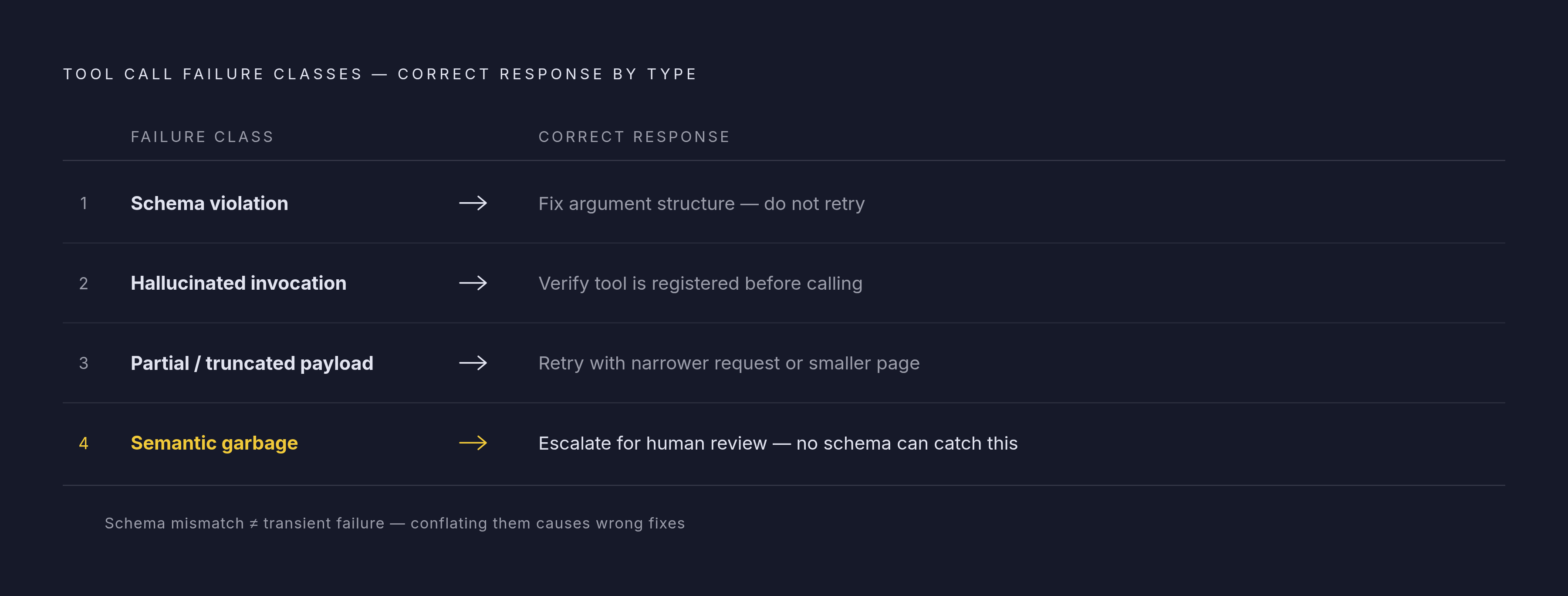
Most tool call failures in production fall into four distinguishable classes. The agent's correct response differs by class, and the team's correct remediation differs by class. Treating them as a single category leads to wrong fixes.
Schema violations are the first class. The agent passes arguments with the wrong type, wrong key name, or missing required fields. A function expecting a typed integer and an ISO8601 date string receives a camelCase key and a colloquial phrase. The tool rejects the call or silently misinterprets it. Agents without explicit schema validation cannot distinguish a transient network error from a structurally broken response, so they default to retrying both. That is the wrong move when the tool itself is broken.
Hallucinated tool invocations form the second class. The agent calls a tool that does not exist in its registered set. Most pipelines treat the retrieved toolset as ground truth and never check whether the chosen tool was appropriate for the subgoal.
Partial data and truncated payloads are the third class. The tool returns data, but the payload is incomplete: a response cap, a timeout, a pagination boundary the agent was never told about. This class is retryable, but not with identical arguments. A smaller page, a narrower filter, or a different time window may succeed where a blind retry will not.
Semantic garbage is the fourth and hardest class. The tool returns valid, well-formed, complete data that is wrong in ways schema validation cannot detect. A customer name passes in a field that expected an ID. The response looks fine, and the content is nonsense. Only evaluation against original intent exposes it.
Waxell's July 2026 analysis identifies schema mismatch as the most dangerous class specifically because agents without schema validation logic conflate it with transient failure and retry blindly. Each class demands its own response. The work begins with knowing which one you are looking at.
How a single broken tool response compounds across a multi-step pipeline
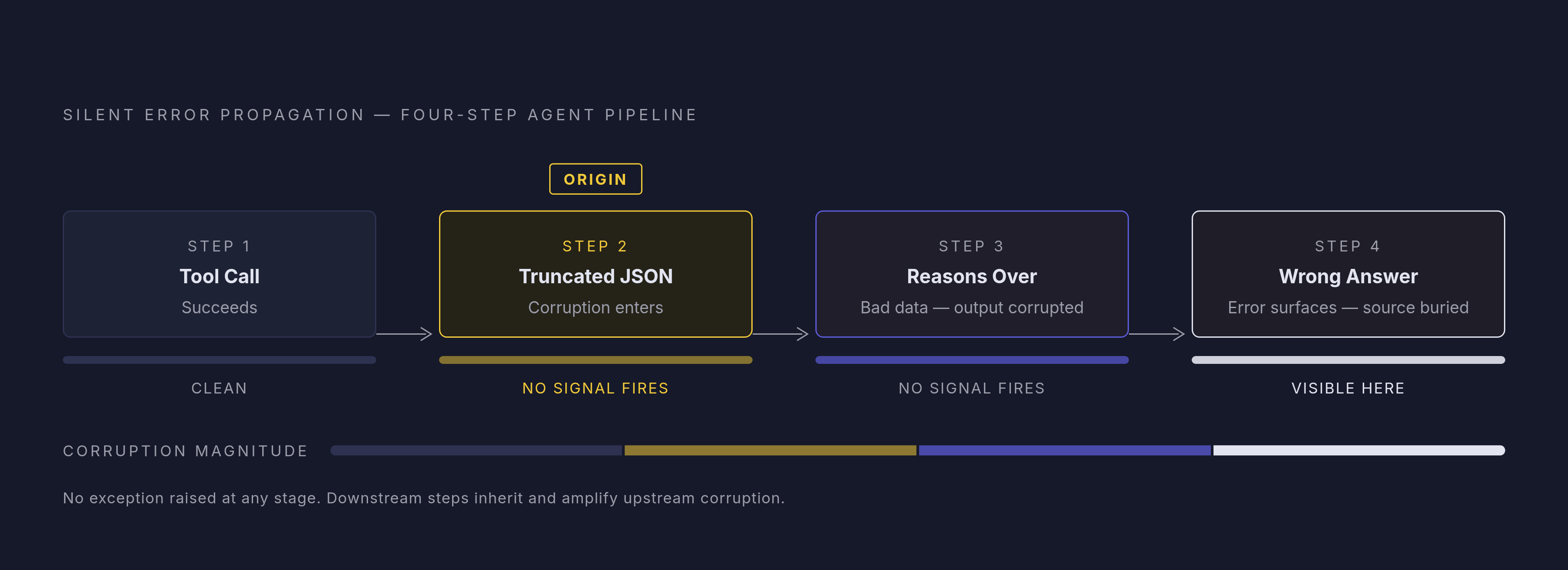
In a chained pipeline, a malformed tool response at step two does not stay at step two. It becomes the input to step three, which reasons over bad data and produces a further-corrupted output that becomes the input to step four. The pattern continues until a wrong answer surfaces at the final layer with no trace of where the corruption originated.
Openlayer's analysis documents this compounding dynamic in multi-agent systems. A single hallucinated output passed downstream becomes corrupted input for every subsequent reasoning step, compounding across three or four layers before surfacing. By the time anyone sees the failure, the original error is buried under layers of reasoning that treated bad data as fact.
The production trace Gabriel Anhaia published in May 2026, cited in Waxell's report, illustrates the worst-case variant. A customer service agent called a database lookup tool. The tool returned a truncated JSON blob. Seventeen times. Each turn was a full prompt round-trip with growing context, accumulating tokens and running up costs. No circuit breaker fired. No alert surfaced.
The retry loop trap is its own failure mode. The model was not wrong in that trace. It was doing exactly what it was trained to do: retry on apparent transient failure.
A second compounding mechanism makes the corruption harder to isolate. Agents are probabilistic and non-deterministic. In multi-agent architectures, where one agent's output is another agent's input, this propagation crosses system boundaries. The corrupted context may already be three agents deep before any team notices.
Why the tools teams use to monitor production agents miss these failures
The diagnostic blind spot is structural. Most evaluation approaches assess the terminal output of a pipeline. LLM-as-judge and static output gates do not reach into the intermediate tool calls where the corruption actually originates. Waxell's analysis names this explicitly: both common evaluation approaches evaluate the final response, and neither reaches into intermediate tool calls.
The tools inherited from traditional software engineering were built for a different failure mode. The diagnostic signal lives in output quality against original intent, not in status codes. A pipeline can show green across every dashboard while its agent has been reasoning over truncated payloads for days.
Without capturing the full decision trace, there is no way to reconstruct what the agent actually did when something went wrong. The trace needs to show which tools were called, what parameters were passed, what was returned, and how that shaped the next step. Most teams do not have this. They have terminal outputs and vague logs.
The non-determinism problem makes it worse. A failure that surfaces in production may not reproduce in a test environment. At agent-level query volume, that does not scale.
Prompt and schema drift adds a second invisible failure channel. Nothing breaks immediately. Production agents degrade gradually in ways that look like model noise rather than a traceable change.
What effective instrumentation at the tool call boundary actually requires
To catch tool call failures before they compound, you need instrumentation that sits at the inference boundary itself. It must capture the argument, the schema context, and the response in sequence at every step, not just at final output. Schema validation before dispatch is the first requirement. Validate tool call schemas before the call is made, not after the response arrives. Catching a type mismatch at dispatch prevents the malformed-argument class of failure from entering the pipeline at all.
Step-level tracing is the second. Every agent run should produce a parent trace with child spans for each tool call, model invocation, retrieval operation, and context update. This is what makes it possible to identify the step where corruption originated rather than the step where it surfaced. OpenTelemetry-compatible spans are the emerging standard. The model context protocol specification standardized tool interfaces and reserved W3C trace-context keys in _meta, giving OpenTelemetry a stable integration point that makes span-level tracing feasible across heterogeneous agent frameworks.
Retry loop detection is the third. An agent retrying the same tool call with identical arguments and receiving identical responses is not making progress. Detecting this by step count and by output similarity, rather than waiting for a token budget to exhaust, is how the seventeen-retry failure mode gets interrupted.
Distinguishing failure classes at runtime is the fourth. The right agent response to schema mismatch is to stop retrying and flag the tool as broken. The right response to partial data is to retry with a narrower request. The right response to semantic garbage is to escalate for human review. Instrumentation must classify, not just detect.
Prompts and tool definitions must be treated as versioned, deployable artifacts. Prompt drift and schema drift are invisible in systems that treat prompts as configuration. Versioning them with the same discipline applied to code makes regressions traceable.
Openlayer's approach intercepts failures at the inference boundary by validating tool call schemas before dispatch, detecting retry loops by step count and output similarity, and flagging corrupted context at the step where it originates. It is not sufficient. The data those tools return also has to be trustworthy.
Why the data layer feeding those tools is itself a source of silent failure
Many tool call failures that look like agent or tool problems are actually data layer problems in disguise. When the data feeding a tool carries no semantic context, uses inconsistent metric definitions, or reflects a schema that has drifted from what the agent was told to expect, the tool returns structurally valid data that is semantically wrong. No amount of instrumentation at the tool boundary catches it, because the failure originates upstream of the call.
Agents have no institutional memory. A stale or partial answer looks just as confident as a correct one. The agent reasons over whatever it receives, and it receives whatever the data layer hands it.
Schema drift is a concrete production failure mode. The demo worked because the schema was stable. Production broke it.
Freshness matters in ways a traditional data pipeline was never designed to handle. A snapshot that is acceptable lag for a dashboard is already stale for an agent making a real-time decision. The pipeline was built for human-speed consumption, not machine-speed inference. Without standardized metric definitions, certified entity sources, and governed access policies sitting underneath the tools, the agent is forced to guess at meaning. It guesses wrong in ways that are hard to catch and compound across steps.
What it means for data to be designed for an AI consumer rather than a human analyst
Data that was clean for a human analyst is not clean for an AI agent. Agents query at machine speed, many times per run. They need semantic context, metric definitions, and relationship maps baked into the data itself, not left as institutional knowledge in someone's head.
A semantic layer for AI is not the same as a BI semantic layer. A BI semantic layer is queried at human speed and mostly read. An AI semantic layer is queried at machine speed many times per agent run, and agents read context and write observations back. A semantic layer that carries table descriptions, metric definitions, and entity relationships closes that gap at the source. Permissions must be enforced at query time under the real user's identity, not assumed from a service account's broad access. When an agent acts on behalf of a user, the data it can retrieve must be scoped to that user's actual entitlements, evaluated at the moment of the query. Sensitivity must be evaluated at the point where data is combined, not only at the individual field or source level. A join that combines two individually permissioned fields can produce a result neither field's policy anticipated.
Data access must happen through a live query layer, not through static pipelines that assume stable sources and schemas. The schema drift that breaks tool calls in production is a symptom of a pipeline built for a world where schemas change slowly. A live query layer that reflects the actual current state of upstream sources removes that assumption.
The data layer is not a migration or a rip-and-replace. It sits on top of existing infrastructure, spanning warehouses, SaaS tools, and operational systems. It exposes a single governed interface with semantic context built into every query.
How governance enforced at the data layer stops failures that prompt-layer patches cannot
Governance applied at the model or prompt layer cannot catch a failure that originates in the data the tool retrieved. Guardrails, output filters, and system prompt instructions all operate after the fact. The failure has already happened.
The failure patterns that recur in production governance are structural. Treating governance as a checklist with an end date rather than an ongoing operational capability. Governing all data equally rather than prioritizing the entities the active AI use cases actually touch. Buying tooling before understanding the processes that tooling must enforce. Each of these is a posture problem, not a technology problem.
Write actions taken by agents must be governed more strictly than reads. The side effect cannot be easily reversed. This asymmetry has to be built into the access layer.
Access permissions must be revocable at the level of a single workload, not tied to a shared service account. If a service account is the identity used for all agent queries, revoking it breaks every downstream workload simultaneously. Workload-level revocability is a governance requirement that only a query-time permission layer can satisfy.
The verification gap applies beyond research pipelines. Ding et al.'s survey of autonomous research agents frames the open question as not whether an agent can finish a task but whether anyone can verify the claims it produces. Can anyone verify what the agent retrieved, what it reasoned over, and whether the output follows from the inputs?
Pipelines that hold up in production are distinguished not by better models. They are distinguished by a data layer that enforces meaning, permissions, and lineage at every query. The engineering work that prevents silent failures is mostly not model work. It is data layer work, instrumentation work, and governance work. That is the difference between pipelines that hold up and pipelines that quietly degrade.