Vector Store Failures on Enterprise Structured Data
Embeddings cannot encode the structural relationships that give enterprise data its meaning.

Vector stores fail on enterprise structured data because they were built for a different problem. A vector database retrieves information by semantic proximity. Structured enterprise data carries meaning through schemas, relationships, and business rules that embeddings cannot encode. This is not an implementation flaw. It is an architectural mismatch, and understanding each failure mode is what allows teams to build retrieval systems that actually work.
Why vector stores and structured enterprise data are a poor architectural fit
Vector stores do exactly what they were designed to do. The standard retrieval pipeline is simple: chunk documents, embed them, and retrieve the top-k results by cosine similarity. This works well when the question is "find me something topically similar." But enterprise knowledge is not a collection of similar documents. It is a web of interconnected entities, dependencies, hierarchies, and contractual rules.
Supply chain tables, ERP ledgers, CRM records, and financial compliance systems get their meaning from the relationships between rows and tables. They do not derive it from the prose content of any single chunk. A question like "How will the delay in Component X impact our Q3 deliverable for Client Y?" requires knowing that Component X feeds Client Y's supply chain and that Client Y's contract carries a penalty clause. Those are structural facts. They live in foreign keys and join conditions, not in embedding proximity.
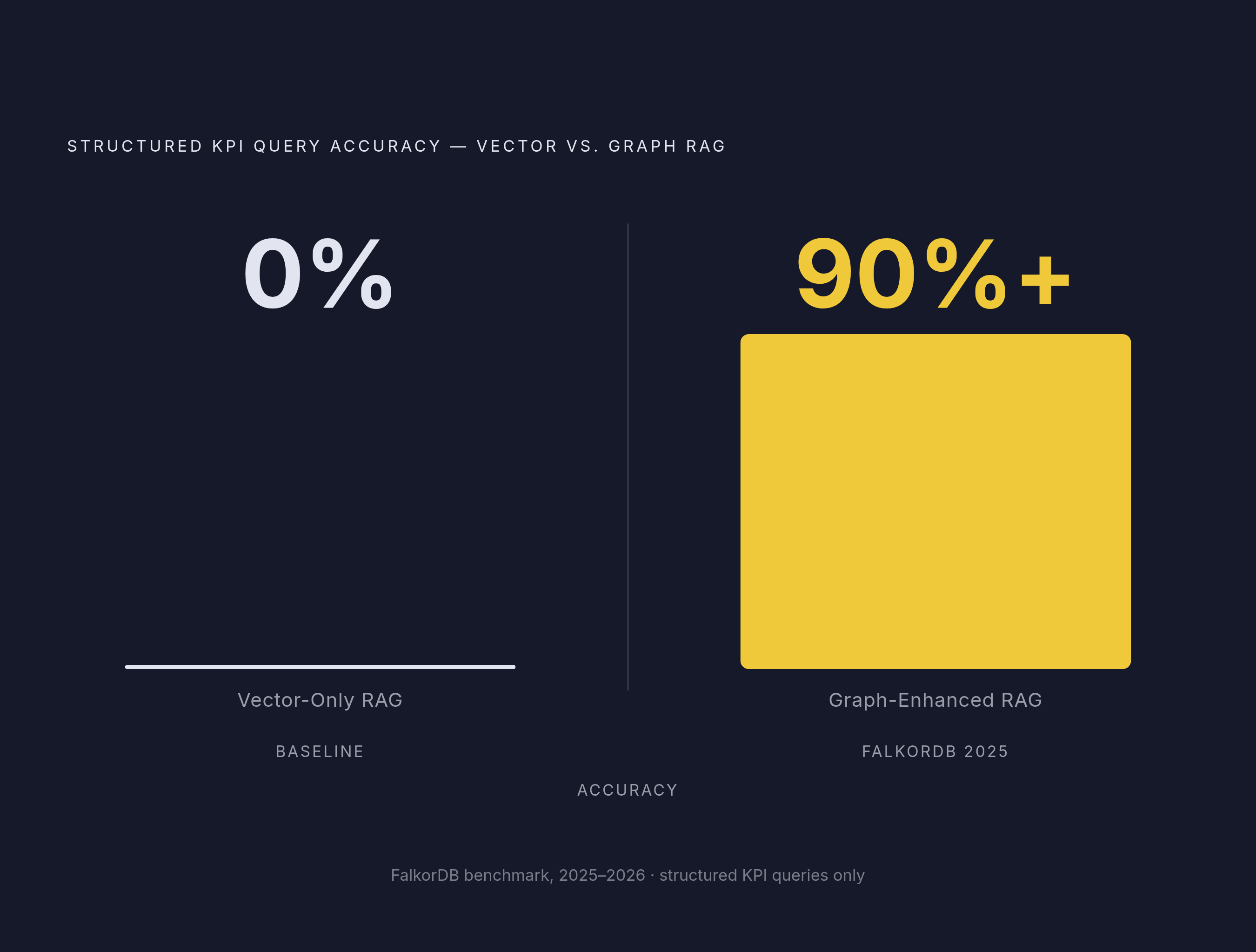
A vector store can retrieve chunks that semantically resemble the query. It has no model of the structural facts that make the answer correct. One 2026 benchmark found Vector-Only RAG achieved 0% accuracy on structured KPI queries. The result is a confident, coherent, and subtly wrong answer. The LLM receives plausible-looking context and does its best with it. The failure is not in the retrieval quality. It is in the assumption that proximity in embedding space has anything to do with correctness for structured data.
How pure vector retrieval breaks when enterprise queries mix structure with semantics
Enterprise queries almost always combine semantic intent with structured constraints. They include date ranges, document types, access scopes, and business-rule filters. Pure vector search cannot satisfy both halves simultaneously. A legal firm's document search needs semantic similarity combined with date ranges, document type filters, and matter-specific access controls. A pure vector search returns the nearest neighbor in embedding space. That nearest neighbor may be semantically close but wrong in every constraint that matters.
Schema-bound KPI queries make the problem sharper. Asking for a specific metric, an exact error code, or a regulatory exception requires exactness. Pure vector search will return the nearest match, which is "close enough" in embedding space but wrong in business terms. This is why developers who replaced lexical search with vectors were forced to reintroduce lexical search alongside them. Then they bolted on metadata filters and rerankers. The hybrid stack emerged not by design but as a patch on a failing pure-vector approach.
The benchmark evidence confirms the gap. A 2025 FalkorDB analysis found vector-only RAG at near-zero accuracy on schema-bound KPI queries. Graph-enhanced retrieval on the same benchmark scored well above ninety percent. That is not a marginal difference. It is categorical.
The tradeoff deserves honest treatment. Graph traversal improves multi-hop reasoning depth on benchmarks like HotpotQA but carries higher average latency. The argument is not that vector search is always wrong. It is that vector search alone cannot handle the structured, relational, rules-governed queries that dominate enterprise workloads. Understanding that tradeoff before building is the point.
How embedding staleness silently degrades retrieval quality over time
Embeddings are generated by a specific model at a point in time. When that model is updated or replaced, existing embeddings become incompatible with new queries. This is not a visible break. No error is thrown. No alert fires. Retrieval simply becomes less accurate over time, and the degradation is gradual enough that organizations do not notice until quality has already collapsed.
Structured enterprise data changes continuously. Schemas evolve. New products are added. Regulations are revised. Business units are reorganized. The embedding corpus faces staleness pressure from two directions at once. The model changes, and the source data changes. Without systematic embedding lifecycle management, there is no mechanism to detect or recover from this drift. That management requires baseline quality metrics at deployment, automated monitoring, and re-embedding workflows triggered by model updates.
Most current deployments have no observability into retrieval quality. Organizations cannot tell whether retrieval is improving or degrading. They cannot identify which queries underperform. They cannot detect when index fragmentation is affecting results. Vector stores assume a stability that enterprise environments do not provide. The lifecycle problem makes them brittle as living systems.
Why metadata filtering under concurrent load becomes a bottleneck at enterprise scale
Metadata filtering is the mechanism that enforces structured constraints alongside similarity search. At enterprise scale, it becomes the dominant performance bottleneck. Similarity calculation is not the problem. The filtering is.
Vendor benchmarks hide this. They measure performance at "Time Zero," immediately after ingestion and before live updates, under static conditions that production systems never see. Production workloads involve continuous writes, index re-optimization, and concurrency spikes. The performance profile under those conditions is categorically different from benchmark conditions. Tail latency and index fragmentation degrade systems long before average query-per-second figures drop. The average metric looks fine while the worst-case experience quietly deteriorates.
Agentic AI workloads intensify this. AI agents issue queries at volumes far exceeding human-driven workloads. They write frequently. They create index bloat and multi-tenancy pressure that read-optimized vector indexes were not built to handle. The 2026 market response reflects this. Practitioners are moving toward "vector as a feature" in existing relational or hybrid platforms rather than standalone vector silos. They discovered the bottleneck the hard way.
How vector stores strip governance and create security exposure that structured data cannot tolerate
The core false assumption is that embeddings are anonymous. They look like opaque numeric arrays, so practitioners treat them as anonymized data. They are not. Research by Morris et al. at Cornell, presented at EMNLP 2023, used the Vec2Text method to reconstruct 92% of 32-token input texts exactly from their embeddings alone. Applied to MIMIC-III clinical notes, the method recovered the majority of full patient names, first and last, from a pseudo re-identified version of the dataset. A zero-shot method called ZSinvert, published on arXiv in April 2025, achieved meaningful inversion without any training on the target model.
Every access permission that applied to the source data must also apply to the embedding store. Most vector stores were not built to enforce that. Pinecone namespaces are logical partitions, not security boundaries. A compromised API key with project-level access can cross namespace lines. Access controls that existed in the source relational system do not transfer. Weaviate added role-based access control as a technical preview in v1.28.0 and made it generally available in v1.29.0. Qdrant's documentation explicitly states instances are insecure by default.
Knowledge base poisoning compounds the risk. The PoisonedRAG attack, presented at USENIX Security 2025, injected adversarially crafted documents that cluster near legitimate queries in embedding space. The attack achieved very high success rates. Retrieved malicious documents then drive the LLM's answer without the user or the system knowing. The Slack AI incident of August 2024, documented by PromptArmor, demonstrated this in production: malicious instructions in a public channel were retrieved as context and used to exfiltrate data from private channels the attacker had no access to. Governance cannot be bolted on after the fact. OWASP added LLM08:2025 "Vector and Embedding Weaknesses" as a new category in the 2025 LLM Top 10. Structured enterprise data in regulated industries carries legal obligations that attach to the data itself. Stripping those obligations when moving data into a vector store does not remove the liability.
What happens when AI agents have no semantic context for the structured data they query
Agents have no institutional memory. They cannot ask what a vague column name means. A stale or partial answer looks just as confident as a correct one. Without a semantic layer, "active customers" can mean three different things depending on whether marketing, finance, or product is asking. Vector retrieval has no mechanism to enforce the canonical definition.
Traditional semantic layers assumed human oversight of static dashboards. AI agents reason dynamically across queries. Governance must enforce deterministic definitions automatically, on every query, not as a periodic review. The relationship problem compounds this. Structured data carries meaning through foreign keys, join conditions, and business-rule constraints. Embeddings flatten those into undifferentiated vectors. The semantic layer is what restores that structure for an AI consumer.
Without table descriptions, metric definitions, and relationship metadata exposed at query time, an agent generating SQL will produce syntactically valid queries that are semantically wrong. The query runs. The answer is returned. The error is invisible. Inconsistent business logic is a major reason why AI does not scale from pilot to production, even at organizations that have invested heavily in AI.
Why the vendor landscape's evolution confirms the architectural diagnosis
The consolidation of the vector database market into integrated platforms, and the rise of hybrid and graph-enhanced retrieval, are not trends in vendor positioning. They are the market's response to failure modes that pure vector architectures produced in production. The standalone vector database category has fragmented and commoditized. Open-source players undercut dedicated vendors on cost. Incumbents added vector search as a feature: PostgreSQL with pgvector, Elasticsearch, Redis, Neo4j, Oracle 23c, Azure SQL, SingleStore, Cassandra, and Apache Solr. Customers increasingly asked why they should introduce a whole new database when their existing stack already does vectors well enough. In most cases, they did not need to. Pinecone, once highly valued, is reportedly exploring a sale. It appointed Ash Ashutosh as CEO in September 2025, with founder Edo Liberty moving to a chief scientist role. The leadership change came as competitive pressure grew and questions over long-term independence mounted.
Hybrid search, keyword plus vector, is now the default for serious applications, not an advanced configuration. Developers rediscovered that precision and fuzziness serve different query needs, and both are required. GraphRAG and graph-enhanced retrieval are emerging for queries that require multi-hop reasoning across connected entities. A 2026 benchmark found Graph-Enhanced RAG achieved over 90% accuracy on structured KPI queries. That is the architectural pattern vector stores categorically cannot serve.
The market in 2026 has trifurcated. Postgres handles smaller vector workloads. Purpose-built engines remain stronger at larger scales. Agentic AI is shifting retrieval toward write-heavy, low-latency, hybrid memory patterns that neither category was originally designed for. Practitioners discovered these failure modes empirically. They are now restructuring accordingly.
What an architecture that actually works for structured enterprise data requires
Each failure mode points to a specific architectural requirement. Hybrid query blindness requires retrieval that combines semantic similarity with structured filtering, exact-match lookup, and business-rule enforcement as a first-class design constraint, not a bolted-on patch. Embedding staleness requires treating embeddings as managed data assets with explicit lifecycle policies. That means baseline quality metrics at deployment, automated monitoring for drift, re-embedding workflows triggered by model updates, and version compatibility management. Governance exposure requires access permissions enforced at the point of query, scoped to the actual end user's identity, not a service account's broad access. Sensitivity must be evaluated at the point where data is combined, not only at the individual field level. Audit logs must capture identity, intent, and lineage together.
Semantic context absence requires a layer that exposes table descriptions, metric definitions, and entity relationships to the AI consumer at query time. Agents can then generate answers that are correct, not just syntactically valid. The production-grade foundation this implies is broad: inventory and lineage, quality and governance controls, a metadata and semantic layer, versioned pipelines, retrieval infrastructure, and identity-aware access with audit logs. These are not sequential phases. They are concurrent requirements from the start.
Data must be designed for AI consumption, not simply inherited from standards that made it clean for human analysts. Write actions taken by agents require stricter governance than reads. The risk profile is not symmetric. Architecture that treats agent reads and writes the same will fail at write actions in ways that are difficult to recover from. New infrastructure should sit on top of what already exists. Replacing warehouses and pipelines is not a realistic path for most enterprises. The semantic and governance layer that structured data needs can be added without migration. Freshness requirements must match the use case. A snapshot acceptable for a dashboard is already stale for an agent making a real-time decision on structured operational data.
The teams that will get structured data into production AI workloads are not the ones with the best embedding models. They are the ones who built the governance, semantic, and hybrid query layer that structured data requires. Embeddings retrieve similarity. Structured data demands meaning. Those are different problems, and they require different architecture.