Data Integration Tools That Work for AI Agents, Not Just Pipelines
AI agents need real-time data, clear definitions, and strict permissions to act safely.

Most data integration tools on the market today were built for one consumer: a human analyst. The tools built to serve that person, mainly managed ELT pipelines like Fivetran and Airbyte that move tables into a warehouse, and iPaaS platforms like MuleSoft, SnapLogic, and Boomi that move business events between applications, all solve the same underlying problem: get data from one place to another so a person can look at it later. AI agents don't work that way. They query constantly instead of on a fixed schedule, they act on what they get back instead of just displaying it, they have no coworker to ask when something looks unclear, and they can't tell a confident wrong answer from a confident right one. A dashboard built on stale or poorly labeled data just looks incomplete, something a person notices and shrugs off. An agent working from that same data acts on it anyway, quietly and with total confidence, often in exactly the wrong direction.
The four requirements that separate an agent-ready integration layer from a pipeline tool
Being ready for agents is the overlap of four structural requirements, and most pipeline tools today only meet some of them, if any. Those four are real-time data access, semantic context, identity-scoped permissions, and governed, auditable output. Treat these as a lens for evaluating any tool, not a checklist where one vendor claims to check every box.
Start with real-time access. A pipeline that syncs at midnight, or an API that hands back yesterday's numbers, doesn't work for an agent making a decision right now. When an agent queries stale data, it doesn't just respond slowly, it acts on the wrong answer and moves forward as if nothing's wrong. The marketing term "real-time" means less here than the actual, documented floor on latency: that floor, whether it's seconds, minutes, or an hourly sync, sets what the agent can actually do with the answer. A snapshot that's perfectly fine for a weekly dashboard is already too old for an agent making an operational call in the moment.
Semantic context is the second piece. An agent with plain warehouse access can read any table it's given, but it has no way of knowing what "active customer" means at a given company, or which of three competing definitions of revenue is the one leadership actually reports. Left alone, it guesses based on column names. That guesswork, happening right at the moment the agent takes action, is where hallucinations and silently wrong answers come from. Real semantic context means table descriptions, metric definitions, and the relationships between them live inside the layer the agent queries, not something the agent has to reconstruct on its own from raw schema.
Third is identity-scoped permissions. An agent that inherits that account can reach data the person it's acting for was never cleared to see. Agent-ready governance checks permissions at the moment of the query, under the real end user's identity, so it never just assumes the service account's access is fine to pass through. The damage a misconfigured agent can do is bounded only by what that underlying account can reach, and in most pipeline setups, that account can reach a far wider net than any one person's actual access.
The fourth requirement is governed, auditable output. An audit log that only records what data got touched, without identity, intent, and lineage attached, becomes inadequate once agents start generating query volume far beyond what any human team produces. When agents run at that pace, governance built for human-scale usage breaks down structurally.
Why enterprise AI pilots stall before production: the data layer
The biggest reason enterprise AI pilots never make it to production has little to do with model quality. It comes down to data that isn't ready for an AI system to use. When leaders are asked directly why AI initiatives fall short, the same themes come up: data quality or availability isn't good enough, governance is inconsistent across tools and regions, and there's limited visibility into how data can actually be used across platforms.
The failure mode agents create is different in kind from the old BI data-quality headache. A dashboard built on bad data looks incomplete or just boring, and people usually catch it. An agent working from the same bad data produces a confident, well-worded answer that sounds right, and someone downstream makes a decision based on it. Regulators are adding weight to this problem too. At that point, companies without governed data lineage in place don't just face an operational risk. They're facing a compliance one.
The semantic layer as the interface between AI agents and business data
A governed semantic layer sits between the warehouse and everything that reads from it, providing one set of business metric definitions, one set of dimension logic, and one set of access rules. It's become the main way companies hand agents data they can actually act on correctly. Having a connection to the data isn't the same as understanding it. An AI tool with direct access to a warehouse can write valid SQL against any table it finds. But valid SQL built on the wrong definition of "net revenue" doesn't throw an error; it hands back a wrong answer that sounds completely plausible.
The industry has started building around this problem directly. The dbt Semantic Layer, running on MetricFlow, was shown alongside a Model Context Protocol (MCP) server, giving agents a standard way to query governed business context. Announcements around the event pointed the same way, naming the Fusion engine and open Apache Iceberg storage as the durable infrastructure underneath it.
Snowflake has been building toward the same goal from the warehouse side. So the same governed-context model pushes directly into the warehouse layer itself. When companies route their AI agents through a semantic layer instead of letting them hit raw data directly, they report far fewer AI query errors. The agent gets a pre-validated business definition drawn directly from the semantic layer.
What agent-ready governance looks like at the infrastructure level
Agent-ready governance is a different architecture from traditional data governance, not an upgrade of it. Agentic governance goes further still: it enforces rules live, scoped to the specific task, before the agent ever reasons or acts. Traditional governance assumed data got collected, stored, reviewed, and then used, all on a timeline built around people. Agents compress that timeline down to almost nothing, pulling in live operational data continuously and acting on it in real time.
Least-privilege scoping has to be built into the architecture itself, not applied as an afterthought. Workspace isolation limits how much damage a single agent can do just by design: a finance agent only sees finance systems, a sales agent only sees the CRM. Permissions need to be revocable at the level of one specific workload, not tied to a shared account whose removal breaks five other things downstream. Identity passthrough is what makes this work in practice: permissions get checked at the moment of the query, under the actual end user's identity, instead of being inherited wholesale from a broad service account.
Sensitivity checks also need to happen at the point where data gets combined, not just at the level of a single field or source. An agent that joins two tables, each individually cleared for access, can produce a combination that neither table was cleared to expose on its own. Write actions need even tighter control than reads, because an agent that can write into an operational system creates consequences a log can't undo after the fact. Most data leaders admit governance hasn't kept pace with AI, and most also say better data quality makes it easier to push AI pilots into production. The gap is well understood across the industry. It just hasn't been closed inside most companies yet.
Current data integration tools against the agent-ready requirements
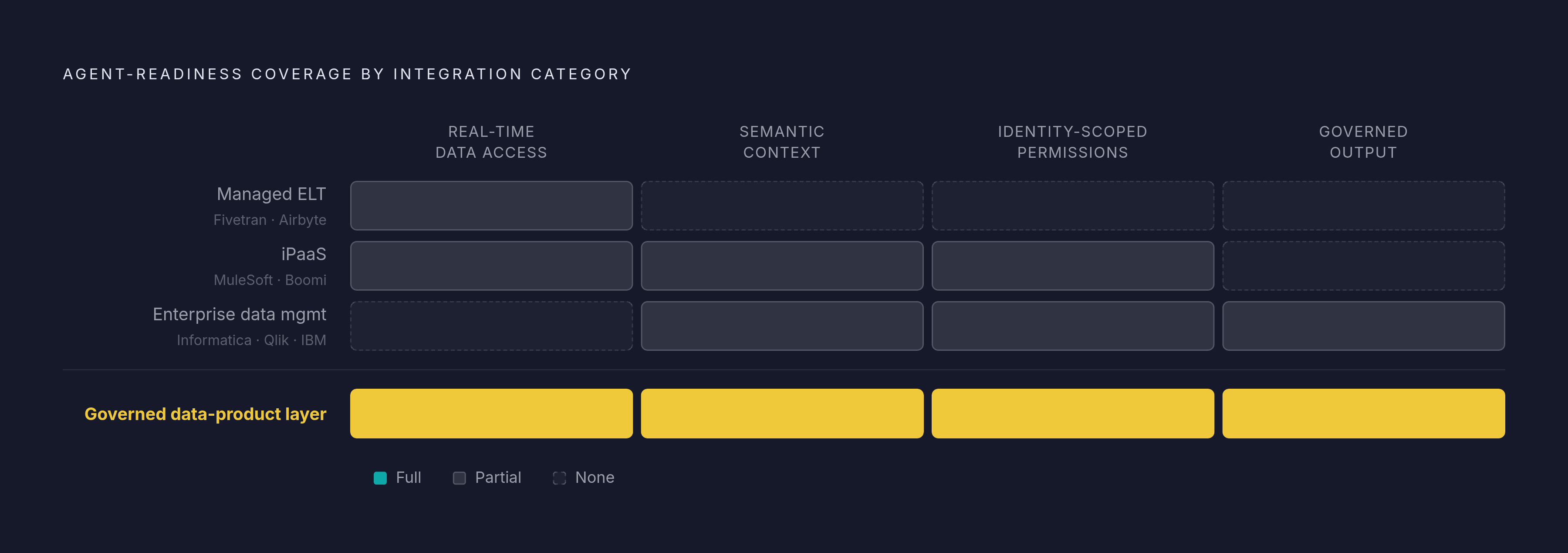
The integration tool market looks fairly uniform from a distance, but measure it against the four agent-ready requirements and it splits into distinct categories, each meeting them to a different degree.
Managed ELT pipelines move data into a warehouse efficiently and are adding AI features at a steady pace. Even so, the primary use case for this category remains warehouse loading. Tools in this category handle the real-time access requirement partially at best, and you need to add another layer on top before you get semantic context or identity-scoped permissions at query time.
iPaaS and application integration platforms cover a different job: moving business events between applications. MuleSoft, SnapLogic, and Boomi are strong at that specific task, but their design isn't built around packaging data as governed products that an agent can safely consume.
Enterprise data management platforms carry the deepest governance capability in the market, along with the most architectural complexity. Informatica, now part of Salesforce, Qlik Talend, and IBM anchor this segment. Governance in this category runs deep, but the tradeoff is that these platforms generally assume data needs to centralize before it becomes usable for AI.
A fourth category has emerged around governed data products built specifically for agent consumption. Nexla is built around this model, treating governed data products, called Nexsets, as the unit agents, apps, and warehouses all consume from the same pipeline, supported by MCP Studio in early access and a latency floor under five minutes. The design puts the data product itself, not the pipeline moving it, at the center of delivery. An AI-ready data layer that sits on top of infrastructure a company already owns, exposing one interface with semantic context and governance built into every query, checking permissions at query time under the real user's identity, and logging every query with full lineage, meets all four agent-ready requirements without forcing a migration or a rebuild of existing warehouses and pipelines. A federation-first approach matters here too: letting agents query data where it already sits, through federated query engines, avoids the cost and risk of centralizing everything first, which is usually what the enterprise management platforms require.
Data products marketplaces as the distribution layer for agent-consumable data
A data products marketplace treats data as a packaged, governed offering rather than a raw asset each team has to interpret on its own. Schema, semantics, quality signals, and access rules all travel with the product itself. A human analyst and an AI agent can both pull from the same marketplace entry, and the value of that setup is that discoverability, context, governance, and quality signals get built once, not rebuilt separately by every consumer who touches the data.
The agent marketplace is developing in parallel with this data product layer. Salesforce AgentExchange combines AppExchange, Slack Marketplace, and Agentforce into one discovery surface, listing more than 10,000 Salesforce apps, thousands of Slack apps and agents, and hundreds of Agentforce agents, sub-agents, tools, and MCP servers, backed by more than 200 launch partners including Google Cloud, Docusign, and Box. The overlap between data marketplace governance and agent marketplace governance is where the next round of enterprise integration challenges will appear. An agent that discovers and calls a governed data product through a marketplace is working from a far more reliable foundation than one querying raw tables through a shared service account. This category is still forming, not settled, but the direction is clear enough to plan around.
Evaluating your integration stack before agentic workflows expose the gap
The right question to ask about an existing integration stack is whether the data agents will consume can be discovered, accessed in real time, governed under the actual user's identity, and understood without the agent having to infer meaning from raw schema. That question breaks down into four diagnostics, one for each requirement covered above.
On real-time access, the question is what latency floor is actually documented for the data agents will act on, and whether that floor matches how fast the use case needs a decision made. On semantic context, the question is whether the integration layer attaches metric definitions, table descriptions, and business logic to the data itself, or whether it just exposes raw schema and leaves interpretation up to the agent. On identity-scoped permissions, the question is whether access gets evaluated at query time under the end user's own identity, or inherited from a shared service account, and whether one agent's access can be shut off without breaking everything else connected to that account. On governed, auditable output, the question is whether audit logs capture identity, intent, and lineage together, and whether they can keep doing that at the query volume agents generate.
Ownership of the tool itself is now a legitimate factor in that evaluation. The stack a company buys today may belong to a very different product roadmap in 24 months. For most enterprises, the realistic path forward isn't ripping out existing infrastructure and starting over. A layer that sits on top of the warehouses, SaaS tools, and operational systems already in place, adding semantic context, identity-scoped governance, and lineage without requiring a data migration, is a far more achievable path than rebuilding from the ground up.
The sequence dbt Summit 2026 laid out applies well beyond dbt's own customers: start with the handful of decisions agents will actually be making, trace those decisions back to the specific metrics they depend on, govern and define those metrics first, and expand outward from there. That works better than trying to make an entire data estate AI-ready before a single agent goes live. The gap between pipeline-era integration and agent-ready integration isn't a future risk still waiting to show up. Enterprises running agentic workflows on top of ungoverned, semantically thin data are already running into it in production, and closing that gap now costs far less than discovering it there.