Data Observability vs Data Quality for AI Pipelines
Most AI pipelines fail on data quality, not algorithms, and the difference costs millions.

Data quality and data observability get treated as synonyms half the time, and that's a mistake that's about to get expensive. Data quality checks whether the data is correct. Data observability checks whether the pipeline delivering that data is healthy. Those are two different questions, with two different sets of tools, and AI pipelines just exposed a third question neither one was built to answer: does the data still mean what an agent thinks it means, right now, at the moment it queries?
Why the cost of getting either wrong has grown well beyond delayed dashboards
Poor data quality costs organizations an average of $12.9 million a year, according to Gartner. MIT Sloan Management Review puts the revenue hit even higher: 15 to 25% lost annually to bad data. Forrester found that more than a quarter of data professionals name poor data quality as the thing standing between their organization and real data literacy. None of that is new information, exactly. What's new is what happens after the number gets bad.
In a traditional BI setup, a broken pipeline means a dashboard doesn't refresh on time. Someone notices. A report gets delayed, an analyst flags the anomaly, the team reruns the job, and the damage is contained to a bad Tuesday. That analyst is doing more than fixing a job, though. They're catching things no schema check would ever catch: a number that's technically valid but obviously wrong given what they know about the business. That human judgment has been the real last line of defense for years, quietly.
Take that person out of the loop, which is exactly what happens when a model consumes the data instead, and the safety net disappears. When a model is making or informing a decision about a loan, a claim, or a diagnosis, "the dashboard was late" is no longer the failure mode worth worrying about. The organization now needs to reconstruct exactly what data fed that decision and justify why it was fit to use. The bar has moved from "is the pipeline up" to "is this data fit for a decision a machine is about to make with nobody checking its work first."
How AI pipelines fail differently, and why most initiatives show it
Between 70% and 85% of AI failures trace back to poor data foundations, not bad algorithms. That statistic alone should reframe how most teams are spending their AI budget, because most of them are still spending it on models.
The numbers on outcomes are rough. MIT's Project NANDA found in July 2025 that 95% of organizations deploying generative AI saw zero measurable return. RAND has put AI project failure rates as high as 80%, nearly double the failure rate of ordinary IT projects. S&P Global found that 42% of AI initiatives got scrapped in 2025, up sharply from 17% the year before. Gartner surveyed 1,203 data management leaders and predicted 60% of AI projects lacking AI-ready data would be abandoned by 2026; 63% of the organizations in that same survey said they either don't have proper data-management practices to support AI or aren't sure they do.
Ask CDOs what's actually in the way, and the answers cluster tightly. A global CDO Insights survey from 2025 puts data quality and readiness at 43% and skills or data literacy shortages at 35% among the top obstacles CDOs cite. The pattern among organizations getting real returns from AI points consistently to data workflow redesign happening before model selection, not after. Gartner's Rita Sallam summed it up bluntly in April 2026: without trust in the data, there's no value from AI, full stop, and the organizations with successful AI initiatives are investing up to four times more in their data and analytics foundations than everyone else. A March 2026 report from Cloudera and Harvard Business Review Analytic Services found only 7% of enterprises consider their data completely ready for AI.
So the failure almost never lives in the model. It lives in data readiness, in how badly the workflow was integrated, and in the absence of a clearly defined outcome before anyone started building.
Here's what makes AI failures structurally different from BI failures: a stale source doesn't throw an error. Distribution drift doesn't throw an error. The job runs, it reports success, and the model output degrades anyway with nobody watching. Roughly 91% of ML models degrade in production without proper monitoring in place, and 32% of teams cite data and model quality as their single biggest obstacle to getting anything into production at all. A volume anomaly buried in a training dataset can silently skew a model toward whatever class dominates the sample, no alert fires, and nobody finds out until the model's behavior looks strange in ways nobody can immediately trace back to the data.
Freshness failures are the sneaky one. An agent pulls stale context and produces a perfectly confident answer based on conditions that stopped being true days ago. The team building on top of that agent might not catch it for days or weeks, because everything upstream still says the pipeline is fine.
The three AI-specific failure modes that structural observability cannot catch
The five pillars of structural observability, freshness, volume, distribution, schema, and lineage, came out of work by Barr Moses at Monte Carlo, and they were built around an assumption that made total sense at the time: somewhere downstream, a human analyst with domain knowledge is going to catch the semantic weirdness that structural checks miss. That assumption is the whole thing that breaks with AI.
Three failure modes live entirely outside what those five pillars can see.
Feature drift happens when the input features a model sees at inference time have statistically diverged from what it was trained on. A fraud model trained on Q1 transaction patterns starts seeing Q4 transactions with a completely different fraud signature, and it degrades, quietly, while every structural monitor watching that pipeline reports green across the board.
Context drift is subtler still. It's what happens when the semantic definitions an AI agent was calibrated on shift over time without anyone updating the layer that agent reads from. An agent that learned "revenue" means one specific calculation keeps applying that calculation long after finance updates the canonical definition somewhere else in the org. Nothing about the data changed structurally. The meaning changed underneath it.
Inference blindspots are a visibility problem: there's often no record of what context an agent actually retrieved before it produced a given output. Traditional monitoring stops at the model's input boundary. For this to be useful, the chain has to run the whole way from source data through retrieval through inference through whatever the agent finally outputs.
Picture a column called customer_status. It sails through every freshness check, every volume check, every distribution check, every schema check, month after month. Meanwhile its actual business meaning quietly shifts from "account active" to "contract pending renewal" after a product team changes something in the CRM workflow. No structural monitor anywhere in the stack catches that, because nothing about the column's structure moved. The result: the observability dashboard is green, the agent's output is wrong, and there's no alert and, worse, no obvious owner for the problem.
This isn't a data quality failure, because the values are all technically valid. It isn't a structural observability failure either, because the pipeline is genuinely healthy. It's a third category, and until recently nobody was naming it as its own thing.
Semantic integrity as the sixth observability pillar AI pipelines require
Call it what it is: semantic integrity. The assurance that the business meaning behind a data field stays consistent as agents consume it, and that definition drift, invisible to all five structural pillars, gets caught before it reaches production output.
The original five-pillar framework, again, traces back to Barr Moses at Monte Carlo. The category has kept expanding since then as production AI systems matured past pilots and into places where a wrong answer actually costs something.
Semantic integrity is checking things the other five pillars were never designed to check: whether a metric definition cached in an agent's context layer still matches the current canonical definition sitting in the source system. Whether a field's business meaning changed since the agent was last calibrated on it, not its data type, not its statistical spread, its actual meaning. Whether "net revenue" or "active user" or "account status," as an agent understands and applies them at query time, still match what the rest of the organization currently means by those terms.
This is where a semantic layer earns its keep. It sits between raw data sources and whatever's consuming them, human or agent, translating the underlying data model into business-friendly concepts and centralizing metric logic in one place, so an agent is querying meaning rather than just querying structure. Most AI analytics failures, when you trace them back, turn out to be semantic failures rather than structural ones. The column's still there. The values are still valid. The definition just quietly expired somewhere upstream and nobody told the agent.
Self-describing datasets are the mechanism that makes any of this monitorable at all: metadata that tells a consumer, human or machine, what a dataset actually contains, how it's meant to be used, and why it can be trusted. Without that contextual layer, semantic observability has nothing to check against.
Put together, the six pillars now look like this:
- Freshness: how long since last update, extended for AI into a freshness signal the context layer actively surfaces to agents
- Volume: row count anomalies, extended into completeness checks on training data inputs
- Distribution: statistical outliers, extended into feature drift detection between training and production
- Schema: column-level changes, extended into semantic contract violations for AI consumers specifically
- Lineage: data provenance, extended into inference-time traceability from input straight through to AI output
- Semantic integrity: definition consistency, covering context drift in how agents reason over meaning
What an AI-ready data layer must provide that quality tools and observability platforms do not
Most data architecture today is still batch-oriented and siloed, because it was built for human analysts pulling reports on a schedule. AI-ready architecture has to be dynamic, real-time, and unified, because agents don't work on a schedule. They work at query time, against whatever state the data happens to be in right that second.
Frameworks for AI-ready data architecture consistently point to five criteria a data layer needs to hit before it can honestly call itself AI-ready:
- Discoverable: every dataset registered in a catalog with real metadata, clear ownership, lineage, and enough business context that both a person and an agent can find and understand it without asking someone
- Accessible in real time or close to it: data moving from transaction systems through CDC or streaming pipelines, so AI workloads are working off current state instead of yesterday's batch export
- Governed end-to-end: one identity model, one policy engine, one audit trail, covering every compute engine, every storage layer, and every agent that touches the data
- High-quality and certified: data contracts, validation gates, and quality SLAs, so what actually reaches the model is trusted, documented, and versioned
- Semantically rich: a centralized semantic layer providing the table descriptions, metric definitions, and relationships an agent needs to produce an answer that's correct, not merely syntactically valid
There's a bigger architectural shift buried in that list, too: a move away from ETL-centric copying, where static pipelines assume the source and schema will hold still, toward runtime access, where agents hit live state directly at query time.
Permissions have to be enforced at query time under the actual identity of the person or process asking, not waved through on a broad service account's credentials. An agent reading data carries a very different risk profile than one writing to a system, and treating them the same is how access controls quietly stop meaning anything. Audit logs need to capture identity, intent, and lineage all together; a log that records only the query itself is close to useless once you're trying to reconstruct what an agent actually did, at agent-scale query volume, weeks later. And sensitivity has to get evaluated at the point where fields get combined, not just at each field individually. An agent joining two fields that are each harmless on their own can produce a combination that no access policy anticipated, because nobody wrote a policy for that specific join.
The pressure to fix all this is already showing up in survey data. Database Trends and Applications found 85% of subscribers had firm plans to modernize their data platforms in 2025, driven largely by generative AI, with 60% actively researching GenAI, LLMs, RAG, and knowledge graphs as part of that work.
The vendor landscape across structural observability, semantic observability, and data quality
The market's growing fast enough that it's worth pausing on the numbers. Data observability is projected to grow from $2.94 billion in 2025 to $3.4 billion in 2026, a 15.7% CAGR, and on to $6.02 billion by 2030 at roughly 15.4% CAGR. The AI-specific slice of that, AI-based data observability software, sat at $1.10 billion in 2025 and is on track for around $3.29 billion by 2035 at an 11.57% CAGR. Gartner expects 50% of enterprises to have adopted data observability tools by 2026, up from under 20% in 2024, which tells you adoption is accelerating fast, but also that most enterprises still aren't there yet. Regulatory pressure is pushing a chunk of that growth, alongside a broader shift from reactive monitoring toward proactive data reliability engineering.
On the structural observability side, a handful of names cover most of the ground. Monte Carlo, having established the five-pillar framework in the first place, launched Observability Agents in April 2025, recommending monitoring rules and diagnosing root causes with a human still approving the actual deployment; by 2026 it had ML-based anomaly detection running alongside those autonomous agents. Acceldata raised a $35 million Series B in Q3 2024, signaling continued investment in expanding its AI-driven observability capabilities. Anomalo, Soda, and Datafold each cover strong ground across one or more of the five traditional pillars. Major cloud data platform providers have moved to deepen observability integrations within their stacks. And in April 2025, Datadog acquired Metaplane, folding end-to-end data observability, including data quality monitoring, into its existing monitoring and security platform.
Feature and model drift is its own smaller lane. Arize AI and WhyLabs are purpose-built for tracking drift between training-time and inference-time data. That's real coverage of the first AI-specific failure mode described above, but it stops there. Context drift and inference blindspots aren't what those tools were built to catch.
Data quality still runs largely on rule-based assertion frameworks: Great Expectations (now GX 1.0 and beyond), dbt tests, and Soda Core, most commonly wired in as stages within the pipeline itself.
None of that touches semantic observability directly. No structural tool on the market was built from the ground up to catch definition drift, which means closing the sixth pillar requires a governed semantic layer sitting on top of the existing stack, integrated with structural observability rather than replacing it. That layer needs to expose one interface with metric definitions, table descriptions, relationships between them, permissions enforced at the moment of query, and full lineage on every query that runs. That's the piece an AI-ready data platform actually has to supply, and it's the piece missing from most vendor stacks in production today.
Streaming environments add one more wrinkle worth naming. In Kafka-based architectures, data quality often gets implemented as stream processors that route bad records to dead letter queues, while observability separately tracks consumer lag, partition distribution, and throughput. Because everything's moving in real time, anomalies show up in seconds instead of waiting for the next batch run, which makes observability tooling especially valuable in that setting.
How to decide what your AI pipelines actually need, and in what order to build it
Quality versus observability was never really the right question, and it matters even less now. The real question is which layer of failure an AI pipeline is most exposed to at this exact moment, and which investment actually closes that gap first.
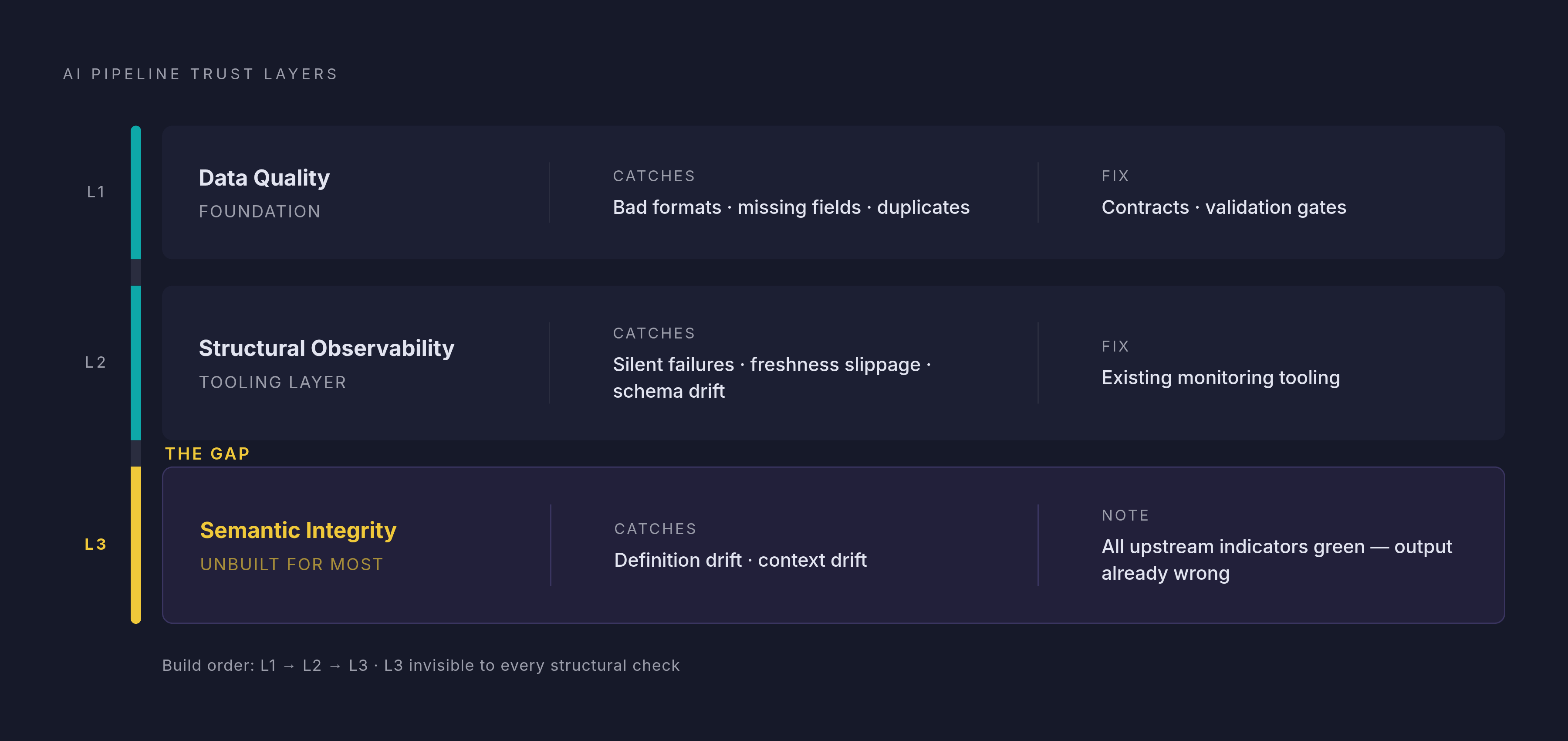
If known, rule-violating errors are getting through, bad formats, missing fields, duplicate records, that's a data quality gap, and it gets fixed with contracts and validation gates before data ever reaches the model. If the pipeline itself is the mystery, jobs failing silently, freshness slipping without anyone noticing, schemas changing underfoot, that's a structural observability gap, and it gets fixed with the structural observability tooling already on the market. But if the pipeline looks completely healthy and the values all pass validation, and the model's output is still wrong in ways nobody can explain, that's neither of those problems. That's semantic integrity failing quietly in the background, and it's the one gap most organizations haven't even started building for yet.
Build in that order: quality first, because it's cheap and catches the obvious stuff. Structural observability second, because it catches the pipeline failures quality checks were never meant to see. Semantic integrity third, but not last in importance, because it's the layer that decides whether an autonomous agent's confident answer is actually true. Skip that third layer, and every dashboard can stay green while the agent making decisions on top of it is already wrong.