tools that enforce data freshness tolerances for AI agents vs. BI dashboards
Autonomous agents need freshness guarantees batch pipelines were never built to provide.

A dashboard reader who sees stale numbers just adjusts, quietly filling the gap with judgment. A pricing agent that sees stale numbers acts on them, confidently, in three seconds, with no one checking its work. That gap, between compensation and propagation, is why freshness tolerances for AI agents can't be enforced the same way they've been enforced for BI, and why the tooling built for one won't save the other.
How batch ETL created a freshness contract designed for human readers
Batch ETL runs on a schedule: extract, transform, load, repeat. Between runs, the destination table is frozen, a snapshot taken at the moment the last job finished, and for decades that was fine.
It was fine because the person reading the dashboard did the compensating. Someone glancing at a sales report built from a 6 AM extract knows, without being told, that anything that happened after 6 AM isn't in there. They mentally carry it forward. A warehouse manager looking at yesterday's inventory count already knows three trucks shipped out this morning. The snapshot was never meant to be the whole truth; it was a reasonable approximation, and the human sitting between the data and the decision closed the gap.
That's the real contract batch pipelines encoded: this data is old enough that someone will know how old, and adjust, with latency accepted, gaps known, and a human sitting in the loop.
Now plug an agent into that same infrastructure. It inherits the identical snapshot, the identical staleness, but none of the judgment that used to sit on top of it. Nobody told the agent three trucks shipped this morning; it just sees the number in the warehouse column and treats it as ground truth.
Batch pipelines aren't broken. They're doing exactly what they were built to do. The problem is that they were never built to serve a decision-maker that can't tell the difference between "current" and "current as of last night." And the staleness compounds faster than most teams assume: B2B data can decay at a rate exceeding 70% per year, according to market.us, which means even a clean batch load from yesterday already carries real drift risk for anything acting on it today.
What a freshness tolerance actually means when it's written for an agent
Take a pricing assistant quoting off a stale catalog. For a human analyst, an outdated price list is an inconvenience, something to double check. For an autonomous agent quoting that price directly to a customer, it's a legal exposure with the company's name on it. The tolerance for that agent isn't measured in business days; it's measured in minutes.
A real freshness tolerance, written for an agent rather than a person, has to specify a handful of concrete things:
- The maximum acceptable age of the most recent data row
- An ingestion latency ceiling
- A required update frequency
- What the agent does when the tolerance is broken: refuse, degrade gracefully, escalate, or alert
That last point is the one most teams skip, and it's the one that matters most. A BI SLA governs when a report becomes available. An agent SLA governs whether the agent is allowed to act at all. Those are different questions with different stakes attached.
Agents should be built to refuse when freshness is violated, without hedging or caveating. An agent that produces a confident answer from data it shouldn't trust is worse than one that stalls, because the stall gets noticed and the confident wrong answer doesn't. This has to be a design contract baked into the agent's logic, not a monitoring dashboard someone checks after the fact.
This is also where the line between "BI-ready" and "AI-ready" data actually lives. BI-ready data is modeled, cleaned, and documented well enough for a human analyst to find and use it. AI-ready data needs to be time-aware, carry rich metadata and lineage, and support real-time access. Those are not the same bar, and a lot of teams are quietly failing the second one while believing they've cleared it.
A semantic layer is what makes that context usable at the moment of the query. An agent doesn't just need the value 500 units; it needs to know how old that number is, where it came from, and how much to trust it. A semantic layer that encodes age, source, and confidence alongside the metric functions as part of the enforcement mechanism itself, not merely as documentation.
The observability tools that monitor freshness at the pipeline level
Adoption of data observability tools is set to jump from roughly 20% of enterprise companies in 2024 to about 50% by 2026, according to Medium/AIDE Learning, and the timing isn't a coincidence. Agentic workloads are the reason for the acceleration.
Testing and observability serve different purposes here. Testing checks expectations at pipeline runtime, at the moment a job runs, while observability watches continuously: freshness, volume, distribution, schema, catching the drift that happens between scheduled tests. Agents don't wait for the next test cycle. They query whenever they query, which means the gaps between tests are exactly where trouble hides.
What these platforms actually watch for, in practice:
- Age of the most recent data row
- Ingestion latency relative to a learned baseline
- Schema drift that could silently break a field an agent depends on
- Volume anomalies that signal a missed or partial load
Monte Carlo uses machine learning to learn each table's normal freshness pattern and flag deviations from it, connecting into Unity Catalog to watch tables, views, pipelines, and field-level values. In 2026 it pushed into AI agent observability and warehouse-grounded validation of AI-generated fields, positioning itself as a combined data-and-AI observability layer rather than a pipeline-only tool.
Datadog entered this space by acquiring Metaplane in April 2025, then rolled out reliability reports and DORA-style metrics for freshness tracking at DASH 2025, aimed at catching stale data before it reaches production.
Soda lets teams define an SLA per dataset, log issues, track quality trends over time, and trigger trust flags when a rule fails. It integrates with data catalogs so freshness signals surface where analysts, and increasingly agents, are already working.
Acceldata launched its Agentic Data Management Platform in May 2025, built around real-time freshness control, automated anomaly remediation, and a distributed control plane that uses AI agents to enforce quality policy directly.
Here's the shared gap, though. Almost none of these platforms watch the data feeding an agent and the agent's own behavior in the same place. Observability, as it exists today, sits on the pipeline side, while the agent side is a separate problem, and it's the one the next wave of tooling is racing to close.
What each observability platform can enforce vs. what it can only report
Detection isn't enforcement. A platform that fires an alert the instant a table goes stale doesn't stop an agent from querying that same table thirty seconds later. The alert and the bad query can happen at the same time, with nothing connecting them.
Atlan sits in a different spot: it's the context and routing layer rather than the detection layer. Monte Carlo tells someone a table's freshness has dropped. Atlan tells them who owns that table, which three dashboards pull from it, and which business team is about to make a call based on stale numbers. It aggregates quality signals from Monte Carlo, Great Expectations, Soda, and others into a single control plane. But even with all that context assembled, routing it into an actual blocked query still requires a governance layer sitting downstream.
Arize works the other side entirely: AI-layer observability focused on model and agent behavior, not the data feeding it. The company raised a $70 million Series C in February 2025 and processes on the order of a trillion spans a month. It watches what the agent does, not what the data looked like before the agent touched it.
That split leaves an open question, and it's the one that actually determines whether an agent acts on bad data:
- Who or what intercepts the query the instant a freshness violation is detected?
- Does the agent know, at query time, whether the data it's about to get back meets its own SLA?
- Can that check happen at the query layer, before data is returned, rather than after the damage is done?
The observability stack, taken as a whole, is necessary, but it's not sufficient. Enforcement at the moment of the query requires a different kind of architecture entirely.
Enforcement at the query layer: how freshness tolerances get embedded in data access
Query-time enforcement means permissions and quality constraints, freshness included, get evaluated when the query lands, not back when the pipeline last ran. That distinction sounds small, but it isn't.
Agents don't query on a pipeline's schedule. They query on their own schedule, whenever a workflow fires, which means the only enforcement point that can be trusted is the query itself. Everything upstream of that is already too late.
Query-time freshness enforcement, done properly, looks like this: the data layer checks the age of the most recent row before it returns anything. If that age exceeds the tolerance defined for this specific data product and this specific consumer, the query gets blocked, degraded, or flagged, rather than quietly served like nothing happened. The agent gets an explicit signal back, something like "this data is stale relative to your SLA," instead of a confident answer built on sand.
The semantic layer does structural work here too. A semantic layer that already encodes table descriptions, metric definitions, and relationships can carry freshness metadata right alongside them. An agent querying through that layer knows the freshness posture of what it's about to receive before it acts, not after a human catches the mistake.
Model Context Protocol has become the common language agents use to call tools, and Gartner projects that 75% of API gateway vendors will ship MCP-native features by the end of 2026. That makes the MCP gateway the natural chokepoint: the architectural spot where a freshness check can happen before data ever reaches the agent, rather than somewhere after the fact.
Trying to patch this in at the prompt layer, telling a model in its instructions to "check if the data is fresh," is fragile and won't hold. Enforcement has to live where the data is actually accessed, not where it gets interpreted afterward.
None of this is verifiable without lineage. Enforcement that isn't logged might as well not exist, because there's no way to reconstruct what happened. Query-time logs that capture identity, source, and the freshness state at the exact moment of the query are what let someone diagnose a wrong agent decision after it's already caused a problem.
Why BI dashboards and AI agents need different pipeline architectures, not just different refresh rates
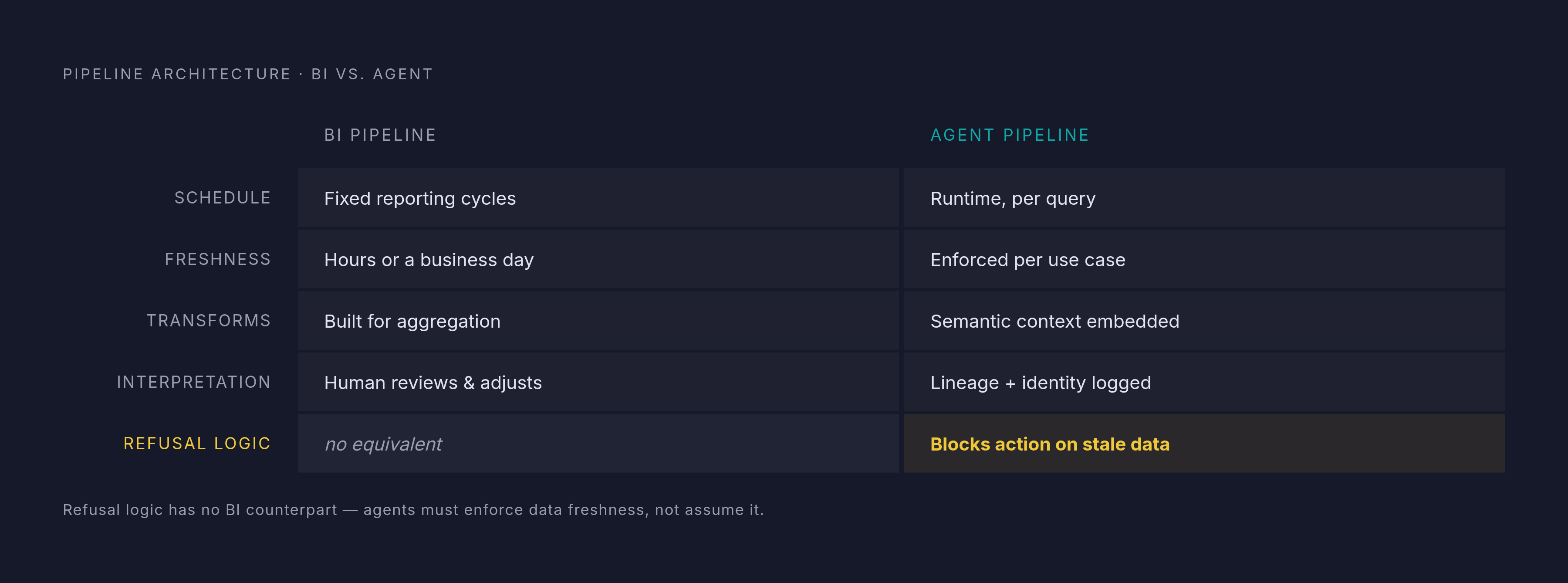
The obvious fix, running batch jobs more often, nightly to hourly to near-real-time, solves latency but not enforcement. A faster batch still can't tell an agent whether the specific data it just received met its SLA at the moment it asked. Speed and enforcement are different problems, and speeding up the pipeline only solves one of them.
BI pipelines need predictable schedules that line up with reporting cycles, transformations built for aggregation and historical comparison, freshness tolerance measured in hours or a business day, and a human on the other end who interprets and adjusts.
Agent pipelines need runtime access to live or near-live source data, freshness tolerance defined per use case and enforced at every query, semantic context embedded in the data itself rather than sitting in a wiki somewhere, refusal logic when tolerances break, and full lineage and identity logging on every single query.
There's a telling contradiction in how organizations describe their own readiness. Ninety percent describe their data as AI-ready, while a large majority name data readiness as the single biggest impediment to putting AI into production, according to a 2026 survey of 250 IT and data leaders. Same respondents, contradictory answers, and the likeliest explanation is that "ready for BI" is quietly getting mislabeled as "ready for agents," when the two aren't the same claim at all.
The consequences of that mislabeling show up downstream. Sixty-one percent of organizations say they frequently delay AI initiatives because they lack trusted, reliable data. Sixty-six percent report AI models generating biased or misleading output because the infrastructure underneath doesn't supply enough context. Fifty-seven percent struggle just to identify which data source is actually authoritative. Platforms built around federated querying, like Peaka, address part of this by letting teams query scattered sources through a single governed layer without moving the data first. Those numbers, from a 2026 State of Context Management Report, describe what happens when one pipeline is asked to serve two consumers with fundamentally different contracts.
The fix isn't replacing the batch pipeline BI still depends on. It's building a live query layer for agents on top of the existing infrastructure, so the two coexist, each serving its own consumer under its own rules.
The freshness monitoring market and where vendor investment is concentrating
The global data freshness monitoring market is on track to hit $5,494.2 million by 2035, up from $523.6 million in 2025, a compound annual growth rate of 38.4%, according to market.us data from February 2026. A tenfold expansion over a decade isn't hype cycle noise; it's a market responding to a problem enterprises have started taking seriously.
Vendor investment is clustering around three things. Agentic data management platforms that close the loop between detection and remediation instead of stopping at the alert, Acceldata's May 2025 launch being one example of the pattern. Unified observability that watches the pipeline and the agent from the same surface, which is the direction Monte Carlo's 2026 AI agent observability push is heading. And governance tooling built directly into the MCP gateway layer, which Gartner's 75% adoption projection for API gateway vendors by end of 2026 suggests is becoming table stakes rather than a differentiator.
Lineage tooling is growing in parallel. Sixty percent of large enterprises are expected to have deployed data lineage tools by 2026 to manage regulatory and operational risk, up from 20% in 2023, per Gartner figures cited by Quinnox. Lineage is what turns an enforcement decision into an audit record, something that can actually be checked after an agent gets something wrong.
What's still missing is a single platform that does all three at once: enforces freshness at query time, carries semantic context for agents, and logs with full identity and lineage attached. Most vendors today cover one leg of that stool, occasionally two, and none cover all three cleanly, which is exactly the gap practitioners are left to fill themselves.
How to assemble a freshness enforcement stack that serves agents without breaking BI
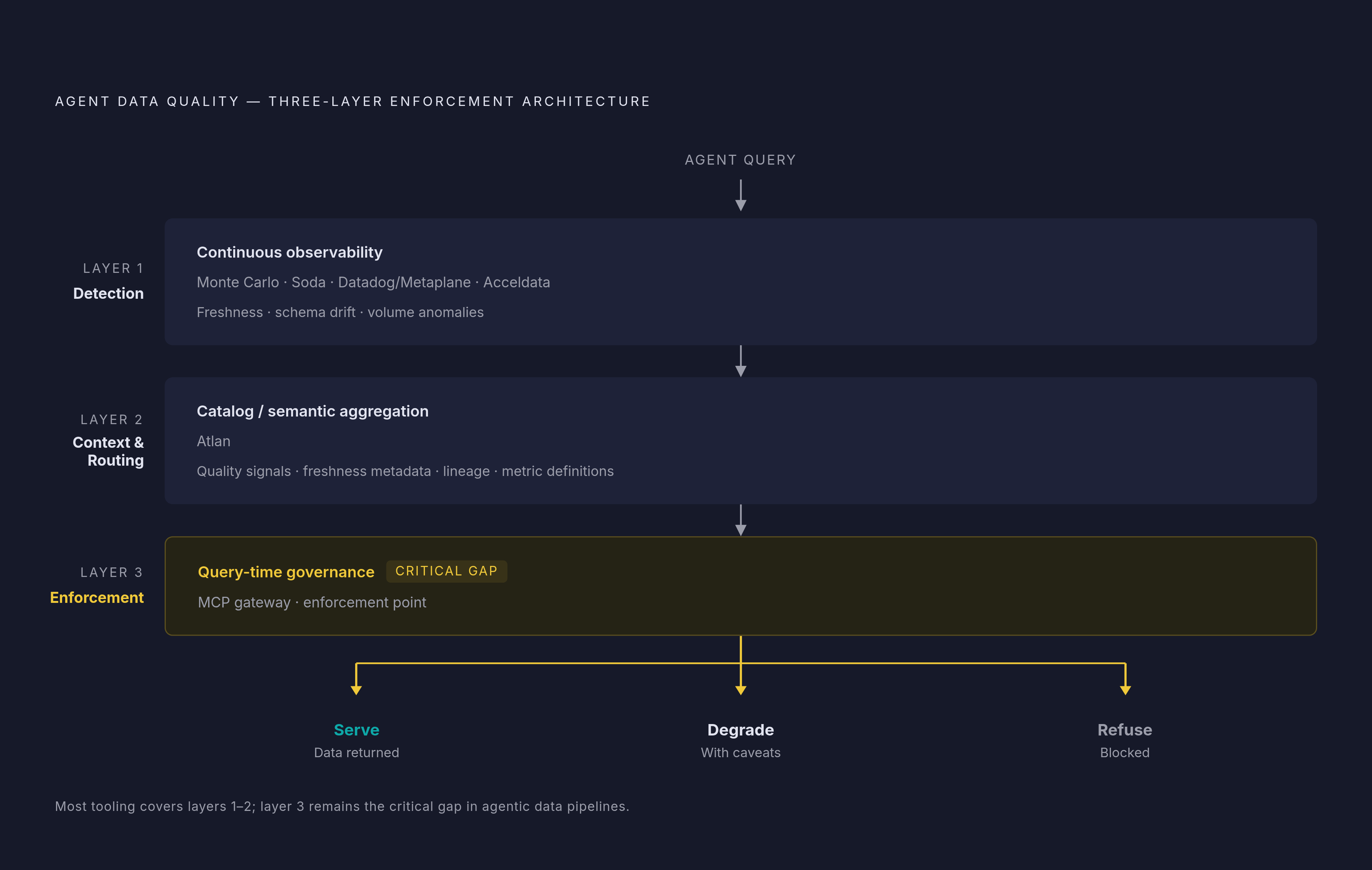
Three layers, stacked in order, each doing a distinct job.
The detection layer is continuous observability, tools like Monte Carlo, Soda, Datadog's Metaplane integration, and Acceldata, watching pipeline freshness, schema drift, and volume anomalies around the clock. This layer fires the alerts and feeds quality signals upward; it doesn't make decisions on its own.
The context and routing layer is a catalog or semantic layer, something like Atlan or a platform with semantic modeling built in, that aggregates those quality signals, maps data assets to the people and agents consuming them, and carries freshness metadata right alongside metric definitions and lineage. This is the layer agents should be querying through, not around it.
The enforcement layer is query-time governance: permissions checked, freshness tolerances checked, at the moment the query actually arrives, ideally sitting at or near the MCP gateway where agent tool calls already pass through. This is the layer that decides whether the query gets served, degraded, or refused, and it's the layer most of today's tooling still doesn't fully own.
Get all three talking to each other, and BI keeps its batch pipelines untouched while agents get a live layer built for the tolerance they actually need. Skip any one of the three, and the stack either can't catch staleness, can't route the alert to the right place, or can't stop the agent from acting on it anyway.