Data Democratization Through AI-Accessible Data Products
Enterprises abandon AI projects when data foundations crumble, but semantic layers can fix it.

S&P Global found that 42% of enterprises abandoned most of their AI initiatives in 2025, and S&P Global Market Intelligence separately recorded that figure at 17% the year before. That's a sharp drop-off rather than a gradual drift. MIT's Project NANDA reported, in a July 2025 study, that 95% of organizations deploying generative AI saw zero measurable return on it. Almost every one of them had a working model. Almost none of them had data underneath that model built to support it, and that gap is the whole story.
The root cause rarely traces back to the models themselves. The Global CDO Insights 2025 survey names data quality and readiness as the top obstacle, cited by 43% of respondents, ahead of budget, talent, or model choice.
Here's the mechanism underneath all of it. Organizations bolted new AI tools onto data environments that were already a mess, and the mess multiplied instead of resolving. A model querying ambiguous, ungoverned data doesn't pause and ask a follow-up question the way a human analyst would; it just answers, fast and wrong, at a scale no analyst could match. The next model release won't fix that on its own. The data layer underneath it is the piece almost everyone skipped.
What it actually means for data to be AI-ready
Clean and ready describe different things, and mixing the two up is where most of these projects go sideways. Data that satisfies a human analyst, someone who can ask a follow-up or correctly guess that "cust_id" means customer ID, is not automatically usable by a machine that has none of that context.
An AI agent can't raise its hand. Feed it a vague schema, a missing metric definition, or an undocumented join, and it won't stop to check. It produces a plausible-looking answer that happens to be wrong, with nothing attached to flag that anything went sideways.
Gartner sets a specific bar for AI-ready data: aligned to actual use cases, governed at the level of the individual asset, moved through automated pipelines with quality gates built in, checked continuously instead of at intervals. Measured against that bar, the industry isn't close. Fluree puts the share of enterprises with genuinely AI-ready data at 7%, and that single number explains the 42% abandonment rate better than any model benchmark could.
The architecture needs four pieces, and skipping any one of them doesn't make the project faster; it moves the failure downstream:
- A unified data access layer, so there's one interface regardless of where the data physically lives
- Centralized metadata and a catalog, so definitions travel with the data instead of living in someone's head
- A governance and security layer that checks permissions at the moment of query, not one that assumes good behavior
- APIs and data-sharing designs built for AI and ML consumption, distinct from repurposed BI connectors wearing a new label
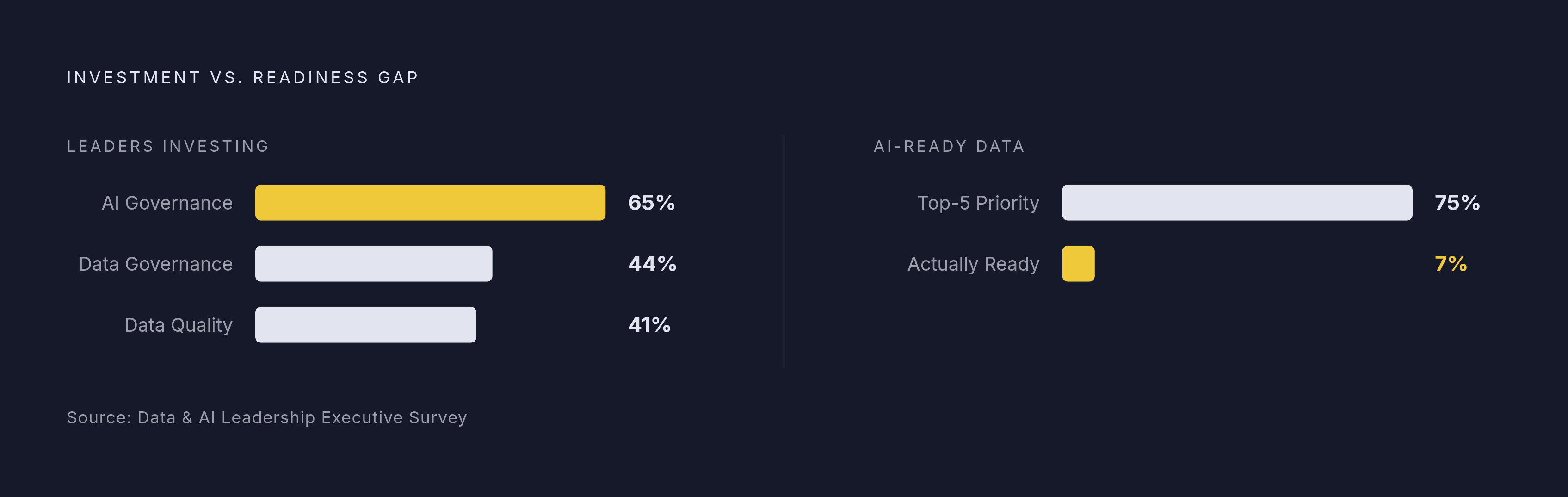
A customer record pulled from a fifteen-year-old warehouse table needs to answer to the same definitions and the same permission checks as one pulled from a SaaS tool onboarded last quarter. Most architectures don't enforce that consistency. That's exactly why Gartner's 2024 Evolution of Data Management survey found 75% of organizations naming AI-ready data a top-five investment priority for the next two to three years, while actual readiness sits at 7%. Money is pouring in ahead of architecture, and pouring money into a gap doesn't close it; it just stacks new infrastructure next to the old mess.
The piece of that architecture doing the most work, and the piece most often skipped, is the semantic layer.
What a semantic layer is and what problem it solves for AI agents
A semantic layer defines, one time, what the business actually means: its entities, its metrics, how tables join, what policies apply. Then it hands those definitions consistently to every tool that touches the data afterward. Think of it as a shared contract, machine-readable, that every consumer downstream, human or otherwise, can rely on instead of re-deriving the logic from scratch.
That's what turns a metric into something closer to a governed API. Revenue gets defined once, instead of one way in the finance dashboard and a slightly different way in the sales team's spreadsheet.
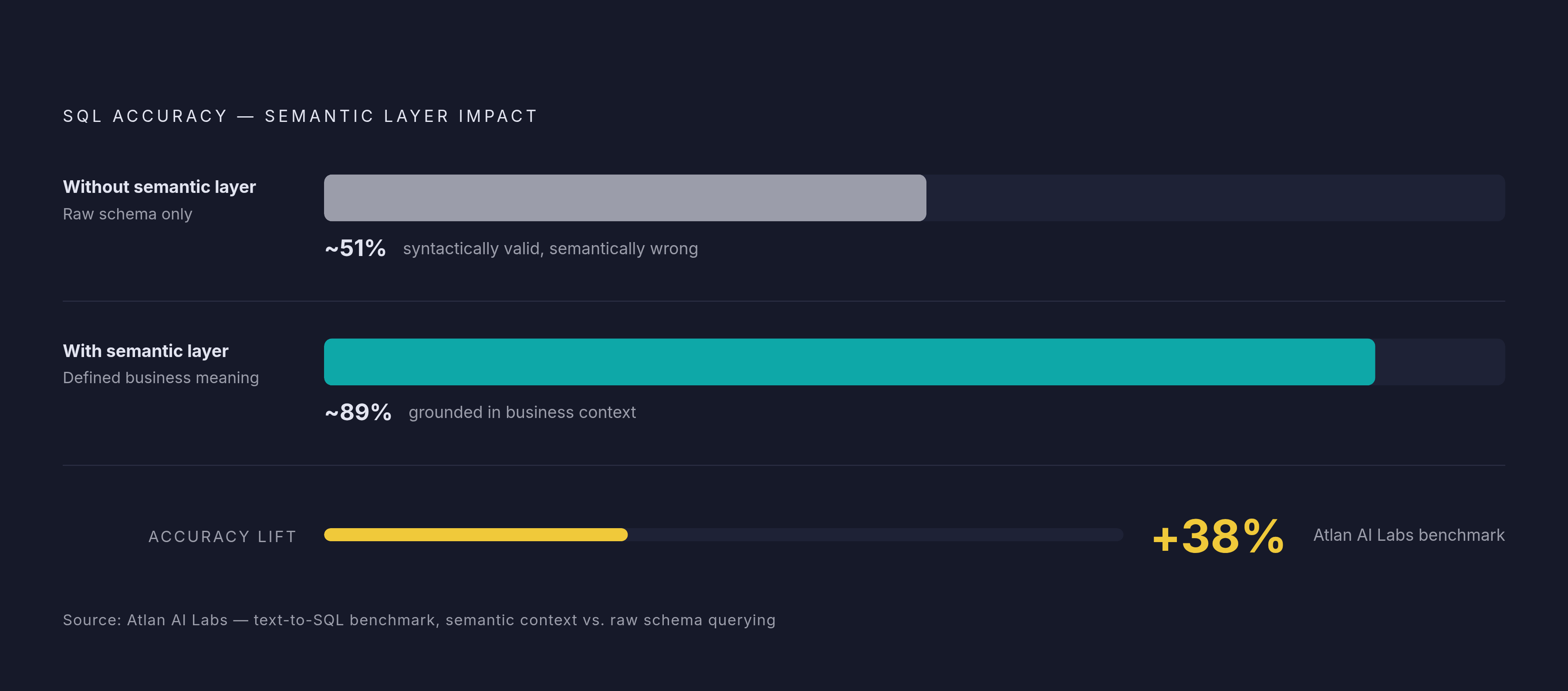
Agents need this more than any human user ever did, for a plain reason: an agent has no institutional memory. It can't look at a column named "rev" and infer, the way a longtime analyst would on instinct, that it means recognized revenue and not booked revenue. Without semantic context underneath it, the agent writes SQL that's syntactically perfect and semantically wrong, with no mechanism to flag the uncertainty to anyone. With semantic context in place, the agent queries against defined business meaning instead of raw schema, and the answer is grounded in something real.
Atlan's AI Labs benchmark found that adding semantic context improved AI text-to-SQL accuracy by 38%, a bigger lever than anything prompt engineering alone can pull. Analyst coverage broadly backs the same read: the semantic layer has moved from nice-to-have to essential infrastructure, pushed there directly by production-scale AI deployment.
Semantic layers vary widely in scope, and this is where most buyers get it wrong. A metrics-only layer keeps calculations consistent, which helps, but it doesn't touch data scattered across disconnected, heterogeneous sources. Solving that takes the fuller stack, ontologies and knowledge graphs included, that connects data across systems before a query gets written. A metrics API alone can't carry an autonomous agent operating across more than one system. Enterprises that stop at the metrics layer are solving half the problem and calling it finished.
How semantic context makes data products the unit of AI-accessible data
Instead of handing anyone, human or agent, a raw table or a bare schema, the data product model treats data as a governed, documented, self-describing package. Definitions, quality checks, a named owner, and access rules travel bundled with the data itself.
For an agent, that bundling is the entire point. It doesn't need a human standing by to explain what it's looking at, because the context arrived with the data instead of sitting in someone's head or a wiki page nobody's touched in a year.
Here's the mechanism behind democratization, and it cuts against how most companies have approached the problem: access without context scales confusion rather than understanding, faster than anyone can catch it. Semantic data products give a non-technical business user, and the agent working on that user's behalf, the same grounding a trained analyst applies by instinct. Definitions embedded, relationships embedded, lineage embedded. None of it assumed.
Define once, reuse everywhere: that's the operating principle. Write a metric definition into the semantic layer, and it propagates to every tool that queries it afterward, the BI dashboard, the AI assistant, the agent running unattended overnight. All of them see the same number, which ends the "which revenue figure is correct" argument that's undermined trust in self-serve analytics for years.
Freshness deserves its own mention, because it's the detail that gets overlooked. A snapshot that's fine for a Monday-morning dashboard might already be stale for an agent making a decision in real time. AI-accessible data products need to state their freshness guarantees outright, so an agent knows going in whether it's looking at live data or a six-hour-old cache.
Sensitivity compounds the same way. A single field might be harmless alone, a zip code, a job title, whatever, but combine three or four of them and something protected becomes reconstructable. Semantic context has to encode that risk at the level of the combination, not just check a box field by field.
Where governance must live when AI agents are the primary data consumer
AI adoption moved from experiment to full execution faster than governance could keep up, and that gap is now measurable. The 2025 Evanta leadership snapshot found 65% of data leaders investing in AI, against only 44% investing in data governance and 41% in data quality. A twenty-point gap in both directions isn't a rounding error; it's the whole problem in miniature.
Enforcing governance at the model or prompt level carries real limits, and it's worth saying plainly why. Prompt-level guardrails can't be audited reliably, they don't hold up across different models, and they aren't scoped to a real, individual user identity. Service accounts make it worse: they hand an agent broad standing permissions that can't be revoked for one workload without breaking three other things downstream. Permissions hold up best when checked at the moment of query, under the real end user's actual identity, at the data layer itself.
Gartner predicts that by 2028, half of all organizations will run a zero-trust posture for data governance, pushed there by a flood of AI-generated data nobody can verify by eye. Organizations can no longer assume data was even human-generated in the first place, let alone trust it by default.
Agentic AI raises the stakes twice over. Read queries from agents happen at a volume no human team can audit by hand, and write actions carry heavier risk still: an agent that can update a record or trigger a workflow needs governance that separates reads from writes at the point of enforcement, not buried in a policy document nobody opens in the moment. Agentic AI stalls out when it hits poor data governance or an environment never built to support it.
Logging matters here too, and volume alone doesn't solve anything. At agent-level query rates, a log recording only what was queried is close to useless. Real accountability needs identity, intent, and lineage recorded together, or the sheer number of entries buries anything worth finding. IBM's Cost of a Data Breach Report found that 63% of organizations that suffered a breach had no formal AI governance policy in place at the time. That's a security failure with a governance-shaped hole at the center of it.
The semantic layer tools organizations are actually deploying in 2025–2026
The market's direction says a lot about where enterprises now think the real problem lives. Futurum Group projects the semantic layer market's growth rate nearly doubling, from 16.0% in 2026 to 30.0% by 2031, as companies shift from experimental chatbots to agents that actually act on their behalf.
A handful of platforms have staked out distinct positions worth knowing. AtScale is built around a universal semantic layer spanning multi-cloud, multi-engine environments. The dbt Semantic Layer fits data engineering teams already living inside dbt for transformation, since metrics get defined in the same codebase they already use. Snowflake's Semantic Views are designed to reduce friction for shops already standardized on Snowflake. Looker, through LookML, has shown according to Google/Looker that structured semantic modeling cuts data errors in generative AI natural language queries by roughly two-thirds. Omni is a newer entrant in the semantic layer space.
Skip the feature lists. The real evaluation comes down to four structural questions, and the first one carries more weight than the other three combined:
- Does the layer sit on top of what's already running, or does it demand a migration first?
- Is governance, permissions, masking, row-level security, enforced at query time under a real user's identity, or does it fall back on a broad service account?
- Are the APIs actually built for agents to consume, or just for BI tools the way they've always worked?
- Does the layer carry lineage and an audit trail, or does it stop at metric definitions and call itself finished?
The semantic layer that works tends to be the one built on top of what already exists, filling the gap above the warehouse or below the pipeline, rather than asking a company to rebuild from zero. Vendors would rather sell the rebuild, but rip-and-replace projects are exactly the kind of initiative showing up in that 42% abandonment figure from the S&P Global survey. Anyone pitching a full migration as step one is pitching the wrong project.
For organizations that need this without tearing out their existing stack, the category worth evaluating is an AI-ready data platform that federates access across warehouses, SaaS tools, and operational systems under one semantic and governance layer, Peaka, a federated data platform with 300-plus connectors, is one example of that approach, especially where a single tool-level semantic layer only closes part of the gap.
What organizations need to do to make data democratization real through AI
Democratization was always more about trust at scale than about access alone, without a human standing between every question and every answer, and that only happens when semantic context, definitions, relationships, governance, gets built into the data itself instead of left for an agent to guess at.
Start where the failure data points. Data quality and readiness account for the largest share of AI initiative failures, so audit against Gartner's AI-ready criteria before buying another tool: is data aligned to specific use cases, governed at the asset level, moving through pipelines with real quality gates, checked continuously instead of occasionally? Most organizations will fail that audit today, and finding out now beats finding out after another abandoned pilot.
Treat the semantic layer as required infrastructure rather than a phase-two nice-to-have. Choose the fuller stack, ontologies and knowledge graphs, over a metrics API alone, if agents are going to operate across more than one data source without a human watching. A metrics API by itself is not enough, no matter how clean the dashboards look.
Move governance down to the data layer itself, enforced at the moment of query, under real user identity, rather than parked at the prompt level where nobody can audit it. Separate reads from writes explicitly: an agent updating a record carries a different order of risk than an agent looking one up, and the governance model should say so.
Build data products as the actual unit of exchange: data bundled with its definitions, freshness guarantees, sensitivity rules, and ownership, so context travels with the data instead of living in one person's head.
None of this is optional if the goal is real. Open access without meaning simply lets confusion move faster, with more confidence, at a bigger scale than it ever could before.