Data Marketplace Design for Internal AI Consumers
Internal AI agents need data marketplaces built for machine consumption, not human intuition.

Enterprise AI adoption has crossed a threshold: agents, copilots, and automated pipelines are now routine consumers of internal data, a shift most planning documents haven't caught up with. This shift breaks a lot of internal data marketplaces, because most were built for human analysts, and machines query first and ask questions never.
A human analyst who hits a weird field name, something like "rev_adj_net," can walk over to a colleague's desk and ask what it means. She can look at a number that seems off and trust her gut enough to double-check it before putting it in a deck. That's institutional memory, and it's built up over years of tribal knowledge, half-documented Slack threads, and hallway conversations. AI agents have none of that. They query whatever schema is in front of them, interpret it literally, and hand back a confident answer whether or not the underlying data actually supports it.
The mismatch isn't cosmetic. It runs straight through four things human analysts have always handled informally: discovery, context, access control, and freshness. Agents can't handle any of those informally, because they don't have judgment to fall back on. The rest of this piece treats each of those four points as a design requirement for the marketplace itself, addressed from the start rather than patched on after deployment. If your marketplace was built for analysts, it was built for a specific kind of consumer, and now you've got two.
How the gap between AI ambition and data readiness actually shows up in practice
The most common failure pattern looks like this: a proof-of-concept runs beautifully on cleaned sample data, sails through internal review, and then falls apart the moment it touches real enterprise data sitting in the actual marketplace.
Cloudera's April 2026 research repays repeated attention, because it captures something that takes time to sit with, what might be called the AI readiness illusion. Organizations report having a clear data strategy. They say they've integrated AI into core processes. Yet a large share of those same organizations admit, in the same breath, that their AI and data initiatives are still held back by limited data access across environments. Both things are true at once, which tells you the strategy documents got ahead of the plumbing.
On the ground, that illusion takes a few specific shapes. Agents query raw schemas and produce SQL that's syntactically perfect and semantically wrong: the joins are correct, but the metric definition behind them isn't what the business actually means by "revenue." Pipelines return stale data without any flag attached, so an agent makes a decision against a version of reality that stopped existing hours ago. Service accounts with broad permissions stand in for actual user identity, which makes access look governed on paper without ever being scoped to who, or what, actually asked for it. Plenty of data that looks clean enough for a dashboard also carries zero context an agent can use: no field descriptions, no lineage, no definition of what the number in the column is actually measuring.
McKinsey's 2025 research on this found something worth sitting with: organizations that saw real returns from AI were far more likely to have redesigned their data workflows before they picked a model. Infrastructure came first. The model came second. Gartner's warning runs parallel to that: a substantial share of AI projects sitting on data that isn't AI-ready get abandoned, and it's rarely because the model underperformed. The data layer was never built to support the thing being asked of it.
Worth naming directly, after working through these numbers: these are data marketplace design failures, not model failures or prompt engineering failures. The fix runs through the marketplace's architecture, not a better prompt or a fine-tuned model.
What separates a data catalog from a data marketplace, and why that distinction matters for agents
A catalog is a management tool. It inventories what exists. A marketplace is a storefront: it governs what gets published, who's allowed to publish it, under what terms, and with what guarantees attached.
That distinction gets lost constantly, and the confusion has a cost. Teams tag datasets in a catalog and assume that act alone makes the data AI-consumable, which is the gap a federated data platform like Peaka was built to close. Immuta's 2025 framing puts it well: a marketplace functions as a formal handoff. Data engineering publishes a data product complete with ownership, documentation, validation, and service-level guarantees. Anyone consuming it, agent or human, knows they're pulling something that already went through a release process, the same way you'd trust a shipped product differently than a prototype still on someone's laptop.
This is data-as-product thinking, and it traces back to data mesh principles. A data product is a specific, designed artifact, whether that's a dataset, an API, or a model output, and it gets managed with actual product discipline. That means a named owner accountable for its accuracy. A documented lifecycle showing when it was last updated, what changed, and when it expires. Consumer-facing SLAs an agent can read and act on programmatically, not just a human skimming a wiki page.
Here's the part that matters most for agents specifically, and it's easy to miss on a first pass: a catalog tells an agent a dataset exists. A marketplace tells the agent whether that dataset is trustworthy, current, and permissioned for the exact query it's about to run. Those are entirely different claims, and only one of them is useful at inference time.
Internal marketplaces also have a different goal than external ones, and that shapes every design choice downstream. There's no monetization angle inside a company. The whole point is making data accessible and reusable across teams that would otherwise rebuild the same pipeline five times. Gartner frames the value of data marketplaces across four areas: accelerating access, democratizing data, enabling AI and analytics, and delivering measurable business impact. Every one of those assumes active consumption, not a passive archive.
Why embedding semantic context into the marketplace is not optional for AI consumers

Enterprise data is loaded with implicit knowledge. Abbreviations nobody wrote down. Columns that got redefined three reorgs ago. Metrics that mean one thing in finance and a slightly different thing in sales ops. Human analysts absorb this over time, almost by osmosis. Agents don't get that runway.
Without a semantic layer, an LLM querying the raw marketplace schema produces answers that are internally consistent with that schema and wrong for the actual business question being asked. The query executes fine. The answer sounds confident. The error stays invisible right up until it causes a real decision failure somewhere downstream.
The accuracy gap here isn't subtle, and it proves surprising once traced through. Internal vendor testing from Promethium in 2026 found LLM query accuracy sitting in the low forties percent range without a semantic layer in place, and climbing to the low-to-mid eighties once governed semantic definitions were added. That's close to doubling reliability, just by giving the model a shared vocabulary to work from instead of raw column names.
A working semantic layer hands an agent several things at once: table and column descriptions that turn a bare field name into an actual business concept, metric definitions that spell out what "revenue" includes and excludes in this specific context, entity relationships that flag which joins are legitimate and which ones quietly produce garbage, and governance policies baked into the definition itself rather than bolted onto the query layer afterward.
GigaOm's 2025 Radar for Semantic Layers and Metric Stores classified the category as mature for the first time. That's a meaningful signal: semantic layers stopped being a nice-to-have and became infrastructure. Open standards are pushing this along too. dbt Labs' MetricFlow and Snowflake's open semantic interchange both point toward the same idea, define a metric once, reuse it everywhere, across BI tools, agents, and pipelines, instead of redefining "active user" seven different ways across seven different teams.
Model Context Protocol is the bridge that makes this practical. MCP lets an agent discover and query semantic models without custom integration work for every new connection. The agent gets governed business logic handed to it directly instead of raw schema. For enterprises running multiple models at once, Claude here, GPT there, an internal model somewhere else, a single MCP server can give every one of them the same semantic foundation to work from.
The design implication is simple to state and easy to skip: semantic context belongs inside the data product itself, published in the marketplace alongside the data, maintained there rather than left in a wiki nobody updates or inferred from a column name someone typed in 2019.
How query-time governance differs from the access controls most marketplaces already have
Most internal marketplaces handle access through service accounts. A broad credential gets granted once, at provisioning time, and every query that runs under it afterward inherits that same permission, regardless of who or what actually triggered the request.
That model worked fine for human analysts, because humans operate inside organizational hierarchies everyone already understands. A person's role implied their access scope. If something went wrong, you could audit it by checking who logged in and when.
Agents break this model in two distinct ways, and it took working through both to see they're not the same problem. First, an agent running under a shared service account inherits far more permission than any single query it runs actually needs, so the blast radius of a misconfigured or compromised agent gets enormous fast. Second, an audit log that just says "service-account-data-pipeline accessed customer table" is close to meaningless at the volume agents operate at. It captures the credential. It says nothing about the identity behind the request, the intent driving it, or the lineage of what got touched.
Query-time governance evaluates permissions the moment a query runs, scoped to the actual end user or workload initiating it, rather than assumed from a credential someone granted three months ago and forgot about. Sensitivity has to be evaluated at the combination level too. A field that's harmless on its own can turn sensitive the instant it gets joined with another one, so governance needs to look at what the query produces, not just which tables it touches on the way there.
Write actions need tighter controls than reads, full stop. An agent that can update a record or kick off a downstream pipeline carries a completely different risk profile than one that can only look. Revocability matters in a way it didn't before: access needs to be revocable at the level of a single workload or agent instance, not tied to a shared account where pulling access breaks every other consumer riding on that same credential.
For agent audit logs to actually be useful, three things need to show up together: who or what initiated the query, what business intent the query represented, and the full lineage of what data got touched. Any one of those three on its own isn't enough to reconstruct what happened. The practical requirement here is blunt: enforce permissions at query time and log identity and lineage together, or the governance stays theatrical, looking controlled from the outside without actually being controlled.
Freshness as a first-class design requirement, not a metadata footnote
Human analysts apply judgment about staleness automatically. Everyone knows the monthly revenue report is, well, a month old, and adjusts how much weight to put on it accordingly. Agents don't make that adjustment on their own, because nothing tells them to.
The canonical failure case, and the one that makes this click: an inventory routing agent queries last night's batch data and routes shipments based on stock levels that no longer exist by the time the truck leaves. The query succeeded. The data was technically there. The decision was wrong anyway.
Freshness tolerance swings wildly depending on the use case. A dashboard tracking quarterly trends can live with a day-old snapshot just fine. An agent making a real-time credit decision cannot. And an agent orchestrating a multi-step workflow needs to know, at each step, whether the data product it's about to touch has changed since the workflow started running.
Most marketplaces today surface freshness as a metadata tag, something like "last updated: 14 hours ago," sitting there for a human to notice and interpret, a label rather than a queryable signal an agent can act on. What agents actually need is freshness baked into the data product's contract: a declared freshness SLA, a staleness threshold specific to the use case at hand, and a way to check whether the product currently meets that threshold before consuming it at all.
This ties back to the bigger architectural point. Data access for agentic workloads needs to run through a live query layer reflecting current state, rather than static pipelines built on the assumption that sources and schemas hold still. Freshness deserves treatment as a data product design problem, with a place in the SLA the producer publishes right alongside the dataset itself, rather than as documentation solved with a better tooltip.
What an AI-native internal data marketplace actually looks like in practice
The organizing idea here: the marketplace functions as a governed publication layer that exposes data products designed for consumption by humans and agents alike, sitting on top of existing data infrastructure rather than replacing it.
No rip-and-replace required. The marketplace layer sits on top of whatever warehouses, lakes, and SaaS sources already exist, adding the context and governance those systems were never built to provide in the first place, without forcing a migration project nobody has budget for.
A well-designed data product inside that marketplace carries a few things at minimum. Semantic definitions: field descriptions, metric logic, valid joins, written in a form a machine can parse, not just a human reading documentation. A freshness contract: declared update frequency, a maximum tolerable staleness threshold by use case, and a way for an agent to check current status before it queries. Governance metadata: ownership, applicable policies, and sensitivity classification that accounts for combinations of fields, not just individual ones in isolation. And lineage: where the data came from, what transformations it passed through, so both an agent and a human auditor can trace any result back to its source.
MCP is emerging as the access protocol tying this together. Recent architecture work, including the "Data Product MCP: Chat with your Enterprise Data" paper from May 2026, describes agents discovering, requesting, and querying data products through an MCP-compatible interface that enforces data contracts in real time, without lowering the governance bar to get there.
A few platforms already point in this direction, and it's worth naming them plainly rather than dressing them up. Ataccama's MCP Trust Layer, launched in mid-2026, connects quality signals and metadata from enterprise source systems, SAP, Oracle, mainframe environments, into the Databricks Marketplace, so agents operate against data that's already been quality-verified rather than taken on faith. Precisely's Data Product Marketplace, built in partnership with Huwise, lets teams publish and share trusted data products so high-integrity data gets reused across analytics and AI workloads instead of getting rebuilt from scratch for every new project. Huwise itself, formerly known as Opendatasoft, adds a business-facing layer over existing lakes and warehouses, pairing semantic standardization with usage context to make trusted data easier to find and distribute. Each of these, in its own way, is solving the same underlying architecture problem: supplying the governance and meaning layer the original systems were never built with.
The self-service piece matters as much as any of the technical layers. A well-designed internal marketplace lets an agent, or an analyst, find a data product, understand exactly what it contains and what it guarantees, and consume it without routing a request through data engineering and waiting a week for a response. The engineering effort happened once, at publication time, not every time someone new needs the data.
Gartner projects that organizations using AI marketplaces well see meaningfully lower costs running their data science and AI programs compared to organizations that don't. The efficiency case rests entirely on reuse: publish a data product once, consume it many times, and stop rebuilding the same dataset from scratch for every new use case that comes along.
Where most organizations are in this transition and what to prioritize first
Gartner's 2024 Evolution of Data Management Survey found a meaningful but still minority share of organizations have actually implemented a data marketplace, with a larger share planning to prioritize one in the next few years. Translation: most organizations are earlier in this transition than their AI ambitions would suggest.
The common mistake, one that has been observed to play out the same way more than once, is starting with governance tooling or catalog software before anyone's actually agreed on what a data product means inside the organization. Governance applied to undefined products just produces defined confusion, dressed up to look like progress.
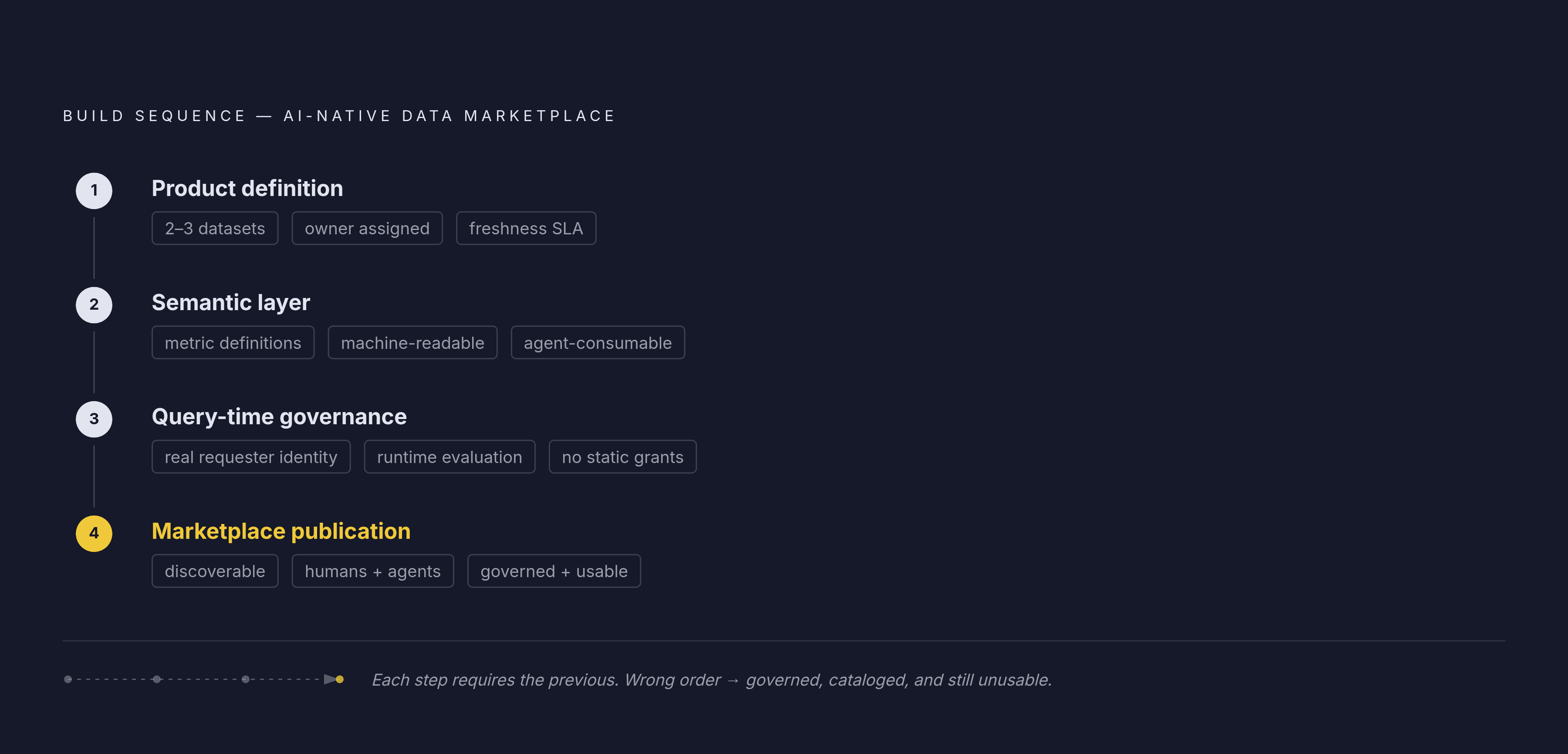
A better sequence starts with product definition itself. Pick two or three high-value datasets and package them properly first: assign an owner, write the description, set a freshness SLA, define the semantics. Do that before building any marketplace infrastructure around them. Add the semantic layer next, built as machine-readable definitions an agent can actually consume rather than a wiki page only a human will ever read; this is where query accuracy lives or dies. Only after that should governance move to query time, away from static service-account permissions and toward permissions evaluated against the real requester at the moment the query runs.
Get the sequence backwards, and the marketplace ends up governed, cataloged, and still unusable for the one consumer it was supposed to be built for.