Stream Processing vs Batch Processing for AI Agent Inputs
Staleness cost determines whether agents need streaming or batch processing.

The choice between batch and stream processing for AI agent inputs comes down to one question: how fast does stale data start hurting the quality of the agent's next move? That's the whole decision. The common story, that streaming is the modern choice and batch is the legacy one, has it backward and skips right past the variable that actually matters.
Staleness cost is the variable. Every workflow that acts on old data pays a price somewhere, whether that's lost revenue, an unsafe automation, duplicate work, a bad routing call, or an expensive rollback after the fact. Data teams have managed that tradeoff for decades. What's changed is who's making decisions on top of the data, and how fast those decisions turn into actions nobody can take back.
Agents don't just answer questions. They resolve support tickets, route shipments, execute trades, update records on live systems. A wrong answer on a dashboard is annoying but recoverable, someone catches it, someone fixes it. A wrong action taken by an agent might not be recoverable at all. Freshness is a property of how well the data reflects the current state, not a property of which tech stack a team happens to like. It belongs to the use case. So the question every team building agent infrastructure has to answer, workflow by workflow, is simple to ask and hard to answer honestly: how fresh does the state this agent reads actually need to be?
What batch and stream processing actually do differently, and why that gap matters for agents
Batch processing collects data over a stretch of time, then processes it in chunks, either on a schedule or once some threshold is hit. Think daily sales reports, invoice runs, nightly ETL jobs, the retraining cycle for a machine learning model. The usual tools are Apache Spark, Hadoop, AWS Glue, and Snowflake. Batch handles large, static volumes of data well, and it's easier to tune for pure throughput. For historical analytics and periodic retraining, it's still the right call, and nothing about agents changes that. The limit shows up in latency: batch jobs run on cycles measured in hours or days, so the state an agent reads could be arbitrarily stale by the time a decision actually needs to get made.
Stream processing works differently. It processes events as they arrive, usually within milliseconds. Fraud detection, IoT sensor monitoring, and live recommendation engines all lean on this model, built with tools like Apache Kafka, Apache Flink, AWS Kinesis, or Google Dataflow. The payoff is low latency and continuous, event-driven inference. The cost is real too: more infrastructure to run, harder scaling, and in some setups, a bigger bill at the end of the month.
Data freshness is the metric that actually separates the two, not some vague sense of which one feels newer. It's the time between a real-world event happening and that data being ready for inference. Batch measures that gap in minutes, hours, sometimes days. Streaming measures it in milliseconds or seconds. That gap shapes how an agent perceives its environment and how it coordinates with the other systems around it.
How batch ETL became a structural liability once agents started taking actions
Back when the main output of a data pipeline was a dashboard, a stale number was a mild annoyance. Someone would notice the report looked off, shrug, and wait for the next refresh. Once agents started acting on that same data, the stakes changed entirely. Stale context doesn't just produce a wrong number anymore. It produces a wrong action, with consequences that play out in the real world, not on a screen someone can quietly correct.
Three failure patterns show up again and again once batch pipelines feed agent decisions. Context drift in retrieval-augmented generation, where an agent pulls outdated documents and answers confidently from a knowledge state that's no longer true. Distribution mismatch, where the data a model was trained on no longer reflects what it encounters in production. And flat-out wrong actions in agent workflows, where an agent takes a consequential action based on state that's an hour, or more, out of date.
Agentic systems that need to act on up-to-the-moment information can't sit around waiting for the next batch run to finish. That said, batch isn't the villain here. Agents can consume batch outputs just fine, for the right kind of task. The liability shows up specifically when batch becomes the sole or primary input for decisions that need current state and can't get it.
And "agentic" doesn't automatically mean "real time." An LLM classification step buried inside a workflow can run asynchronously without any harm. A deterministic inventory update sitting right next to it might genuinely need a real-time push. Something other than batch processing itself is the real problem. It's inheriting batch-era pipelines to power decisions whose freshness needs batch was never built to meet.
Matching agent use cases to their actual freshness requirements
Ask this for every workflow: can fresher state actually change what the agent does next, before the allowed delay window closes? If the answer is no, streaming buys nothing but extra cost and extra complexity. Teams that reach for streaming by default, because it sounds more current, end up paying for infrastructure that never changes an outcome. That's the mistake worth naming plainly: streaming-by-default is a budget problem dressed up as an engineering decision.
Some use cases genuinely demand streaming. Fraud detection has to act inside the transaction window, where acting on stale data can mean the difference between catching and missing a fraudulent event. Patient monitoring systems process vital signs continuously and need to surface anomalies quickly, where delays carry direct safety consequences. IoT anomaly detection on edge devices needs very low-latency reaction time. Live customer experience work, personalization, support routing, real-time dispatch, depends on a person or system acting inside the service window. High-frequency financial operations depend on continuous state, where acting on outdated data can produce costly errors.
Other cases are correctly served by batch, and no amount of streaming infrastructure improves them. Retraining ML models on large historical datasets. Compliance exports and audit reports. Invoice generation and financial reconciliation. Classifying last week's support conversations, where a few hours of delay changes nothing about the output's value. Large aggregations where getting the full, repeatable picture matters more than getting it fast.
A few signals point toward streaming: a live participant who can act inside the delay window, a measurable cost, financial or safety, tied to delay, or a genuine need for live coordination between people or systems. Signals pointing the other way, toward batch: value coming from completeness and repeatability, work centered on reconciliation, verification, or retraining, or real limits on inference cost and compute capacity.
"It feels more modern" is not a service-level objective, and treating it like one is where budgets go to die. If nobody on the team can name an acceptable delay, or name who actually gets hurt by stale data, skip the streaming rebuild entirely. This has to get decided at the level of individual steps, not whole pipelines. A single agentic workflow often has one step that needs millisecond freshness sitting right next to another step that's perfectly happy running on last night's batch.
Why most production agent systems end up hybrid, and what that looks like in practice
In practice, teams rarely land on pure batch or pure streaming. They end up combining both, for good reason. A common split: streaming handles inference, scoring incoming transactions for fraud or generating live recommendations, while batch handles training, running periodic retraining jobs over large historical datasets to keep accuracy up over time.
Two formal patterns have come out of this split. Lambda architecture keeps real-time and batch layers separate, then merges results at query time, which preserves batch's reliability while adding a low-latency path on top. Kappa architecture goes simpler: one streaming backbone handles both the real-time path and any reprocessing, which cuts operational overhead but demands a genuinely solid event log underneath it.
A useful rule of thumb: persist the canonical events somewhere durable, stream compact notifications or state deltas for anything time-sensitive, and push the heavy lifting (reconciliation, verification, training) into batch. And even when events are streaming continuously, that doesn't mean every single one should trigger a model call. Filtering, debouncing, caching, and coalescing events before invoking an LLM saves real money and cuts down on noise. Not every event actually warrants inference.
Business state itself needs to stay durable regardless of which path an event takes. A notification can tell you something changed. A database or event log needs to prove it happened and support recovery if something breaks downstream.
The tooling caught up in 2025. Platforms like Apache Flink, Delta Lake, and Confluent Cloud now run batch-style queries directly over streaming data, letting teams blend both paradigms inside one architecture instead of stitching together two separate systems. Apache Iceberg, meanwhile, is becoming the standard table format for lakehouses across cloud platforms, which matters directly for how events get persisted across these hybrid paths. The broader trajectory has moved from batch jobs, to real-time stream processors, to lightweight streaming compute like Pulsar Functions and Kafka Streams, and now toward agentic compute, where the logic sitting on top of the stream doesn't just process events. It perceives them, reasons about them, and acts.
What streaming infrastructure alone cannot solve: the data meaning problem
None of this fixes the deeper issue. A stream that delivers current data in milliseconds still fails an agent completely if the agent has no idea what the fields mean, how a given metric gets calculated, or which joins are actually valid between two tables.
Most accuracy failures in AI systems aren't model problems at all. They're context problems, and context isn't something a stream protocol carries on its own. An agent has no institutional memory to draw on. It can't turn to a coworker and ask what some vaguely named column actually represents, and a confidently wrong answer looks exactly like a correct one from the outside.
That's because most existing data architecture wasn't built with agents in mind. It was built for dashboards and quarterly reports, read by human analysts who already carry the business knowledge needed to fill in the gaps. An agent doesn't have that knowledge sitting in the back of its head. Data that's actually ready for AI needs to carry its own context along with it: table descriptions, metric definitions, and relationship semantics, spelled out explicitly instead of assumed.
An October 2025 Harvard Business Review study sponsored by Cloudera found that 65% of data decision-makers expect agentic AI to take over or reshape a large share of business processes within two years. At the same time, 73% said their organization has struggled to prepare data for AI in the first place. That gap says something important: the struggle is mainly about something other than latency. It's about meaning. Picking the right processing model gets a team partway there, but the data coming out the other end still has to make sense to a system with no shared context to lean on.
How a semantic layer gives agents the context that raw pipelines cannot carry
A semantic layer defines metrics, dimensions, joins, and access rules one time, in one place. Instead of an agent writing its own SQL against raw tables and guessing at what a column means, it picks from a governed set of definitions that are already correct. It's the translation layer between raw schema and the business language people actually use day to day.
Industry analysts have increasingly positioned the semantic layer as essential infrastructure for enterprise AI broadly, not just for reporting.
There's a real gap, though, between a semantic layer built for BI and one built for agents, and treating them as the same thing is the mistake most teams make. A BI semantic layer solves query consistency: making sure two analysts asking about "revenue" get the same number back. That's the job it was built for, and it does that job well. An agent-ready semantic layer has to do more. It needs to carry persistent business context, domain-specific knowledge, rules for how to investigate a question, and orchestration logic the agent can use on its own, with no person in the loop. Agents don't just query data. They investigate, remember what they found, plan next steps, and act on conclusions. Governing a single SQL query and governing an autonomous agent making a string of decisions are two different engineering problems, not the same problem at different scales.
The vendor landscape has moved fast in response. dbt open-sourced MetricFlow. Snowflake formalized Semantic Views. Databricks shipped Metric Views. Salesforce launched Tableau Semantics. And in September 2025, the Open Semantic Interchange initiative launched, backed by Snowflake, Salesforce, dbt Labs, and others, aimed at letting semantic definitions move across BI tools, warehouses, and AI agents without getting rewritten each time.
Emerging protocols like the Model Context Protocol give agents a structured way to discover and query governed metrics by name, instead of hand-writing SQL against a schema they don't fully understand. That matters even more in agent-to-agent workflows, where multiple agents chain together to finish a task. Without shared grounding, a sub-agent can return results calculated with different metric logic than what the orchestrator agent expected, and nobody notices until the numbers stop adding up. Google's A2A protocol, released in April 2025, defines how agents in a chain communicate task requirements to each other.
A concrete example of what this looks like in production: Snowflake Ventures invested in Honeydew in May 2025, and Pizza Hut has been cited as a reference customer, reporting reports delivered four hours earlier, insight development 50% faster, and a 30% cut in cost and engineering effort. And governance has to run at query-compile time, before the SQL ever gets generated, so an agent is structurally unable to query data the requesting user isn't cleared to see.
Why freshness requirements and governance requirements must be solved at the same layer
A 2026 CDO survey found 76% of data leaders admit governance hasn't kept pace with how fast AI has moved, while 61% said higher-quality data makes it noticeably easier to move AI pilots into actual production. Those two numbers sit in tension, and that tension is exactly where things break.
AvePoint's State of AI 2026 report, based on a survey of 750 global IT leaders across financial services, healthcare, and government, found that 89.5% of organizations had at least one GenAI-related security breach in the past year, and 88.4% had at least one breach tied specifically to an AI agent. That breach surface widens fast once agents are querying live data at volume with no per-query access control locking things down.
Permissions need checking at query time, scoped to the actual person behind the request, not to a shared service account with broad access. Passthrough authentication is what makes role-based access control actually hold for agents: the query runs under the end user's real identity, so existing permission structures apply automatically, with nothing extra bolted on. Least privilege applies structurally too. Workspace isolation limits the blast radius of anything that goes wrong, so a finance agent only ever sees finance systems, and a sales agent only ever touches the CRM.
Write actions need tighter governance than reads, full stop. That distinction used to matter less. It matters enormously now that an agent can execute a transaction, not just look one up. And audit logs need to capture identity, intent, and lineage together as a single record. At the query volume agents generate, a log that only shows what got queried, without showing who asked and why, is dead weight the moment there's an incident to chase down.
Freshness and governance aren't separate problems solved one after another. A streaming pipeline that delivers perfectly current data through a shared service account with sweeping permissions has solved exactly one problem while quietly creating another. Both need solving together, not in sequence. Any team that ships the fast pipeline first and plans to bolt on governance later has already built the breach, whether or not it shows up on this quarter's incident report.
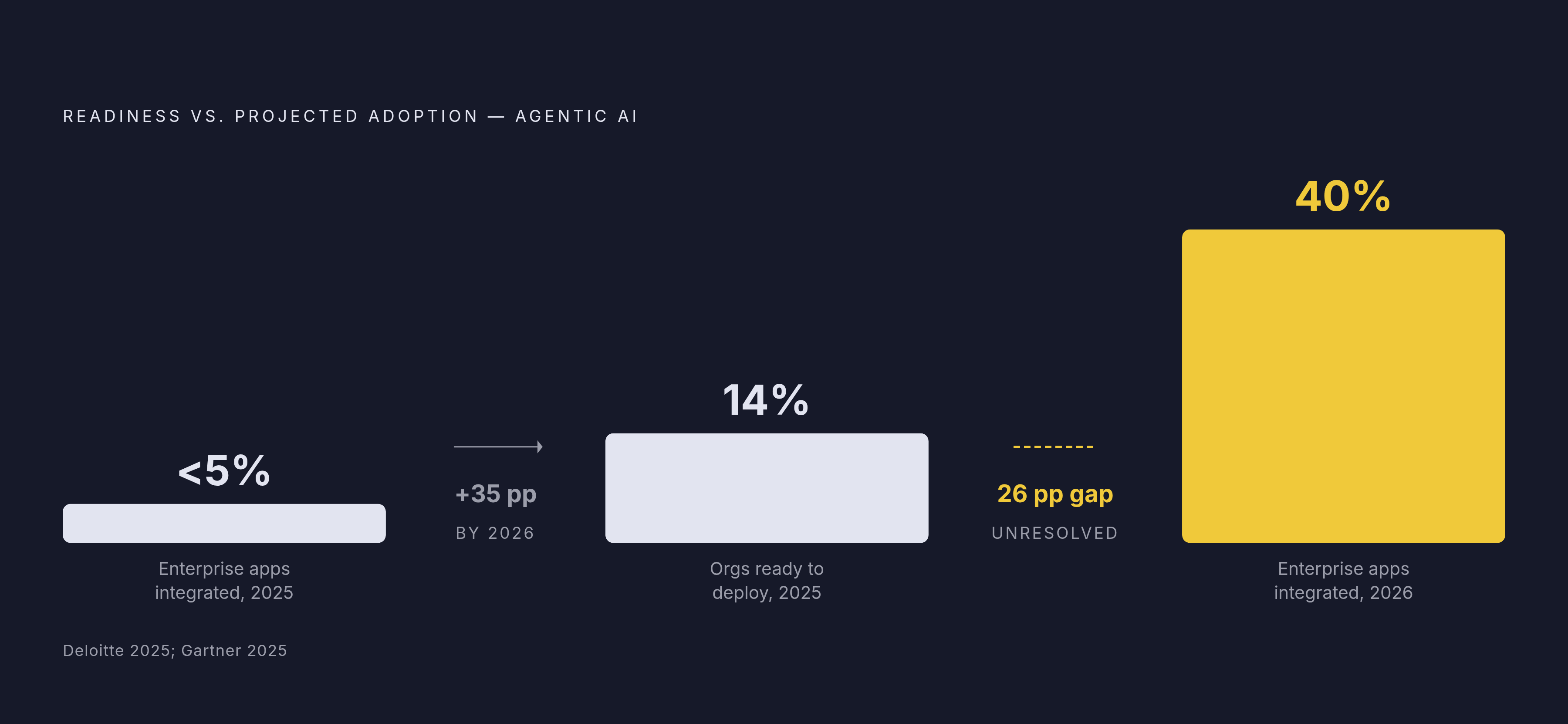
Deloitte's 2025 Emerging Technology Trends study found only 14% of organizations currently have systems actually ready for agentic AI deployment, citing data architecture as the main bottleneck holding the rest back. Meanwhile, Gartner projects 40% of enterprise applications will be integrated with task-specific AI agents by the end of 2026, up from under 5% in 2025. The distance between those two numbers, readiness sitting near 14%, adoption racing toward 40%, is exactly where the unresolved problems in freshness and governance are going to surface. An AI-ready data layer, one that sits across the infrastructure teams already have instead of ripping it out and starting over, is what closes that gap.
Sources
- Streaming vs Batch Processing in AI Pipelines: An Architect’s Perspective | by Nitin Kaushal | Medium
- From Data Streaming to Agentic AI: The Evolution of Processing
- pubnub.com
- Confluent Blog | Tutorials, Tips, and News Updates
- avepoint.com
- Why Batch Pipelines Break AI Agents: The Case For Streaming-First Network Operations – IEEE ComSoc Technology Blog
- risingwave.com
- airbyte.com