Clean Data vs AI-Ready Data
AI agents can't ask colleagues what the data means, so the metadata has to live in the data itself.

Clean data and AI-ready data get treated like the same idea wearing different marketing. They're not. Clean data was built to satisfy a person, an analyst who can ask a colleague what rev_final_v2 means, or remember which table finance trusts when the quarter closes. AI-ready data has to carry that same knowledge inside the data itself, because an AI agent has nobody to ask. That difference is the whole story, and most teams building AI right now haven't reckoned with it.
The definition of "clean" data built for a human in the loop
Any data team's onboarding doc runs through the same checklist: accurate, complete, consistent, deduplicated, properly typed. Every one of those properties shares a trait. A person can verify it just by looking at the output. That's the whole design, and it's also the whole limitation.
Traditional data quality standards assume a human sits between the data and the decision. An analyst pulls rev_final_v2 and knows, without a comment in the schema anywhere, that it's the authoritative revenue table. Someone mentioned it once, in a hallway conversation three years ago, not because the column name says so. That knowledge lives in the person. It never made it into the data itself.
Outliers tell the same story. Most analytics pipelines strip them out on purpose, because outliers tend to obscure the trends a human reader is looking for. That's the right call for a quarterly business review. It's the wrong call for a fraud-detection model, where the outlier may be exactly what the model needs to act on. Clean has always meant legible to a person. It was never a neutral, absolute standard. It was built around one specific reader, and that reader is disappearing from the process.
The shift from analyst-in-the-middle to AI agents
Taking that reader out of the loop causes the whole system to stop working the way it used to.
An AI agent can't ask what gm_amt_net stands for. It can't remember that the CRM's version of "Revenue" includes refunds while Finance's version doesn't. It has no way to tell which revenue column is the one the CFO actually relies on at quarter-close. For years, "AI-ready" quietly meant clean, governed, well-documented data handed to a model, with a human still standing between the model's output and any real decision. Agents removed that person, so nobody's left to catch the mistake before it ships.
The agent takes whatever the retrieval layer serves up, and a wrong answer looks exactly as confident as a right one. The model treats an arbitrarily picked table the same as a certain one, and just answers. It just answers.
Without the human checkpoint, a handful of failure modes appear on repeat.
Take metric hallucination first: the model invents a formula on the fly, and the number it spits out looks plausible but matches no definition the organization ever approved. Join confusion works differently. The model picks the wrong relationship between two tables and computes an answer from data that was never meant to be combined that way. Term ambiguity is its own trap: ask about "comp sales" and you've opened a can of worms. Does that include stores open less than 13 months? Remodeled locations? E-commerce? The model silently picks one interpretation and never tells you it made a choice. And governance bypass might be the ugliest of the four: the model reaches data through a path a human in the same role would never have been authorized to use.
None of these are hallucinations in the sense people usually mean. The model is making reasonable-looking decisions with incomplete context, the same way a new hire would if nobody bothered to explain the org's data before handing over the keys.
How widespread the resulting AI project failures are
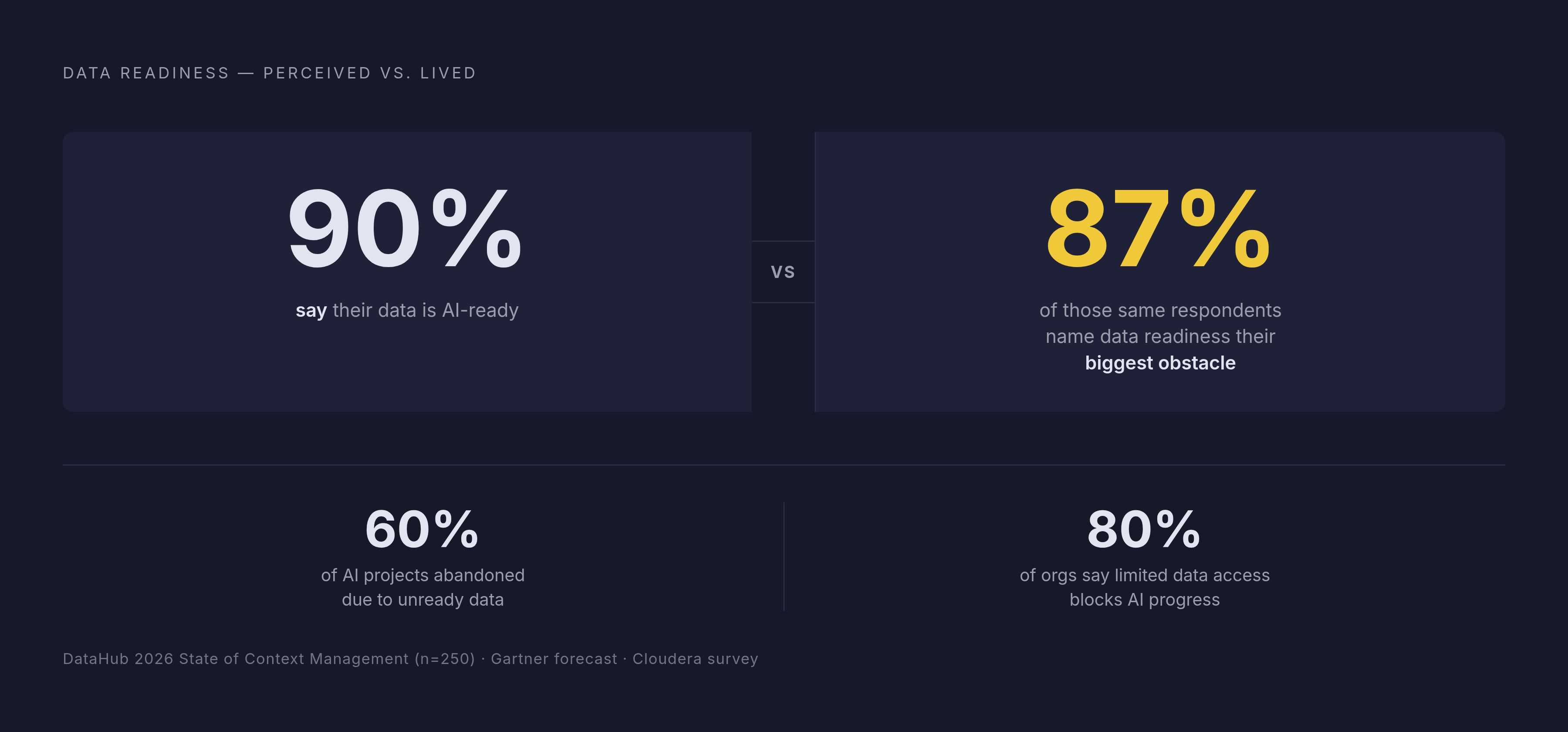
The numbers here are stark enough to sit with for a second.
DataHub's 2026 State of Context Management Report surveyed 250 IT and data leaders and found a genuine contradiction inside the same dataset. 90% said their data is AI-ready. 87% of that same group named data readiness as the biggest obstacle to getting AI into production. Same survey, same respondents, opposite conclusions depending on which question you asked them.
Gartner's numbers point the same direction. 63% of organizations either lack the right data management practices for AI or aren't sure they have them, and Gartner's own forecast states it directly: 60% of AI projects will get abandoned because they weren't backed by AI-ready data.
Cloudera's research adds texture. 96% of organizations report folding AI into core business processes, and 85% claim a clear data strategy on paper. Yet almost 80% admit that limited data access across environments is holding their AI and data work back. Asked why AI initiatives fall short, the top reasons were data quality (22%), cost overruns (16%), and poor workflow integration (15%).
Research backs this up from another angle. According to the Stanford AI Index, 74% of enterprise ML teams cite data quality and integration as the top barrier to scaling generative AI into production, a finding consistent with the broader pattern of data readiness undermining AI ambitions.
Everyone believes their data is ready. Almost nobody's AI project actually treats it that way, and that gap is where most of the abandoned projects live.
The five properties that separate AI-ready data from clean data
Treating machine-readiness as a stricter version of clean is the mistake most teams are making right now. It's a different category of thing entirely, built from five properties: high-quality, governed, semantic, interoperable, and accessible.
Data quality for AI runs on six dimensions, not the usual five: accuracy, completeness, consistency, timeliness, uniqueness, and fitness-for-purpose. Standard IT checks stop short right where it matters, because they skip the last two. Timeliness and fitness-for-purpose decide whether an agent's answer means anything.
Fitness-for-purpose exposes something uncomfortable, too: readiness is relative to whatever workload is asking the question, not some fixed state the data either has or doesn't.
A customer table with 18 months of history is plenty for a churn model. A seasonality forecast that needs five years of data fails outright when fed that same table. A product catalog with clean SKUs but no written descriptions works fine for inventory reconciliation. A support agent trying to answer a customer's product question finds it useless. Nothing about the data changed in either case. The question changed.
Readiness also expires. Schemas drift. Definitions get revised without anyone updating the downstream documentation. Upstream systems get swapped out. A dataset that passed every check six months ago can fail today, silently, with nobody the wiser until an agent hands someone a confidently wrong answer.
What a semantic layer adds beyond cleaning
A semantic layer sits between the raw data and whatever application is querying it, translating messy data models into concepts a business actually recognizes. It's a set of technologies and conventions that gives everyone, human or machine, the same interpretable read on what the data means.
That layer contributes its own value, and no amount of schema cleanup replaces it.
Certified metric definitions come first: one approved calculation for gross margin, one for comp sales, one for net revenue retention, stored centrally, so the AI agent and the CFO's spreadsheet read off the same formula instead of two formulas that happen to share a name. Governed hierarchies and dimensions matter just as much: time, geography, product line, customer segment, each defined with its levels and relationships spelled out, so a query actually slices the data the way the business thinks about it. Access controls need to travel with the query itself, permissions enforced at query time scoped to whoever is actually asking, not inherited from a broadly permissioned service account. And freshness and lineage close the loop: the agent needs to know where the data came from, what transformations touched it, and how old it is, rather than treating every number as equally current.
The most common failure this prevents is duller than it sounds and twice as expensive. Teams frequently define the same metric multiple times across different tools and functions, each version drifting from the others. Changing the metric means updating it in every place it was separately defined, and inconsistencies are easy to miss.
A large share of AI analytics failures trace back to semantic ambiguity in the underlying data. The model picks the wrong table. It joins at the wrong grain. It aggregates a number that should never have been summed. A governed semantic layer addresses these failure modes by resolving ambiguity upstream, before a query runs, rather than leaving it to be guessed at downstream.
Governance built into the data layer, not patched on afterward
AI systems don't just read data the way a dashboard does. They learn from it, act on it, and sometimes feed their own outputs back into the next round of decisions. That loop is why governance bolted on after the fact stops holding up.
The numbers reflect the consequences. 66% of organizations report their AI models generate biased or misleading insights because the underlying infrastructure doesn't supply enough context. 57% say they struggle to even identify which data source is the authoritative one to begin with.
Bolt governance onto the model or the prompt layer instead, and it still can't stop the model from reaching data it was never supposed to see. Access has to get enforced at the moment of the query, scoped to whoever's actually asking, not inherited wholesale from a service account with broad permissions nobody's audited in a year.
Sensitivity checks have to happen where data gets combined, too. Two tables can each pass every compliance check on their own and still produce a non-compliant result the instant somebody joins them.
What an AI-ready data architecture looks like in practice
None of this requires ripping out the warehouse or migrating years of data to a new platform. It requires adding a semantic and governance layer on top of existing infrastructure, one that exposes a single queryable interface instead of a dozen disconnected ones.
At query time, that layer has to deliver a few specific things. Table descriptions, metric definitions, and entity relationships, so the agent has enough context to write a query that's actually correct, not merely one that's syntactically valid SQL. Permissions enforced under the real end user's identity. Full lineage, down to which source, which transformation, and how old the data is. And a computation engine, not just a catalog, because there's a real difference between a system that describes what gross margin is and one that resolves it the same way every time, across every tool that asks.
Interoperability carries just as much weight. Data has to move across CRM, ERP, supply chain, and regulatory systems without losing its business meaning along the way. The semantic layer is what keeps that meaning intact once data crosses a system boundary, where it would otherwise flatten into whatever the receiving system assumes.
Freshness has to match the workload, too. A snapshot that's perfectly fine for a weekly dashboard is already stale the moment an agent needs it for a real-time decision. Architecture built for AI has to support live query access alongside static extracts. Treating the extract as good enough for everything is exactly the assumption that breaks first.
Assessing whether your data is AI-ready for a specific workload
Readiness is a judgment made against one specific workload at a time. The same table can pass that judgment for one use case and fail it completely for another, and pretending otherwise is how teams end up surprised.
A few questions cut through most of the noise. Do all the tools consuming a given metric pull from the same certified definition, or is each one calculating it independently, quietly drifting apart over time? Can anyone actually point to the single authoritative source for a given number, or does that answer depend on who you ask? Is the data fresh enough for the decision the agent is making right now, not the decision a dashboard made last week?
Those questions won't produce a clean yes-or-no. They'll produce a workload-specific answer, which is the only kind of answer that was ever going to hold up once the human in the loop stopped being there to fill in the rest.