Data Catalog vs Data Dictionary for AI Teams
Dictionaries define columns, catalogs find tables.

What a data dictionary contains and what it cannot do
A data dictionary is a ledger of column-level facts inside a single system: field names, data types, nullability, primary and foreign keys, permissible values, basic column statistics. Sensitivity tags for PII, GDPR, or HIPAA usually live here too, alongside a data owner and a freshness timestamp, assuming someone actually keeps it current.
Whether it updates itself is the detail that decides how much you can trust it. Some dictionaries pull structure straight from the source through schema introspection or a tool like dbt. Plenty of others, especially in older environments, still get maintained by hand. Hand-maintained dictionaries break the moment someone alters a source table, and nobody touches the doc until an analyst hits a mismatch three weeks later and starts asking why the numbers don't add up.
Scope is the other constraint, and it's intentional. A dictionary describes one database or one system. It was never built to describe an enterprise, and teams that stretch it to try end up with a document nobody trusts, updated by nobody in particular.
For an AI agent, the dictionary is genuinely useful, but only after the hard part is solved. It tells the agent what a column means once the agent has already landed on the right table. It answers "what does this field mean?" It has nothing to say about which table to look at. That second question is where most AI projects actually die, and no amount of column documentation fixes it.
What a data catalog adds on top, and its limits
A catalog picks up exactly where the dictionary's scope runs out. Its job is automated discovery across everything: warehouses, lakes, SaaS tools, pipelines, all crawled and indexed into one searchable inventory, with lineage, ownership, quality scores, and certification status attached.
Four things fall out of that job that a dictionary structurally can't do. Crawlers harvest metadata continuously instead of whenever someone remembers to run an update. A business glossary ties technical table names to the terms people actually use, so ownership stops living in one person's head. Visual lineage shows how data moves and transforms upstream and downstream, so a change in one pipeline doesn't quietly break three dashboards nobody thought to check. Access classification and certification policy get enforced at the asset level, which is a different job than a column-level constraint buried in a dictionary.
Most teams get it backwards: they assume a catalog is close enough to an AI grounding layer that bolting a chatbot on top will just work. It won't work, because a catalog was never built to supply what an AI grounding layer requires. A catalog can tell an agent a table's existence, its owner, and its certification status. It cannot hand the agent executable context, reference SQL that shows how a query was built correctly before, the authority to know which join path is valid, or the grain a metric is supposed to be computed at. None of that lives in a catalog, no matter how well the catalog is built. Agents need that executable context layered on top before they can generate correct queries with any reliability, and skipping straight from catalog to chatbot is how teams end up shipping a confident, wrong answer.
Why AI agents fail without both layers, with the numbers behind it
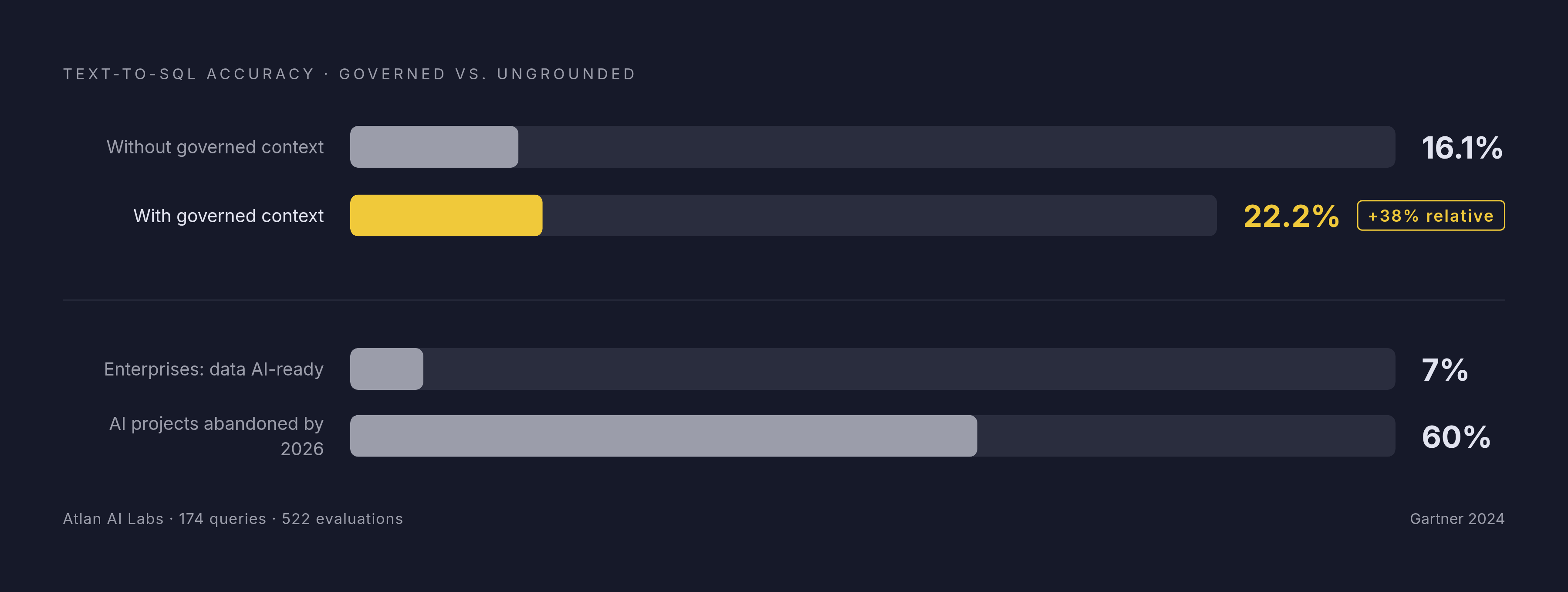
Atlan's AI Labs benchmark put a number on this exact gap. Giving an agent governed context lifted text-to-SQL accuracy from 16.1% to 22.2%, a 38% relative gain, measured across 174 unique queries and 522 evaluations. That's the baseline cost of skipping this problem, and it's not a rounding error.
The pattern behind most abandoned AI projects repeats with almost no variation. A team builds a demo on a clean, curated sample dataset, and it performs well. Leadership signs off, funding gets approved, the project moves to production, and it meets the actual data estate: fragmented across systems, contradictory by department. "Customer" means one thing in the CRM and something else in billing. "Order" splits across three definitions depending on who's asking. "Revenue" gets computed five different ways by five different teams. The demo never had to survive that. Production does, and most demos don't make the trip.
This isn't a footnote on an otherwise healthy industry. Only 7% of enterprises say their data is completely ready for AI. Gartner predicts that through 2026, organizations will abandon 60% of AI projects because the underlying data was never AI-ready to begin with, and a separate Gartner forecast puts the agentic AI abandonment rate at 40% by 2027. Those numbers represent most of the money currently being spent on AI initiatives. That's not a tail risk worth shrugging off; it's the base case.
The semantic layer: what fills the gap between catalog metadata and agent-ready context
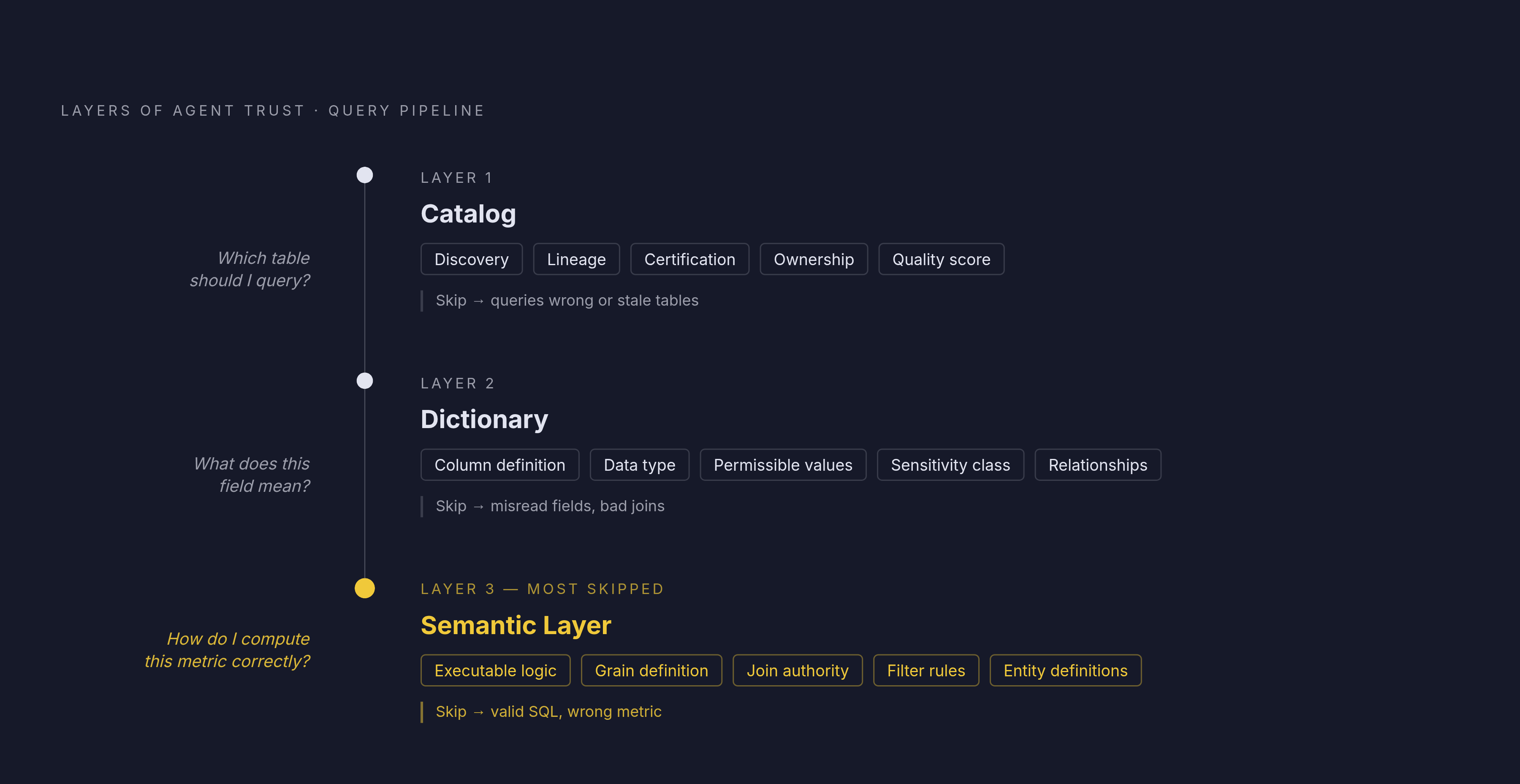
A catalog's table description sitting next to a dictionary's column type still leaves neither one, nor both together, telling an agent what "net revenue" actually means. The computation logic isn't there. The grain isn't there. The join path and the filter rules are missing too. That gap has a name and a fix, not just a vague shortfall everyone shrugs about.
A semantic layer closes it. It holds executable metric logic, business-friendly entity definitions, and one centralized place where a metric gets computed the same way every time, with governance over what that metric is allowed to mean. It translates a business concept into a form both a human analyst and an AI agent can query without reinventing the definition from scratch every time someone asks.
Gartner addressed this directly at its Data & Analytics conference: semantics are what break the barrier between raw data and AI agent-ready data. The direction Gartner is pointing is clear: semantic layers are moving toward critical infrastructure, not an optional add-on teams get to skip. Gartner also projects that by 2027, organizations that prioritize semantics in their AI-ready data will see model accuracy improve by up to 80%, with costs down by up to 60%. Numbers like that are what turn a nice-to-have into a line item a CFO actually signs off on.
How catalog, dictionary, and semantic layer divide responsibilities for an AI agent at query time
Every reliable query an agent runs has to clear three separate questions, and each one belongs to a different layer. Mixing them up is where things go wrong, and it happens constantly.
"Which table should I query?" That's the catalog's job: discovery, lineage, certification status, ownership, a quality score the agent can weigh before it commits to a source.
"What does this field mean?" That's the dictionary's job: column definition, data type, permissible values, sensitivity classification, and the relationship constraints that tell the agent how tables connect.
"How do I compute this metric correctly?" That's the semantic layer's job: executable logic, grain definition, join authority, filter rules, and the entity definitions that keep "revenue" meaning the same thing no matter who's asking.
If a team skips the catalog, the agent picks a plausible-sounding table that happens to be uncertified, deprecated, or scoped to the wrong business unit. The query still runs. The answer still looks fine on screen. It's wrong, and nothing in the pipeline flagged it, because nothing was watching that door.
If a team skips the dictionary, the agent guesses at a column's meaning from its name alone. "Revenue" is gross in one system, net in another, and excludes refunds in a third. The agent has no institutional memory to sort that out, because nobody wrote it down anywhere the agent could read it.
If a team skips the semantic layer, the agent can do everything else right (correct table, correctly understood columns, technically valid SQL) and the metric still comes out wrong. The join path or the filter logic that actually defines the metric never got encoded anywhere a machine could reach it.
Choosing the right tools: what to look for in a catalog, a dictionary implementation, and a semantic layer for AI use cases
This isn't a pick-one decision. Most AI teams need all three layers running at once, so the real question is not which layer to skip. It's whether each one was actually built for AI, or retrofitted after the fact with an API bolted on as an afterthought.
Check any catalog on four dimensions before betting an AI initiative on it: confirm there's a verified agent interface, identify where enforcement actually stops, examine what the pricing model counts against usage, and confirm definitions survive a vendor rename or acquisition intact.
MCP support is a reasonable baseline filter, not a finish line. As of Atlan's 2026 buyer's guide, 10 of 16 leading catalog tools ship a first-party MCP server. Connectivity by itself doesn't mean much if the agent connects and still gets an ungoverned, unusable answer back.
Across the catalog landscape, the players look distinct enough to name specifics, and the differences affect which vendor can actually support an AI agent in production.
Informatica, acquired by Salesforce in November 2025, brings 600+ certified connectors, with a deployment timeline of 6 to 9 months. It fits multi-cloud enterprises that need deep integration and can absorb a longer rollout without the project stalling out.
data.world, acquired by ServiceNow in a deal announced May 2025 and closed that July, now runs as ServiceNow Data Catalog. MCP support wasn't confirmed as of the guide's publication, which matters if agent connectivity is the whole point of the purchase.
Secoda, acquired by Atlassian in December 2025, deploys in 1 to 2 weeks, the fastest turnaround in the field, with a first-party MCP server. It's built for fast-growing, modern-stack teams in the 5 to 50 data-user range, not sprawling legacy shops trying to untangle a decade of pipelines.
Atlan holds a Leader position in Gartner's Magic Quadrant for both Metadata Management Solutions and Data & Analytics Governance Platforms, plus a Forrester Wave Leader and Customer Favorite distinction for Data Governance Solutions, and a 4.5 out of 5 rating on G2. Deployment runs 4 to 8 weeks, with a first-party hosted MCP server. Kiwi.com's deployment cut engineering workload by 53% within 90 days, a number that makes the wait for deployment look worth it.
Collibra fits regulated enterprises where compliance weight outranks speed: banking, insurance, pharma. Deployment runs 3 to 9 months, among the longer timelines in the group, and it ships a first-party MCP server.
OvalEdge carries the highest G2 rating in the field at 4.9 out of 5, with a first-party MCP server, and it fits mid-market teams that want governance without unpredictable ownership costs creeping up later.
Open-source options round out the field, but they come with a real tradeoff, not a free lunch. OpenMetadata ships a first-party MCP server on by default. Apache Atlas and Amundsen both lack confirmed first-party MCP support, and Amundsen is archived and no longer maintained. Open source costs nothing to deploy up front, but the engineering time it takes to run and maintain it appears later as a real bill, usually one nobody budgeted for.
Whichever combination a team lands on, the same test applies. Can the agent locate the right table? Can it understand what's actually in that table? Can it compute the metric the same way a trusted analyst would, using the same join path and the same filter rules every time? Fail any one of those three, and the answer coming back isn't trustworthy, no matter how confident it sounds on the screen.