Agentic AI Examples in Enterprise Data Workflows
Poor data governance, not weak models, blocks agentic AI deployment.

Examples of agentic AI in enterprise data workflows show what changes when software starts to act on data as well as answer questions. They also expose the main barrier to reliable deployment. Data that lacks meaning, freshness, or governed access usually poses a greater barrier to reliable deployment than a weak model does. Agents need a data layer built for decisions.
How agentic AI is actually being used in enterprise data workflows today
In customer operations, agents triage tickets, resolve known issues, update CRM records, and follow up without a person handling each step. That work follows a repeating loop in which the agent senses data, decides what to do, executes across systems, and learns from the outcome. The goal stays in place while the steps can change. Traditional automation follows a predefined path, whereas an agent selects tools and replans when something goes wrong. The LLM supplies the reasoning core, but the agent layer turns that reasoning into a workflow.
In 2026, agents work the same way in other parts of the enterprise. Sales agents research accounts, personalize outreach, clean CRM data, and coordinate campaigns across channels. Finance and procurement agents monitor spending, flag anomalies, handle purchase requisitions, and review contract risk. Supply chain agents coordinate with ERP systems to support demand forecasting. In internal knowledge work, agents search wikis, tickets, code repositories, and documents, then synthesize what they find.
Salesforce’s internal Agentforce deployment gives a named example of this work in production. Salesforce reported that agent orchestration cut the time it took to resolve cases by a large amount and saved many live-rep hours per year. As its own “Customer Zero,” Salesforce also reported significant annualized cost savings from its internal deployment. These are vendor-reported outcomes, but they show the practical scope of the work.
Why so many agentic deployments stall before they reach production
Deloitte’s 2026 Tech Trends analysis found that a large share of organizations are exploring or piloting agentic AI, but only a small minority have solutions ready for deployment. An even smaller share are using them in production, and a majority still lack a formal strategy. Gartner predicts that over two-fifths of agentic AI projects will fail by 2027 because legacy systems cannot support modern AI execution demands. The gap is between demonstrating an agent and giving it a working enterprise foundation.
Deloitte names three things that stand in the way: legacy integration, data architecture, and governance. Agents still depend on APIs and conventional pipelines that were not built for real-time interaction. Data warehouses and ETL processes organize data for reporting, but do not necessarily supply the business context an agent needs to decide. A Deloitte survey found that nearly 48% of organizations cite data searchability as an active challenge to their AI automation strategy. Traditional IT governance also lacks mechanisms for systems that make independent decisions and act on them.
The McDonald’s and IBM AI voice-ordering pilot illustrates the consequence of acting on uncertain inputs. The pilot was shut down after repeated misunderstandings in ordering. The case shows why ambiguous or contextually incomplete inputs need a governing layer that catches errors before they reach customers, rather than treating every failure as a model problem. Across AI projects, a majority of project time goes into data preparation, leaving less time for model tuning or deployment.
What specifically goes wrong at the data layer when agents try to act
At the data layer, agents fail when context is missing, inputs are stale, or access is ungoverned. Missing context begins with a simple limitation, which is that agents have no institutional memory. A column name that a human analyst understands through experience may tell an agent very little. Without metric definitions, table descriptions, and relationship maps, an agent can produce SQL that is syntactically valid but semantically wrong. The query runs, yet its answer misrepresents the business.
That ambiguity grows when agents reach across transactional databases, operational systems, and unstructured repositories. Without shared definitions, joining sources can make the mismatch worse. Even correctly interpreted data can then fail the freshness test. A snapshot suitable for a dashboard may be too old for an autonomous procurement or fraud decision. Toyota’s agentic deployment needed real-time vehicle status from pre-manufacturing through delivery, so it had to move from working through a mainframe screen by screen to live data that agents could access.
Access creates a separate failure path because agents often authenticate through service accounts with broad permissions. Those permissions apply at the account level across individual queries and the end users behind them. In a multi-agent payment workflow, one agent may call a pricing API, another trigger a transaction, and a third log for compliance. Traditional governance does not set out who is accountable for those handoffs, track the context that agents pass to each other, or check the scope of each tool call. The final distinction is decisive, because an agent that reads stale data gives a bad answer, while an agent that writes on bad data changes a live system before a human reviews it.
Why a semantic layer is not optional when the data consumer is an agent
A BI semantic layer maps business terms to physical tables, while an agentic semantic layer must also explain how data from different, live sources fits together. It needs certified metric definitions that spell out the calculation logic and the scope that has been agreed on. It also needs machine-readable table and column descriptions, relationship maps across source types, and domain context. With that context, an agent can tell when fields in different systems stand for the same thing in the real world.
This structure changes both the accuracy and the cost of a query. Without it, an LLM querying a database directly reads as much of the schema as it can and loads that material into its context window. That consumes tokens and can also consume warehouse credits on a consumption-based database. With a semantic layer, the context is already structured, so the question reaching the LLM can be narrower and more precise. Less guesswork means less unnecessary reading and querying.
Gartner predicted that by 2027, organizations prioritizing semantics in AI-ready data would materially increase GenAI model accuracy and reduce costs. Onix research across enterprise queries found meaningfully higher accuracy with unified, multi-dimensional context than with semantic definitions alone. Forrester’s June 2026 report frames the next-generation semantic layer as a control plane for data and analytics applications. It centralizes metric definitions, calculations, and access policies, then delivers them consistently to BI tools, data products, and AI agents.
How governance must be enforced when agents act autonomously and at scale
That control plane must both enforce rules while agents work and keep a record of the rules for later review. Traditional governance assumes named human actors making deliberate, reviewable decisions. Agents, by contrast, can run thousands of queries and dozens of write actions per hour through a shared service account. Tightening that account’s permissions does not identify the end user behind each query, and revoking its access can break everything downstream that shares it. Agent governance therefore requires a different architecture from analyst governance.
The architecture starts with an enterprise agent registry that records which agents exist, who owns them, what they may access, and when they were provisioned. Without that record, shadow agents can accumulate with outdated permissions and no owner. Runtime policy enforcement then evaluates each query under the actual end-user identity rather than accepting broad permission granted at session start. Attribute-based access control applies row-level security and column-level masking to what the query returns. A fraud detection agent can thus get transaction amounts and timestamps without getting payment card numbers or customer names.
Governance must also evaluate sensitivity when sources are joined, because individually harmless fields can combine into a confidential or regulated record. Audit logs need to record identity, intent, and lineage along with the fact that a query ran. They must connect the actor, the data touched, the decision that followed, and the reason access was allowed. This preserves accountability across the handoffs described earlier. It also gives read and write actions a traceable place in the same governed workflow.
Prolifics describes a leading U.S. regional bank that put formal data governance in place before it expanded its use of agentic analytics for credit risk, fraud detection, and customer personalization. AI model error rates fell sharply. In the nine months after the framework was put in place, the bank recorded zero data compliance violations. Regulatory audit preparation time dropped by more than half. Time-to-production for new agents fell sharply to five weeks.
How data products give agents a stable, trusted surface to work from
Semantics and access controls only help if the agent can find the right data and judge whether it is fit for the task. BARC’s June 2026 Spotlight report by analyst Florian Bigelmaier found that a large majority of respondents struggle to find relevant data. A similarly large share reported problems with the reliability and interpretability of their data and analyses. An agent faces that friction without the option of asking a colleague. When the right source is hard to discover, it can default to whatever it can reach.
A governed data product packages the information needed to avoid that default. It supplies a clear owner and a verified definition, so the agent does not have to infer what the data represents. A quality signal or trust score indicates whether the product is ready for a given purpose. Versioning and documented provenance make source changes controlled and traceable, preventing silent breaks in downstream behavior. A marketplace makes those products discoverable, turning the architecture into something an agent can consume at runtime.
Ataccama announced new data product capabilities in Ataccama ONE at Snowflake Summit 26, held June 1–4, 2026. Customer, Transaction, Supplier, and Account records each become governed data products with a clear owner, a verified definition, and an Ataccama Data Trust Index score indicating readiness. Ataccama’s MCP Server delivers them into Snowflake CoCo, Cortex CoWork, and enterprise AI tools. But a marketplace also creates a maintenance obligation as the number of registered products grows. If governance and quality scoring do not keep pace, the catalog becomes noise and undermines the trust it was meant to provide.
What the data layer must actually provide for agents to act reliably
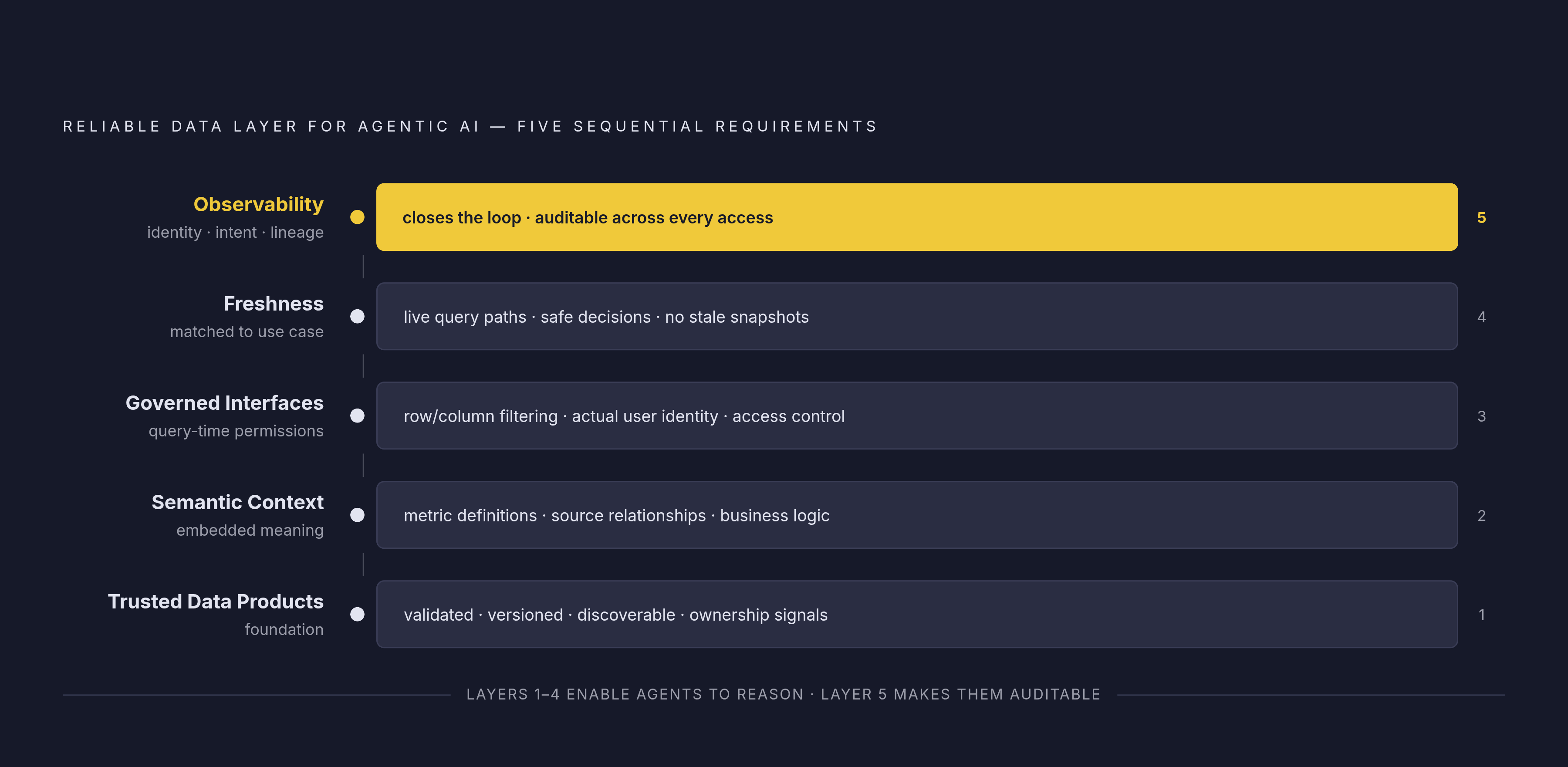
Together, these examples define five requirements for an AI-ready data layer. Trusted data products provide the starting point by making validated, versioned data discoverable with ownership, definitions, and quality signals attached. Embedded semantic context then explains what that data means, how business metrics are calculated, and how sources relate. Those definitions need to be in the layer itself as well as in model prompts or assumptions drawn from schema names. This closes the gap between finding a Customer record and understanding whether it is the right record for the task.
The third requirement, governed interfaces, checks permissions at query time and filters the rows and columns returned under the actual user’s identity. The fourth, freshness matched to the use case, sends agents to live query paths when a static snapshot is too old for a safe decision. Observability records identity, intent, and lineage as agents access data and then make decisions. It provides the accountability that a shared account and a basic query log cannot.
This architecture does not require replacing existing warehouses, pipelines, or SaaS systems. The layer sits on top of them and exposes a single governed interface with semantic context built in. That is a practical constraint as much as an architectural choice, because agents must work across the systems enterprises already have. Deloitte’s 2026 analysis describes the broader shift as moving from ETL-based pipelines toward enterprise search and indexing built on knowledge graphs. The aim is organizational data that is discoverable and contextually accessible without extensive extraction, giving agents a dependable basis for action.