Data Reliability SLAs for AI-Facing Data Products
AI agents need data contracts that guarantee freshness, meaning, and lineage—not just uptime.

An AI agent can't shrug and double-check a number the way an analyst does. That single fact changes what a service-level agreement has to promise: not just uptime and load times, but freshness, meaning, and lineage that hold up when the reader is a machine acting on its own.
Here's the asymmetry in plain terms. A human analyst looking at a dashboard that refreshed six hours late will feel a flicker of doubt and go check the source system, or just ask someone. An agent doesn't have that instinct. It takes what's in front of it, treats it as ground truth, and produces a confident-sounding answer regardless of whether the underlying number is three weeks stale. This problem compounds across chained systems: one model's output becomes another model's input, so an early reliability issue doesn't stay contained. It rides downstream, and by the time anyone notices, the original error is buried under three or four layers of derived decisions.
One case makes the stakes concrete. A Fortune 500 healthcare company had patient outcome predictions running 30% off target because a pipeline failure silently fed incomplete records into an ML model for over three weeks. The model never flagged doubt, because it isn't built to doubt. It just calculated, and kept calculating, on broken input.
The old SLA logic was built for a world where lag was an inconvenience. A dashboard running a few hours behind was mildly annoying for whoever opened it. An agent that has already made thousands of decisions off a stale table isn't inconvenienced, it's compromised, and there's no un-making those decisions after the fact. That's the argument for a structurally different contract, one that treats freshness, semantic correctness, availability, and lineage as things you define and enforce up front, not qualities you hope hold true.
How widespread the gap is between AI ambition and data readiness
Gartner projects 60% of AI projects will be abandoned through 2026; the data underneath them isn't sound enough to support them, and that insufficiency is what drives the abandonment. That's a big number on its own, but the readiness side of the ledger is worse.
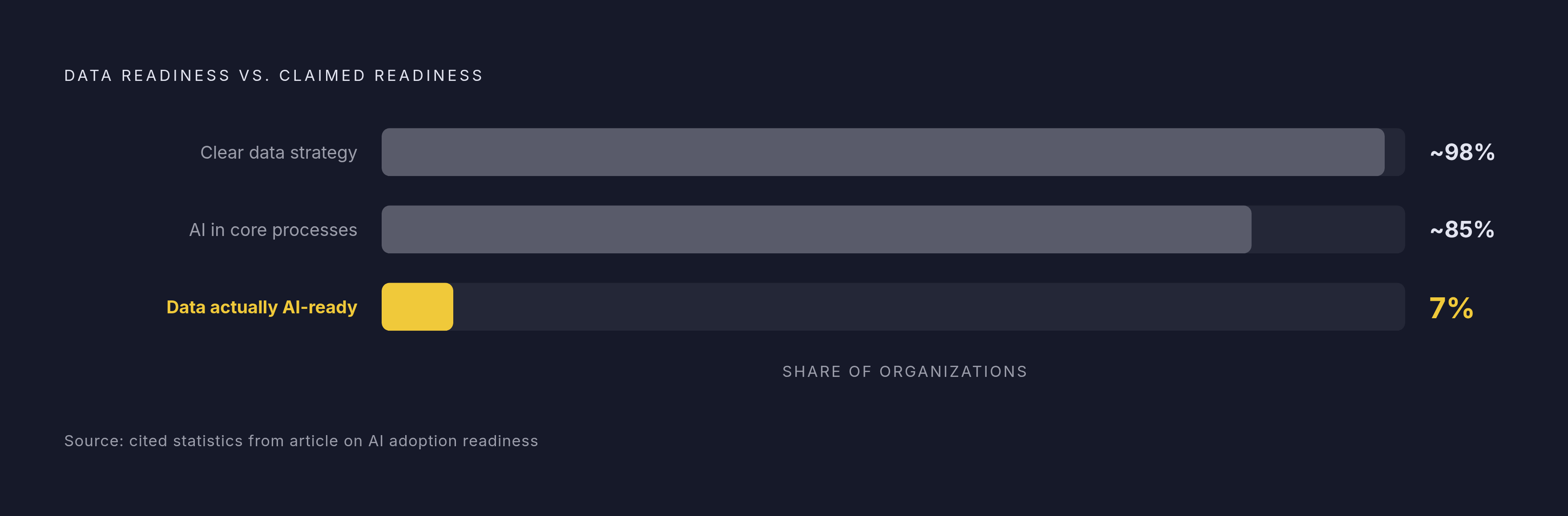
A Cloudera and Harvard Business Review Analytic Services survey found only 7% of organizations say their data is completely ready for AI adoption. Seven percent. Everyone else is running AI initiatives on data foundations they themselves don't fully trust.
Call the mismatch the AI readiness illusion. Nearly every organization in Survey research on data readiness finds that a large share of organizations report AI is now part of core processes, and nearly all claim to have a clear data strategy on paper. Yet a large majority admit their AI and data initiatives are still held back by limited data access across environments. Everyone has a strategy document. Almost nobody has the plumbing.
That gap isn't really about ambition. Organizations aren't short on models, or on pipelines, or on enthusiasm for the next agent deployment. What's missing is the contract layer between the data and whatever's consuming it; nobody budgets for it because it's invisible until it breaks. Among higher-maturity organizations, 56% list data product development as a top priority alongside AI and advanced analytics work, which says something hopeful, but that maturity sits in a small slice of the market, not across it.
None of this is random. The gap traces back to specific SLA dimensions that most existing data products were simply never built to expose, let alone honor.
The four SLA dimensions AI-facing data products must define explicitly
Data quality has always had its usual suspects: accuracy, completeness, consistency, uniqueness, validity, freshness. Fine for a textbook. For an AI consumer, though, these can't stay aspirational. They have to become commitments a machine can check against, in real time, without a human in the loop.
Freshness: a weekly sales snapshot might be perfectly fine for a Monday morning report. That same snapshot is already useless to an agent making a pricing or routing call ten minutes from now. Freshness has to be scoped to the use case, not the product category, and written as a maximum acceptable lag paired with a monitoring cadence, not just a target. If the SLA promises data no more than one hour old, monitoring needs to run at least every thirty minutes, because the agent has no internal sense of "this feels old." Somebody, or something, has to tell it.
Semantic correctness: an agent reading a column called revenue has no way to know whether that's booked revenue, projected revenue, or something finance quietly redefined last quarter. Semantic SLAs commit the data producer to keeping accurate, versioned definitions for every metric and entity the product exposes, not just a valid schema. If the same KPI gets calculated two different ways in two different tools, that's a violation of the SLA, full stop, even if every single pipeline behind it ran clean. Metric drift is a reliability failure, not a rounding error.
Availability and lineage coverage: for a human, availability usually means "the table exists and I can query it." For an agent operating at inference time, availability means the product is queryable with full context attached, right then, not five minutes later after a cache warms up. Lineage belongs in this same bucket: the product needs to expose its provenance chain so the agent, or the governance layer sitting behind it, can judge whether to trust the answer before acting on it. The principle is clear: once dashboards, operational systems, and AI models all depend on defined SLAs, informal or eyeballed monitoring introduces risk nobody can quantify. Reliability has to be measurable, or it isn't really an SLA.
Sensitivity and permission state at query time. Human analysts usually get permission-checked once, at login. Agents running thousands of queries an hour need permissions evaluated at the moment of each individual query, under the actual end user's identity, not a broad service account that quietly has access to everything. And sensitivity isn't just a field-level or source-level property. An agent can join two individually harmless fields and produce something genuinely sensitive in the combination. The SLA has to commit to a specific evaluation model for this, not assume a wide-access service account has it covered.
Why the semantic layer is not optional infrastructure, it is where the SLA lives
A semantic layer sits between the raw tables and whatever's consuming them, translating column names and joins into business concepts both a person and a machine can actually rely on. It's the thing that lets an agent know revenue means booked revenue, recognized under whatever accounting rule finance uses, without anyone hardcoding that logic into a prompt.
The semantic correctness SLA is only real if the definitions live somewhere centralized and machine-readable. A governance wiki page in Confluence is documentation. It is not an SLA, because nothing enforces it and nothing checks it at query time.
What a proper semantic layer hands to an agent: table descriptions, metric definitions, entity relationships, and the business logic connecting them. That's context the agent has zero institutional memory to reconstruct on its own from raw schema, no matter how good the underlying model is. Teams that standardize meaning across sources through a semantic layer report meaningful reductions in query errors once those definitions are in place.
Two concrete implementations show what this looks like in production. Looker's semantic layer, built on LookML, lets its AI-powered agent interfaces query governed business logic directly instead of guessing meaning from raw tables. Internal Google testing found this cuts data errors in generative AI natural language queries by as much as two-thirds. Databricks took a different path with Metric Views, which reached general availability on April 2, 2026. Metric Views separates measure definitions from dimension groupings, so a metric gets defined exactly once and stays queryable across any dimension at runtime, no separate BI layer needed (Unity Catalog is a prerequisite for it to work).
Industry research puts governance frameworks and semantic layers as a top investment area for roughly two-fifths of organizations. Growing, clearly, but still far short of universal. The semantic layer is core infrastructure for making querying faster and results auditable. It's the mechanism that makes a semantic correctness SLA something you can actually audit, rather than something you hope is true.
Data contracts as the enforcement mechanism that turns SLA commitments into operational reality
A data contract, in the AI context, is a formal agreement between whoever produces a dataset and whatever AI systems consume it, covering schema, quality thresholds, semantic meaning, freshness, and access policy, all in one place.
The difference from a traditional pipeline contract is precise and specific. A traditional contract enforces structure at the pipeline boundary: data comes in, gets checked, moves on. An AI-ready contract adds machine-readable definitions an agent can query directly at inference time, impact analysis that traces every dependent downstream agent, and enforcement that runs continuously when the agent queries, not just once when the data first lands in the warehouse.
Ownership has to be unambiguous here. The producing team owns and updates the contract, and accountability can't be diffused across a shared backlog that nobody's actually responsible for. SLOs need to trace to a named team.
The practical mechanism is CI/CD. Schemas, timeliness thresholds, and quality SLAs get codified directly into the pipeline's CI/CD process, and automated scanners flag deviations at commit time, before anything reaches a consuming agent. Early adopters of this kind of contract enforcement report up to 40% fewer incident tickets, which frees up engineering time that was going to break-fix work and puts it back on features. SLO attainment rate, SLO burn rate, mean time to detect, and mean time to resolve should be tracked under this model, reviewed on a regular cadence as the actual operational proof that the SLA means something.
The market's growth tracks how seriously this is being taken. The AI-in-data-quality segment is projected to grow substantially from 2025 to 2026, a 25.0% CAGR, as contracts stop stopping at the pipeline boundary and start extending all the way to the consuming agent.
Tiered SLA structures: matching commitment level to how an agent uses the data
Not every data product carries the same cost if it misses its SLA. An agent making a real-time routing decision needs a completely different freshness and availability guarantee than a quarterly financial summary someone glances at for trend direction. Treating both the same is either wasteful or dangerous, usually both.
A useful way to segment:
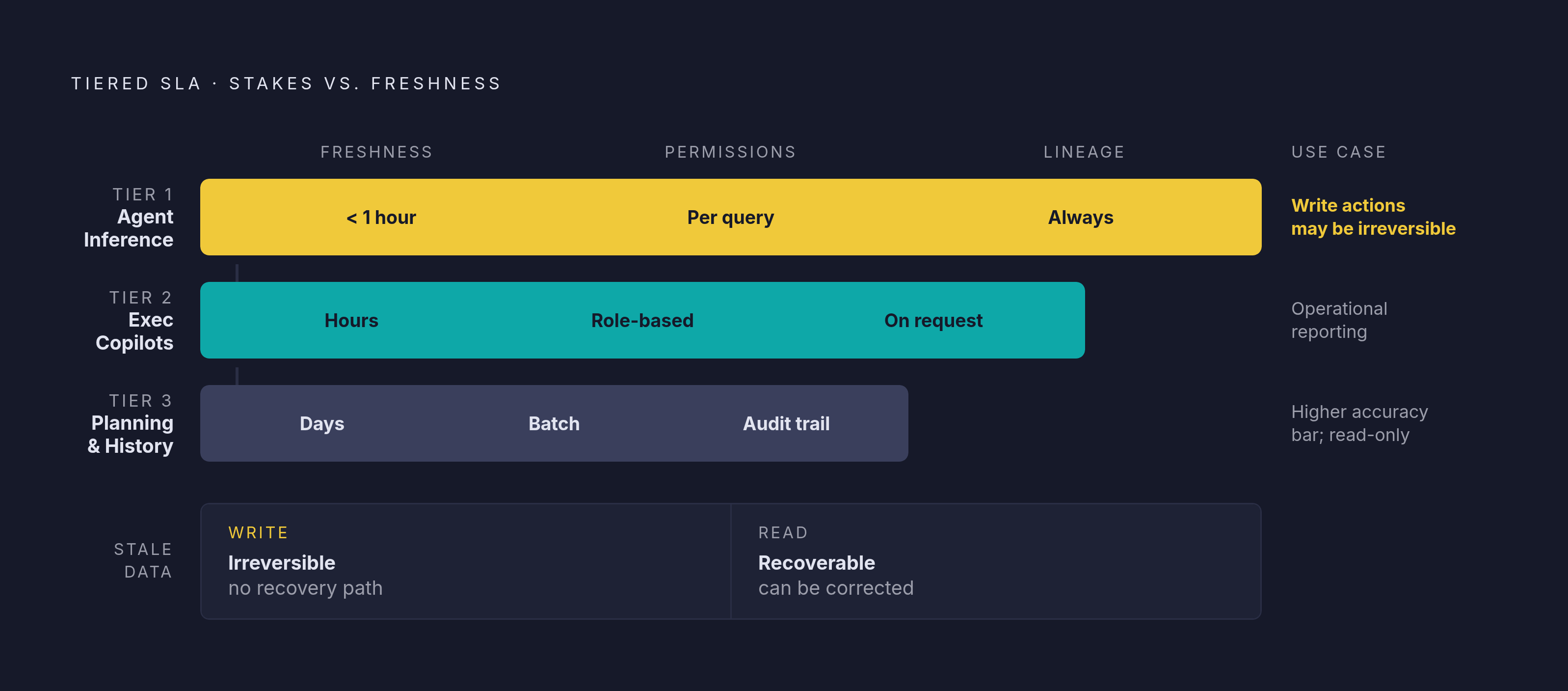
Tier 1, agent decision support at inference time. Sub-hour freshness maximums, permission checks on every single query, full lineage exposure required, no exceptions. Tier 2, executive copilots and operational reporting. Certified pipelines, freshness windows measured in hours rather than minutes, lineage available on request rather than pushed automatically. Tier 3, planning and historical analysis. Longer processing windows are fine here, but the accuracy bar should go up to compensate for the reduced freshness.
The mistake is promising an SLA that sounds impressive in a slide deck but that current infrastructure simply can't hold. dbt Labs' 2026 guidance says to baseline actual pipeline performance first, then set the target, not the other way around.
Tiering also has to account for what an agent is allowed to do with the data, not just how fast it gets it. An agent that can only read is recoverable if it acts on a slightly stale number, an agent that can write or trigger downstream actions is not. A missed freshness window on a read is an annoyance. A write action taken on stale data might not be reversible at all.
And because production agents routinely pull from several systems in a single workflow, tiering has to think about cross-system compatibility too. If four data products feed one agent decision and three of them promise sub-hour freshness while the fourth promises daily, the fourth one sets the real, effective SLA for the whole output, whether anyone wrote that down or not.
What observability and monitoring must look like when an agent is the consumer
Monitoring that leans on a human catching something after the fact works fine at analyst scale. It falls apart completely at agent scale, where query volume and speed make after-the-fact human review close to useless.
Freshness monitoring cadence has to be set against the SLA window itself, not against whatever's operationally convenient for the engineering team. dbt Labs' guidance is specific here: a one-hour freshness SLA needs checks running at intervals of thirty minutes or less. Anything looser and the SLA is really just a suggestion.
Automated remediation can handle the simple stuff, network timeouts, transient resource limits, that kind of thing. Complex failures still need a human to step in, but automated diagnostics need to fire the moment something looks wrong, so the time between failure and detection stays short even before a person gets involved.
Lineage-aware monitoring matters just as much as detection speed. When something breaks, lineage tracking lets a team isolate the root cause and identify every downstream agent touched by it, fast. Without that lineage map, impact assessment turns into a manual hunt through dashboards and team messaging threads, which is slow exactly when speed matters most.
There's a compute cost hiding in here too. A pipeline that isn't state-aware will reprocess tables that never actually changed, even after a freshness check confirms there's nothing new to compute. Pairing freshness checks with state-aware execution, which dbt's tooling supports, avoids burning compute on work that produces no new information.
Audit logs need to capture identity, intent, and lineage together, not just "what was queried." A log entry showing a query ran, with no record of which agent ran it, under whose identity, or what it returned, is close to worthless once query volume climbs into agent territory. The data observability market itself has grown into a multibillion-dollar category with steady growth projected through 2031, per Mordor Intelligence figures, and 2025 saw real movement in this direction: Monte Carlo launched AI agents that recommend monitoring rules and diagnose root causes on their own, and Datadog acquired Metaplane in April 2025 specifically to bring end-to-end data-quality monitoring into its observability platform.
The data product management capabilities that make SLAs enforceable across domains
A catalog makes data visible. A governance tool enforces policy. Neither one makes data operationally accountable on its own, and that distinction matters a lot once multiple domains each own their own data products but are all supposed to honor the same SLA standard.
Without a management layer tying this together, a data mesh tends to drift apart on its own. Each domain sets its own quality bar, SLAs go inconsistent or vanish entirely, downstream agents have no reason to trust data crossing a domain boundary, and lineage across systems turns opaque fast.
The platform layer that fixes this adds a few specific things: explicit ownership assigned to a person, SLA monitoring tied to that named owner rather than a team address, lifecycle management that covers a product from its first definition through its eventual retirement, and marketplace-style discovery where the contract terms are visible right alongside the data itself, not buried in a separate doc.
Gartner's finding on this is stark: 63% of organizations either lack the right data management practices for AI or aren't sure whether they have them. Federated governance with SLA enforcement built in is the direct architectural answer to that uncertainty, since it doesn't require every domain to agree on everything, just to honor the same contract terms.
Access has to follow the same logic. Approvals need to be structured and traceable, and permissions need to be revocable at the level of one specific workload, not tied to a shared service account where pulling access breaks five other things downstream that had nothing to do with the original problem. A data product that's genuinely ready for AI consumption exposes technical and business metadata, semantic definitions, lineage, and its contract, together, as one package. That combination is what turns a dataset into something an agent can actually trust, rather than just something it can technically query.
Investment dollars back up how seriously the market treats this shift. The data analytics vertical pulled in billions in VC funding in the first half of 2024 alone, according to PitchBook, a clear signal that demand for systems which treat data as an accountable product, not just a stored asset, is real and growing.
How to audit whether your current data products can honor an AI-facing SLA
Before assuming a data product is ready for an agent to rely on, check it against five criteria: discoverability, real-time accessibility, a unified identity and policy model, high-quality and versioned semantic definitions, and full lineage exposure at the point of query.
Run through each honestly. Can an agent, or the team building one, find this product without asking around first? Can it be queried at inference speed, with permissions checked against the real requesting identity rather than a shared account? Are the metric definitions versioned somewhere machine-readable, or do they live in someone's head and a slide from eighteen months ago? And when something goes wrong three layers downstream, is there a lineage trail that actually leads back to the source, or does someone have to reconstruct it by hand?
Most organizations, based on where the readiness numbers sit, will fail at least two of these five on a first honest pass. That's not a reason to panic, it's the actual starting point. The SLA gap between AI ambition and data readiness doesn't close by buying a better model or a faster pipeline. It closes by making these five things true, one data product at a time, before an agent is ever allowed to act on what comes out of them.
Sources
- Data Products Examples for Analytics, AI & Operations (2026)
- How to ensure data product SLAs and SLOs | dbt Labs
- Data Reliability in 2025: Complete Guide to Ensuring Trustworthy Data Systems
- The 2026 Enterprise Guide to AI-Ready Data: Definition, Requirements, and How to Get There - My Framer Site
- cloudera.com
- acceldata.io
- From asset to action: How data products have become the foundation for AI agents | Google Cloud Blog
- Lack of AI-Ready Data Puts AI Projects at Risk