What a Data Virtualization Platform Actually Does
It unifies queries across scattered data without copying anything.

A data virtualization platform lets an application, a dashboard, or an AI agent query data sitting in scattered sources as if it all lived in one place, without ever copying it. That single mechanic, a unified query layer sitting on top of scattered sources, is the thing to understand, because everything else these platforms do traces back to it.
How a data virtualization platform works
If the marketing language is stripped away, the definition is simple: a software layer that gives unified query access to multiple, distributed data sources. It does this without copying or moving any of the underlying data. "Virtual" here means what it sounds like. The data stays put, in whatever database, warehouse, or SaaS tool it already lives in, and the platform builds a logical view on top of it that behaves like a single, coherent source.
Here's how a query actually moves through the system. A request comes in, the platform figures out which source systems hold the relevant pieces, reaches out to those systems (often several at once), pulls back only the data needed to answer the question, and stitches the result together on the spot. Nothing gets staged in a warehouse first. Nothing waits for tonight's batch job.
Three components make this work. A federated query engine sits above the connectors, coordinating execution across sources and pushing computation down to wherever it can run most efficiently. And a semantic or abstraction layer presents all of this back to the user as one unified schema, no matter what actually generates it underneath.
Whether the underlying source is Oracle, Snowflake, Salesforce, or a plain flat file is completely invisible to the person or application running the query. They see one governed view. The complexity persists, hidden behind that single governed view.
Not every deployment handles this the same way. Pure virtual access keeps everything live, with no replication at all, which maximizes freshness but carries more latency risk since every query has to reach out to source systems in real time. Hybrid setups virtualize some data and cache or partially ingest the rest, based on performance needs. Materialized views go further, storing frequently accessed data in optimized formats specifically to speed up response times. Most enterprises don't pick one pattern and stop there. They blend them, based on what each dataset actually needs.
Why does any of this matter now more than it used to? Because enterprise data no longer sits in two or three systems. It spans on-premises databases, cloud warehouses, SaaS platforms, data lakes, streaming feeds, and third-party APIs, often all at once. Centralizing all of that into one place has become slow, expensive, and in a lot of cases, simply impractical.
The pattern itself has also evolved. Federation engines built on Trino, Apache Kyuubi, and Apache Gravitino work on the same core idea, but they run at far higher concurrency and plug natively into open table formats and cloud object storage. In practice, most enterprises end up running a blend: high-value, cleaned data is stored in a central Apache Iceberg lakehouse, while everything else stays federated in place, governed under the same rules.
Why enterprises don't just centralize everything instead
The obvious counter-argument is ETL: extract the data, transform it, load it into a central warehouse or lake, and query it from there. It's a familiar pattern, and for a long time it worked well enough.
It doesn't hold up anymore, at least not on its own. Data volume and the sheer number of sources have outgrown what traditional ETL pipelines were built to handle. Every time a source schema changes, downstream jobs break, and someone has to go fix the pipeline before the dashboard works again. Worse, by the time data has been replicated and integrated, it can have already changed at the source, which means the analysis built on top of it is working from a version of reality that's already out of date.
Storage and compute costs stack up fast too, since petabytes get duplicated across systems that all need to be maintained separately. And the time-to-answer problem is brutal in practice: a stakeholder asks a question, IT provisions access, engineers build a pipeline, and a dashboard finally appears, weeks after the question was first asked.
SaaS adoption made this worse, not better. BI tools used to connect to a handful of sources. Now, SaaS and cloud technologies have created a landscape where data sits locked inside multiple clouds, apps, databases, and legacy platforms, each one its own silo. IBM has framed the zero-copy alternative directly: it saves time and money while giving access to more data, without the replication overhead.
Cost used to be the real barrier to adopting virtualization instead of ETL, especially for smaller organizations. That's shifted. Fully managed virtualization services from the major cloud providers have cut initial deployment costs by 35 to 50 percent compared to the old perpetual-license model, which has opened the door to small and midsize organizations that never had the capital for an on-premises appliance deployment Market Research Future.
None of this means centralization disappears. Most organizations can't rip out what they already have, and they shouldn't try. The real value sits in a layer that works with existing infrastructure, pulling it together, rather than a replacement that demands everyone start over.
The problem that makes data virtualization more urgent than ever: why AI initiatives stall
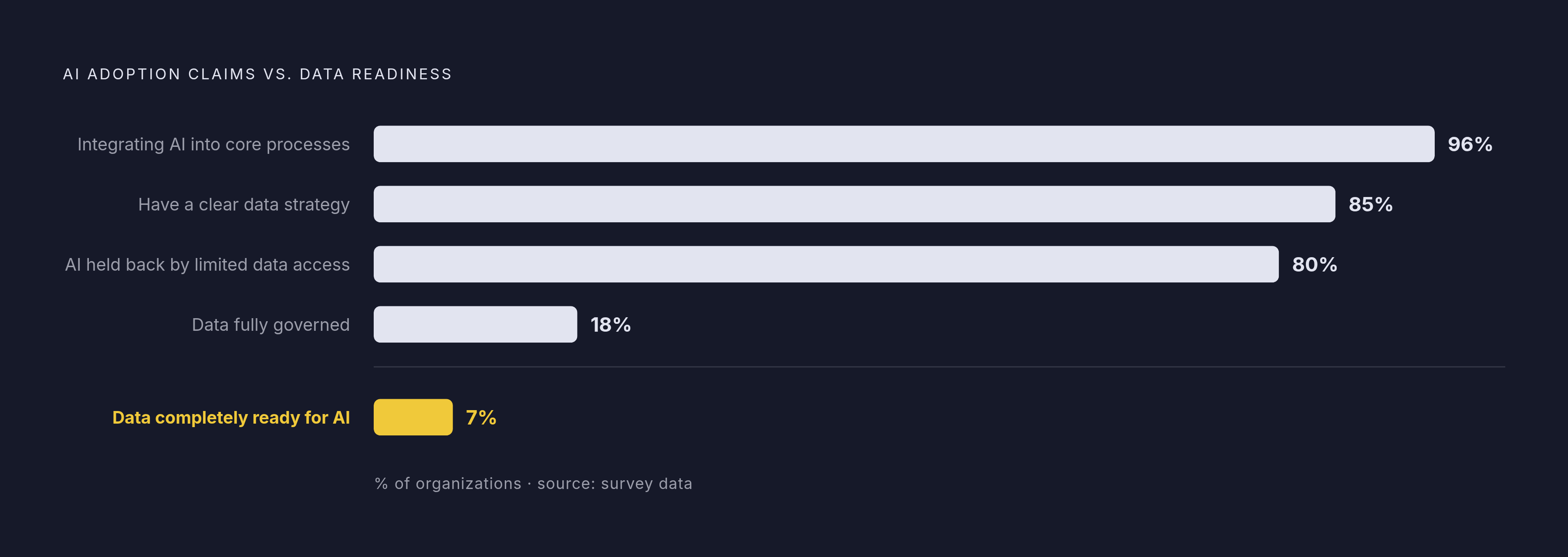
The numbers here describe a genuine paradox. The Cloudera Data Readiness Index 2026, which surveyed nearly 1,300 global IT leaders between January and March of that year, found that 96% of organizations report integrating AI into core business processes. Yet almost 80% of those same organizations admit their AI and data initiatives are still held back by limited data access across environments Cloudera Data Readiness Index 2026. Nearly everyone is doing it. Nearly everyone is also stuck.
The governance numbers make the paradox worse. 85% of organizations in that same survey claim to have a clear data strategy, but only 18% describe their data as fully governed Database Trends and Applications / NextOlive Cloudera Data Readiness Index 2026 Cloudera Data Readiness Index 2026 / DQ Channels. The strategy exists on paper, but the governance gaps remain in the systems themselves.
A separate study backs this up. Harvard Business Review Analytic Services, working with Cloudera and surveying over 230 respondents in October 2025, found that only 7% of enterprises say their data is completely ready for AI, and 73% say their organization struggles with AI data preparation Cloudera / Harvard Business Review Analytic Services. Two different surveys, two different timeframes, the same story.
Gartner's numbers, from a Q3 2024 survey of 248 data management leaders, show 63% of organizations either lack the right data management practices for AI or aren't sure whether they have them Database Trends and Applications / NextOlive. Gartner has gone further, predicting organizations will abandon 60% of AI projects that aren't backed by AI-ready data, through 2026 Database Trends and Applications / NextOlive. Other industry reporting from 2025 and 2026 puts the pilot-stage failure rate above 70%, with 74% of organizations saying they can't even measure business value from their AI initiatives Nexos. RAND Corporation data shows 42% of companies abandoned most of their AI initiatives in 2025, up sharply from 17% the year before Cloudera / Harvard Business Review Analytic Services RAND Corporation / QuickLaunch Analytics. For generative AI specifically, Gartner reports that by the end of 2025, more than half of all GenAI initiatives had already been shelved after the proof-of-concept stage, killed by data quality problems, risk-control gaps, or costs that spiraled out of control.
So what's actually breaking? Not the model. Production data sits fragmented across systems that were never designed to talk to each other. Basic terms mean different things in different departments: "customer," "order," even "revenue" can carry three separate definitions depending on who's asking. Historical records carry gaps, inconsistent formats, and mismatches that never appear in a clean demo dataset, because that demo dataset bears almost no resemblance to what real enterprise data actually looks like.
Respondents in the Cloudera 2026 survey named their own top failure causes directly: data quality at 22%, cost overruns at 16%, poor integration into existing workflows at 15% Cloudera Data Readiness Index 2026. McKinsey's 2025 research adds a useful twist: organizations that achieved significant returns from AI were twice as likely to have redesigned their data workflows before picking a model at all. The infrastructure decision comes first, the model decision second. Connecting AI systems to real enterprise data, real workflows, real security models, and the operational mess that actually exists, that's where most initiatives stall, not in the model itself.
What a virtualization platform delivers: the capabilities that flow from the core mechanism
Once the query layer exists, a handful of capabilities fall out of it almost automatically. Time to insight shrinks, because there's no pipeline to build and no ingestion job to wait on. Queries run straight against live source systems.
Agility improves as well. A schema change at the source doesn't force a rebuild of every downstream pipeline that touches it, and adding a new source doesn't require a migration project.
Freshness is the default, not a feature someone has to configure. Because nothing gets copied on a schedule, whatever an application or AI agent pulls back reflects the current state of the source system, which matters enormously for anything tied to an operational decision. And cross-platform access, being able to find and use governed, production-grade data no matter where it's stored or which vendor's tool provides it, has stopped being an advanced feature. It's now a baseline requirement for enterprise AI.
Governance lives inside the query layer itself. Permissions get evaluated per query and per user, not assumed from some broad service account sitting in the background, so access policy travels with the data no matter which application happens to be asking for it.
In practice, these platforms show up in two shapes. A stand-alone deployment runs as a separate server acting as a logical data warehouse, which is common but has historically been large, costly, and IT-intensive to maintain. An embedded deployment lives inside another application, an analytics tool or an AI agent platform, and stays lighter and mostly invisible to whoever's using it.
The agentic AI use case makes all of this concrete. Platforms like CData Connect AI give tools such as ChatGPT, Claude, Databricks Genie, and MCP agents credentialed, live access to enterprise systems through a single governed endpoint, keeping context and access policy intact the whole way through. Virtualization functions as the connectivity backbone underneath agentic AI, not as an abstract architecture diagram. Data virtualization delivers reduced cost by minimizing data replication for lower storage and compute spend, and by requiring fewer ETL jobs, resulting in less infrastructure to maintain.
Why connectivity alone isn't enough: the role of a semantic layer
Connectivity and meaning are two different problems. Data virtualization solves the first one: can an application reach the data it needs. A semantic layer solves the second: does everyone querying that data agree on what it means.
Here's the failure mode virtualization alone doesn't touch. If several BI tools or AI agents all query the same virtualized data, but each one applies its own calculation logic, the organization still ends up with multiple, conflicting versions of the truth. The plumbing worked. The numbers still disagree.
This matters more for AI than it ever did for human analysts. A person looking at a vague column name can ask a colleague what it means, or notice that "revenue" in the sales system doesn't match "revenue" in finance. An AI agent has no institutional memory to draw on for that. It just picks something and runs with it.
That's why AI analytics failures tend to be semantic failures far more often than they're hallucinations in the sci-fi sense. The model chooses the wrong table, joins data at the wrong level of granularity, or aggregates something incorrectly. And the output looks exactly as confident either way. A stale or partial answer reads with the same polish as a correct one, because the agent has no way to signal that it's unsure what a field actually means.
A semantic layer closes that gap by attaching governed definitions, metric logic, table relationships, and access policy consistently across every tool that touches the data, so "ARR" or "active customer" means the same thing whether the query comes from a dashboard, a written report, or an AI agent. The evidence backs this up concretely: recent deployments show teams cutting query errors by 40 to 70 percent once a semantic layer standardizes meaning across sources.
Most organizations haven't gotten there yet. As of 2026, only 36% of survey respondents say they have both semantic layer and data virtualization capabilities in place strategy.com. Connectivity has largely been solved. Meaning hasn't. That's why a platform that carries semantic context inside the query layer itself, table descriptions, metric definitions, relationships, all embedded rather than bolted on, closes both gaps in a single infrastructure move instead of two separate projects. A semantic layer matters more for AI than for humans.
Governance inside the query layer, not patched on afterward
Traditional architectures tend to grant access at the service-account level: one broad credential covers whatever application or agent happens to be making the request, instead of checking that request against the actual person behind it. That's a shortcut that worked fine when query volumes were low and every request came from a human.
AI agents break that assumption completely. They issue queries at a volume and speed no team of human analysts ever approached, and a single misconfigured service account can expose data to every agent workload running underneath it. Permissions need to be revocable at the level of one specific workload, without taking down everything else that depends on the same account.
Sensitivity itself shifts depending on context. A field that's harmless on its own can turn sensitive the moment it's joined with another field, so the check has to happen at the point where data actually gets combined, not just at the individual field or source level. Audit logging has to keep pace with the same shift: a log that only records which query ran isn't enough anymore. It needs identity (whose request this was), intent (what the agent was trying to accomplish), and lineage (which sources got touched), all recorded together, or the log turns into noise the moment agent-level query volume kicks in.
Only 18% of organizations with a stated data strategy describe their data as fully governed, which makes the Cloudera 2026 figure a governance story more than a policy story Cloudera Data Readiness Index 2026 / DQ Channels. That's not a paperwork problem. It's a gap in the infrastructure itself Cloudera Data Readiness Index 2026 / DQ Channels.
There's a further wrinkle as agents stop just reading data and start acting on it, writing back to operational systems, updating records, triggering downstream processes. Write actions carry a different risk profile than reads, and they need to be governed more strictly, not treated the same way. A newer risk follows from this: shadow AI, unmanaged agent deployments spreading faster than anyone's visibility into how those workloads consume compute, storage, and network resources. Governance has to live inside the core platform itself. Treating it as a separate AI infrastructure layer, bolted on after the fact, doesn't hold up at the scale agents now operate at.
The market these platforms now operate in, and its implications for buyers
The market's growth curve tells its own story. That's not incremental growth. That's a market being reshaped by demand it wasn't originally sized for.
Worldwide AI project spending explains where that demand is coming from: $1.8 trillion in 2025, a projected $2.5 trillion in 2026, and $3.3 trillion by 2027 TechTarget. Data virtualization is the infrastructure decision that decides whether all of that spending actually produces returns TechTarget.
Cost has stopped being the barrier it once was for smaller organizations. Fully managed virtualization services have cut initial deployment costs by 35 to 50 percent against the old perpetual-license model, and AWS Marketplace and Azure Marketplace listings for virtualization tools climbed 62% between 2023 and 2025 Market Research Future. The capital wall that used to keep this technology confined to large enterprises has mostly come down Market Research Future.
Adoption intent backs this up from the buyer side too. 85% of DBTA subscribers confirmed plans to modernize their data platforms, driven largely by generative AI, and 60% of organizations are actively researching GenAI, LLMs, RAG, and knowledge graphs Database Trends and Applications / NextOlive Cloudera Data Readiness Index 2026 Gartner.
So what should a buyer actually be weighing, given all this? Access to data has become table stakes at this point, not a differentiator. The real separation between platforms now appears in semantic context, governance depth, and AI-agent readiness. Deployment model still matters a great deal too: stand-alone, embedded, or fully managed each carry a different total cost and a different IT overhead profile, and getting that choice wrong later produces either an unmaintainable server or a tool too rigid to extend. Connector breadth rounds it out, since a platform is only as useful as the share of the actual data estate it can reach without someone writing custom integration code to bridge the rest. The global data virtualization market is estimated at USD 6.11 billion in 2025, projected to reach USD 7.24 billion in 2026, and USD 21.12 billion by 2032 at a CAGR of 19.38%, according to 360iresearch.com.