Data Strategy Roadmap for ML Platform Adoption
Build your data foundations before deploying AI platforms to production.

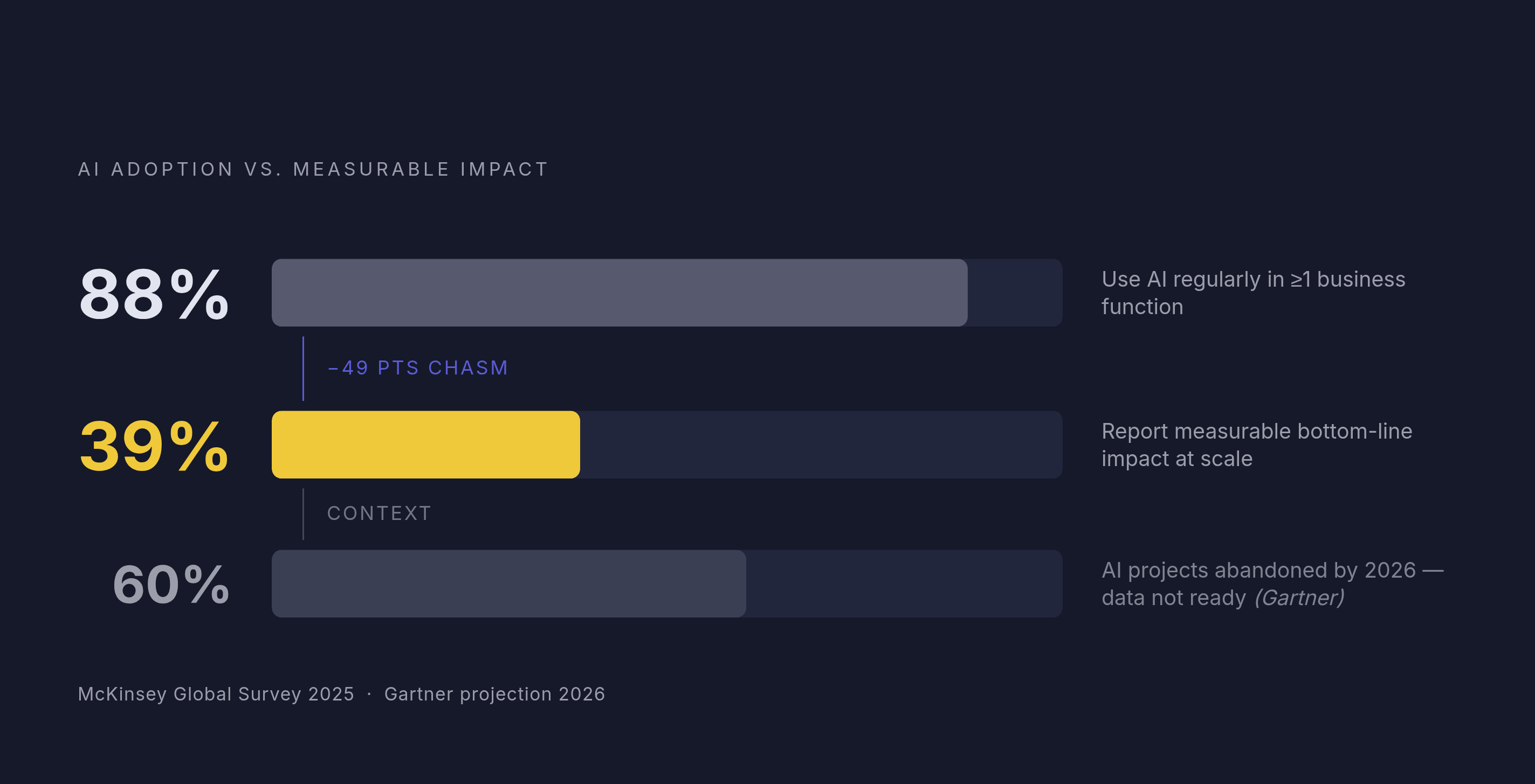
Most ML platform rollouts don't fail because the model is bad. They fail because the data underneath it was never built for a machine to consume, and that gap becomes visible only after the platform is already in production. McKinsey's 2025 State of AI survey found that 88% of organizations now use AI regularly in at least one business function, but only 39% report measurable bottom-line impact at scale McKinsey 2025 State of AI survey. That's not a small gap. That's a market where almost everyone has adopted the technology and less than half can point to a dollar figure it moved.
Gartner projects that through 2026, 60% of AI projects will get abandoned specifically because the data behind them wasn't ready Gartner / GridDynamics. RAND Corporation's numbers are even starker: over 80% of AI projects fail historically, roughly double the failure rate of comparable non-AI IT projects Straits Research RAND Corporation / GridDynamics Gartner / Devoteam Innovaccer - Wikipedia. And the failure doesn't usually happen at the start. It happens in the middle, after the pilot has already shown promise. Roughly 62% of organizations get stuck in what's been called "Pilot Purgatory," where a project works fine in a controlled sandbox and then falls apart the moment it touches real, messy, enterprise data jenstirrup.com.
The gap between AI ambition and impact is well-documented: 88% of organizations use AI regularly in at least one business function, yet only 39% report measurable bottom-line impact at scale McKinsey 2025 State of AI survey. Syntes AI's analysis found failure rates climbing from 70% for simple chatbots up to 85% for agentic workflows, the kind of system that has to string together multiple decisions instead of answering one question MIT Project NANDA / GridDynamics. More moving parts means more exposure to the same underlying weakness: data that wasn't ready for the load being put on it.
RAND, MIT, and Gartner point to the same causes (weak data foundations, unclear success definitions, and poor workflow integration), and the underlying model technology is rarely the reason a project fails. Weak data foundations. Unclear definitions of what success even looks like. Workflows that were never actually integrated into how people work. The technology is rarely the reason a project dies. So the real question, the one the rest of this piece is built around, is simple: if the model isn't the bottleneck, what does a roadmap look like when it's built around the actual constraint?
"AI-Ready Data" and Why Enterprise Data Almost Never Qualifies
Start with a number that should stop anyone mid-sentence: only 7% of organizations rate their data as completely ready for AI, according to a survey of 1,574 enterprise IT leaders run by Cloudera with Harvard Business Review Analytic Services Cloudera / Harvard Business Review Analytic Services. That's not a niche problem confined to laggards. A separate Gartner survey covering 248 data management leaders found that 63% either don't have the right data management practices for AI or aren't sure they do. Not sure. At this stage of AI adoption, "not sure" is itself the finding McKinsey 2025 State of AI survey.
The 2026 CIO Customer Data Readiness Report, built on responses from more than 220 senior IT leaders at enterprises with over 5,000 employees, traces the gap back to three structural causes: poor data readiness, misaligned success metrics, and workflow integration that never actually happened. Those three causes recur across every phase of this roadmap, appearing in each one in turn.
Here's the distinction that trips most teams up. There's data that's clean for human analysts, and there's data that's genuinely AI-ready, and those are not the same bar. An AI agent can't do any of that. It just answers, and a stale or half-wrong answer comes out looking exactly as confident as a correct one. Enterprise data was built for humans with institutional memory, not for a system that takes a column name at face value. Inheriting whatever "clean" meant for the BI team doesn't clear the bar.
The gaps that appear in practice are consistent. Data sits scattered across warehouses, SaaS tools, and operational systems with no single access layer tying it together. Column names describe structure, not meaning, so a field called status tells an AI model nothing about which values are valid or what the business actually means by "active".
The consequence isn't abstract. S&P Global reported that 42% of firms abandoned their primary AI initiatives in 2025, up sharply from 17% the year before, and the top obstacles cited were cost and data or security risk, not a lack of ambition S&P Global / Syntes. That's the organizational cost of skipping the readiness work: money spent, momentum lost, and a harder conversation next budget cycle about whether AI was worth the bet at all McKinsey 2025 State of AI survey.
The five pillars a modern data platform must satisfy before an ML platform sits on top of it
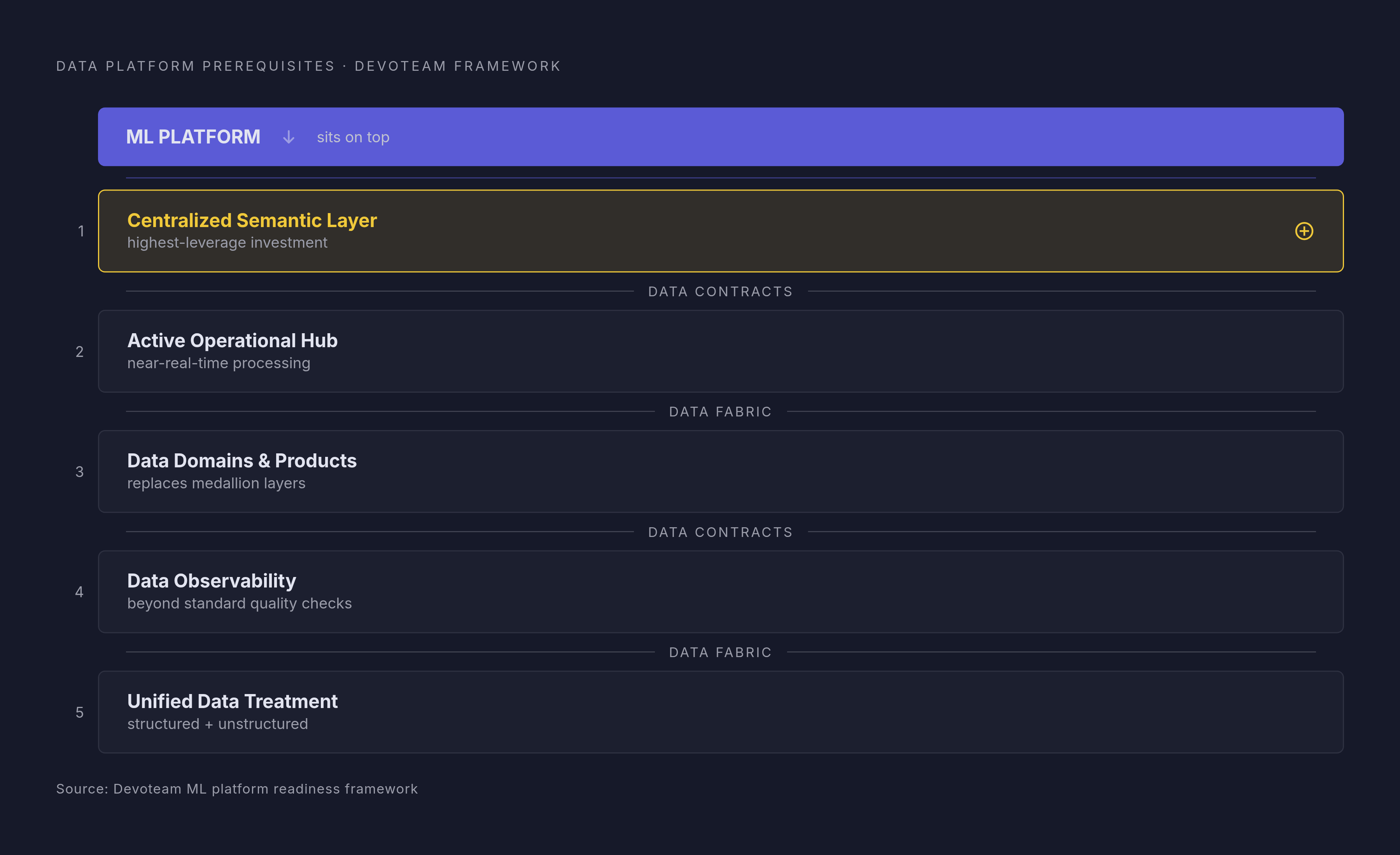
Devoteam's five-pillar framework for AI and agentic data platforms offers a useful spine for thinking through what "ready" actually requires structurally, and it should be treated as an organizing lens rather than a checklist to tick off in order. Gartner's forecast makes clear this isn't a hypothetical architecture shift either: by 2026, 80% of enterprises will have adopted a modern data platform architecture, driven mainly by AI and advanced analytics Straits Research RAND Corporation / GridDynamics Gartner / Devoteam Innovaccer - Wikipedia. The shift is already happening under most companies' feet, whether or not their ML platform strategy has caught up to it.
The first pillar is a centralized semantic layer. Instead of every BI tool keeping its own private definition of "active customer" or "monthly revenue," those definitions live in one shared, queryable place. That single source feeds everything downstream, dashboards, ML models, AI agents, consistently, instead of each consumer working off its own private interpretation.
The second pillar treats the data platform as an active operational hub rather than passive storage. Traditional data lakes were built to answer "what happened last quarter." AI workloads need to answer "what's happening right now" and often need to act on it. Devoteam names near-real-time processing as a hard requirement for a 2025/2026-era data platform, not a nice-to-have upgrade. An agent making a decision on a stale batch job from six hours ago isn't making a decision at all, it's guessing https://iceberg.apache.org/vendors/.
Third is a shift toward data domains and data products, moving away from the classic medallion architecture of bronze, silver, and gold layers. That layered approach was built for human-readable reporting pipelines, where a person eventually reviews the gold table before a chart gets built from it. Data products flip that: each one carries its own quality guarantees, a named owner, and semantic context baked in, so an AI system can consume it directly without someone translating it first. Apache Iceberg is emerging as the open standard underpinning this shift for structured data across multi-cloud and hybrid-cloud environments, according to Devoteam.
Fourth: data observability, which goes further than standard data quality checks. Quality checks catch problems you already know to look for. Observability catches the ones you didn't, schema drift, a pipeline that silently stopped updating, a source system that changed its units without telling anyone. An AI agent has zero tolerance for that kind of silent decay; a wrong number moving at agent speed compounds a lot faster than a wrong number sitting on a dashboard nobody's checked yet.
Fifth, and often the one most legacy platforms get wrong: unified treatment of structured and unstructured data. BI-era platforms were built around clean, structured tables. A platform designed only for rows and columns is designed for a shrinking slice of the actual workload.
Two connective concepts tie the five pillars together. Data fabric is the metadata-driven layer that links disparate systems, clouds, on-prem infrastructure, SaaS tools, without forcing everything into one central repository, per Trigyn's analysis of data engineering trends. And data contracts formalize the handoff between whoever produces data and whoever (or whatever) consumes it: versioned agreements that spell out schema, meaning, service-level guarantees, and quality expectations. Neither is optional decoration. Both are load-bearing.
The semantic layer as the most important investment in the roadmap
Of the five pillars, the semantic layer deserves its own section, because the evidence points to it as the single highest-leverage investment in the entire roadmap. The 2025 GigaOm Radar for Semantic Layers and Metric Stores classified the category as mature for the first time, a formal signal that this moved from a helpful abstraction into essential infrastructure. A MIT CISR research briefing states it even more bluntly: business leaders need to invest in a semantic layer to make their priority AI initiatives actually work.
What does a semantic layer actually do, mechanically? It defines metrics, dimensions, joins, grain, and permissions above the raw tables, in one centralized semantic layer. It takes a natural language question from an AI agent and turns it into the correct data operation, one that respects the business rules someone already agreed on. And it guarantees that "revenue" means the same number whether a BI dashboard, an ML model, or an AI copilot is the one asking.
That last point matters more than it sounds. Most of what gets blamed on "AI hallucination" in analytics contexts isn't hallucination at all, it's a semantic failure. The model picks the wrong table. It joins two tables at the wrong grain and silently double-counts. It aggregates a metric the wrong way and produces a number that's internally consistent but factually wrong. A governed semantic layer catches those errors before the query even runs, because the rules for "correct" are enforced upstream instead of hoped for downstream.
Skipping this step doesn't just create risk, it creates ongoing cost. Without a shared semantic layer, teams define the same metric in multiple systems, and any change to that metric has to be replicated across analytics engineering, BI, and AI copilots separately, multiplying maintenance cost and divergence risk. That's not a one-time tax. It compounds every time the business changes how it counts something.
The 2026 platform landscape reflects how seriously vendors are taking this Gartner / GridDynamics. Databricks Metric Views, announced in 2025 and reaching general availability in April 2026, brought a native semantic layer into the Databricks lakehouse, implemented through Unity Catalog Metric Views, letting a metric get defined exactly once and queried across any dimension at runtime. Snowflake Semantic Views does the same define-once, query-anywhere job natively inside Snowflake. Even so, an industry survey cited by Omni found that organizations are actively experimenting with semantic layers, data virtualization, and homegrown tooling to fix inconsistent metrics across AI and BI, and satisfaction with what they've built so far remains low. Building the semantic layer is clearly recognized as necessary. Getting it right in practice is a different problem, and one most organizations haven't solved yet.
The architectural implication for a roadmap is direct: an AI-ready data layer needs table descriptions, metric definitions, and relationships embedded and enforced at the moment a query runs, not documented somewhere and hoped for. That's not a feature to add later. It's the choice a roadmap has to make explicit up front.
Restructuring governance and permissions for AI workloads
Traditional data governance assumes a human analyst logging in under their own name, through a known interface, asking one question at a time. AI agents and ML workloads violate every one of those assumptions. Agents typically run under broad service accounts instead of a named person's identity. Query volume at agent speed makes manual review physically impossible, there's no analyst sitting there checking each request. Sensitivity has to get evaluated at the point where fields get combined, not just field by field, because two harmless columns can become a sensitive one the moment they're joined. And a write action taken by an agent, updating a record, triggering a workflow, carries a fundamentally different risk profile than a read, and needs to be governed more tightly.
The stakes of getting this wrong are already visible in the numbers. Gartner projects that more than 40% of agentic AI projects will be cancelled by the end of 2027, citing escalating costs, unclear business value, and inadequate risk controls as the reasons Gartner / GridDynamics. Risk controls, not model performance. That's a governance failure recorded on a project cancellation report.
The Model Context Protocol, or MCP, has emerged as the standard trying to solve the interoperability half of this problem. It's an open protocol for connecting AI tools to enterprise systems securely and with context, without every integration requiring a custom-built connector. Adoption moved fast: by early 2025, the MCP ecosystem had grown past 1,000 available servers, according to CData, and major AI providers, including OpenAI, Anthropic, Hugging Face, and LangChain, standardized around it that same year cdata.com. MCP brings governance concepts that didn't exist in most enterprise stacks a few years ago: sandboxed environments so an agent can't reach further than intended, explicit declarations of what context an agent is allowed to see, and permission scoping that maps onto the access controls a company already has in place. The security concerns enterprises are watching closely include tool poisoning attacks, unauthorized access from permissions that got misconfigured, and compliance alignment with regimes like the EU AI Act and HIPAA.
A rebuilt governance model is still required alongside it. A roadmap has to address a handful of things explicitly: permissions checked at query time, under the real user's actual identity, not inherited from a shared service account. Access that can get revoked at the level of a single workload, not tangled up in one shared credential everyone depends on. Audit logs that capture identity, intent, and lineage together, because a log of query strings alone is meaningless once volume hits agent-scale. And data accessed at query time, live, rather than pulled from a static pipeline output, so that freshness and policy enforcement travel together instead of drifting apart.
Evaluating ML deployment platforms against a data-ready foundation
Once the data foundation is in shape, the platform conversation actually becomes tractable, and it helps to be honest about where most projects still get stuck. Anaconda's 2026 Buyer's Guide states that the bottleneck is almost never the model itself: it's the gap between a working prototype sitting in a Jupyter notebook and a deployment a production team can actually govern, reproduce, and trust. Domo's 2026 platform guide puts a number on that gap: up to 90% of AI models never make it past the pilot phase, and the reason is deployment infrastructure, not model quality domo.com medium.com.
The category landscape itself has splintered. Anaconda describes 2026's field as full-lifecycle cloud platforms, inference servers, LLM inference engines, managed model hosting, open-source deployment frameworks, and MLOps platforms, all overlapping. Picking among them without a clear data strategy first makes the category distinctions basically pointless, since none of them fix a data layer that isn't ready.
Among full-lifecycle cloud platforms: Amazon SageMaker leads in raw adoption, largely riding AWS's overall market share, and offers an end-to-end ML lifecycle with deep AWS integration plus Model Monitor and Clarify for governance. Google's Vertex AI, rebranded as the Google Gemini Enterprise Agent Platform following Google's announcement at Cloud Next 2026, fits organizations already built on BigQuery and the GCP data stack, with AutoML and integrated model monitoring. Azure Machine Learning appeals most to Microsoft-centric enterprises, with strong hybrid deployment support and a Responsible AI Dashboard.
Domo's 2026 comparison covers a more deployment-focused set of tools Gartner / GridDynamics. Domo itself targets business teams operationalizing AI directly, running cloud or hybrid, with workflow integration, no-code access, and governance built in. BentoML suits ML engineers packaging models as microservices across cloud, edge, or hybrid environments, with flexible packaging and a lot of developer control. Seldon Core is Kubernetes-native, built for advanced inference graphs, A/B testing, and monitoring through Prometheus and Grafana. NVIDIA's Dynamo-Triton, formerly Triton Inference Server, handles high-performance inference across GPUs and CPUs with multi-framework support and dynamic batching. NVIDIA TensorRT optimizes models for low-latency inference across data centers, workstations, laptops, and edge devices. OctoML, now OctoAI following NVIDIA's 2024 acquisition, focuses on hardware-agnostic optimization across different targets. And TorchServe stays focused and simple: PyTorch model serving with straightforward deployment and metrics export.
DataOS, as described by Modern Data 101, approaches this from the data layer rather than the model layer, turning fragmented data into governed, context-rich data products with quality checks and semantic clarity built in, with APIs and multiple interfaces letting models and agents reach the right data without a heavy engineering lift, and observability, lineage, and compliance designed in rather than bolted on.
The right way to evaluate any of these is to weigh serving capability, ML stack support, deployment flexibility, monitoring, security, and LLM-specific handling, and then recognize that none of it matters if the data it depends on isn't governed, semantically clear, and fresh at the moment of query. As a rough matching guide: teams without a dedicated MLOps function tend toward managed platforms like SageMaker, Vertex AI, or Domo. Teams needing real-time inference at scale look at Triton, SageMaker, or Vertex AI. Teams prioritizing portability lean toward BentoML, Seldon Core, or container-based setups. And hybrid or on-prem requirements point toward Azure ML or BentoML. Fortune Business Insights expects large enterprises to account for 54.8% of global MLOps market share in 2026, and those organizations, with the heaviest governance and scale demands, are where the data-layer-first argument matters most.
A phased roadmap that sequences data readiness before platform deployment
The 2026 CIO Customer Data Readiness Report outlines a practical roadmap for closing the data readiness gap, and it's a useful anchor for how this section's phased structure should run.
Phase zero starts before any platform decision gets made: an honest audit of where data actually lives, who owns each source, and which of the five pillars are already missing. Skipping this step is how organizations end up buying a platform and then discovering, six months in, that the semantic layer they needed was never built https://iceberg.apache.org/vendors/.
From there, the sequence follows naturally from everything above. Get the semantic layer defined and governed before agents start querying against it, since that's the single fix that prevents the most common class of AI analytics failure McKinsey 2025 State of AI survey. Rebuild permissions around workload-level identity rather than shared service accounts, because retrofitting governance after an agent is already in production is far harder than designing it in from the start. Stand up observability before scaling query volume, not after something breaks silently at agent speed. Only then does the platform decision, SageMaker versus Vertex versus a deployment-focused tool like BentoML or Seldon Core, actually become a fair comparison, because by that point the data layer that supports them can support any of them.
If the sequence is skipped, the platform choice stops mattering. A best-in-class deployment tool sitting on top of scattered, semantically inconsistent, poorly governed data will produce the same 60% abandonment rate Gartner already sees coming, regardless of which logo is on the platform Gartner / GridDynamics. Phase 0 (). SOURCE PAGES, what the pages behind the outline's links say.
Sources
- AI & Agentic-ready Data Platforms: A Roadmap for 2026 | Devoteam
- 2026: The Year for Enterprise-Ready MCP Adoption
- 10 AI Model Deployment Platforms to Consider in 2025
- Top 5 Data Platforms for 2026. Check out this list to close in on the… | by Modern Data 101 | Medium
- AI Model Deployment Platforms: The 2026 Buyer's Guide
- How to Choose an AI-Ready Data Platform: A 2026 Buyer
- cisr.mit.edu
- omni.co