Data Mesh Implementation Challenges and Lessons
Organizations skip the cultural work and pay the price when domain teams resist ownership.

Data mesh implementations fail in predictable places, and the pattern has become clear enough to map. The architecture rarely breaks first. What breaks is domain ownership, then governance, then the whole thing collapses under AI workloads that expose every shortcut the organization took getting there.
By 2026, Thoughtworks calls data mesh a mature socio-technical paradigm, which is a polite way of saying it survived, but not in the form its early advocates promised. The global market for data mesh reached $1.69 billion in 2025, so this isn't a whiteboard exercise anymore; real budgets are behind it. Gartner floated the idea back in 2022 that data mesh might go obsolete before it matured. That didn't happen. Instead, most organizations that announced full transformations quietly kept the parts that worked (domain ownership, data products, federated standards) and dropped the dogma that didn't survive contact with actual teams, actual incentives, and actual budgets. Pinning down exactly where that dogma broke is worth walking through, because it's the fastest way to avoid repeating the mistake.
Why data mesh is an organizational transformation that gets treated as a technical one
Thoughtworks, after more than six years of watching these implementations unfold, states this plainly: the hardest part is changing how people and teams behave, not choosing a query engine or a catalog tool. Data mesh isn't something you buy. It's not something you deploy over a weekend. It requires deliberate change management, which sits awkwardly with how most technology budgets get scoped, since finance departments are built to fund tools, not behavior change.
Consider what's actually being asked of a domain team. Someone who used to build reports for their department now has to think like a product owner, with SLAs, versioning, and a support queue for other teams that depend on their data. That's not a new dashboard. That's a different job.
And here's the uncomfortable prerequisite, the one that took some sitting with before it made sense: an organization that never managed to enforce governance on a centralized data lake has almost no chance of pulling off federated governance across a dozen autonomous domains. Decentralizing weak governance doesn't fix it; it multiplies it. The dimensions that have to move together are domain boundary identification, distributed skill-building, a cultural shift from centralized to decentralized control, and ongoing data quality work; each one alone could be its own multi-year project, and mesh asks for all four at once.
The cost of underestimating this is not abstract. Some implementations report that a significant share of domain staff left or requested transfers when organizations hadn't budgeted for the human toll of the change. That's not a tooling failure. That's an organization that treated a culture shift like a software rollout.
How domain ownership breaks down before it gets established
Twenty-plus years of siloed data culture doesn't unwind because a slide deck says "decentralize." To a domain leader who has spent a career treating data as leverage, giving it up doesn't feel like gaining accountability. It feels like losing the thing that made their team indispensable.
The incentives run deep. Domain teams have been rewarded for years for hoarding data, not for exposing it with clean contracts and uptime guarantees. Asking them to reverse that overnight, without executive backing, produces what practitioners have started calling governance arbitrage: domains comply when it's convenient and quietly opt out when it isn't, because there's no consequence either way. Without alignment from the top, that arbitrage becomes the default operating mode.
Domain boundaries look tidy on an architecture diagram and fall apart in the actual enterprise. Real businesses have overlapping ownership, shared processes, and three departments with three different definitions of "customer." No diagram resolves that. Only a decision, made by someone with the authority to make it, resolves that.
There's also a talent gap that's easy to underestimate, and it took cross-referencing a few sources before the scale of it clicked. The role mesh needs, someone who understands distributed systems and thinks like a product manager, doesn't exist in most traditional data engineering teams. The U.S. Bureau of Labor Statistics projects 28% growth in data architect demand through the decade, which tells you how scarce this skill set already is. When ownership is fuzzy and the right talent isn't there, data products get built by whichever team moves first, not the team that actually has authority over the data. That produces contested lineage before the mesh is even a year old.
The three anti-patterns that kill implementations after the architecture is in place
Three failure patterns show up again and again, once the technical pieces are already in place.
Decentralization without platform investment. The central data team disbands, and no self-service platform shows up to replace what it did. Every domain builds its own ETL, its own catalog, its own quality checks, from scratch. Within roughly a year, the organization has as many versions of the same problem as it has domains. That's worse than the centralized mess it replaced, because now the mess is distributed and none of it talks to each other.
Federated governance that's actually no governance. "Federated" gets misread as "voluntary." Domains skip shared standards because nothing enforces them. Data products from different parts of the business can't be joined, classifications conflict, lineage breaks somewhere in the middle, and the interoperability that was the entire point of the exercise never shows up.
Data product theater. Someone renames a dataset a "data product" and calls it done. No SLA. No versioning. No one to call when it breaks. The label changes; the dataset underneath doesn't. Consumers figure this out fast, trust erodes, and domain teams lose whatever motivation they had to build something real.
All three trace back to the same root cause: a gap between announcing a principle and actually building the infrastructure that makes the principle true.
Why federated governance fails without an enforcement layer
Federated governance is the hardest of the four mesh principles to operationalize, because it asks autonomous teams to give up some of their autonomy for a collective benefit they may not personally see. That's a hard sell even with the best intentions in the room.
The failure here is structural, not a matter of goodwill. Without a platform that enforces shared standards at the moment a query runs, schema contracts, semantic definitions, access rules, governance lives in a document nobody rereads after the kickoff meeting. Permissions that get scoped to a shared service account instead of the actual person or workload requesting the data create broad access that no auditor will sign off on. Governance has to be enforced where data actually gets combined, not just at the level of a single field or a single source.
Audit logs that only record what got queried, without recording who queried it or why, are close to useless at the volume distributed domains generate. And the clearest test of whether federated governance is actually working has nothing to do with policy documents: it's whether "revenue" means the same thing in finance's data product as it does in sales'. If it doesn't, governance has failed, no matter what the policy says on paper.
This is where a semantic layer earns its place, standardizing definitions across domains and acting as an enforcement mechanism rather than a reference document. It isn't a side project bolted onto governance. In mature implementations, it's the thing that makes federation real instead of aspirational.
What happens when data mesh meets AI workloads
AI is where all the shortcuts come due at once.
Gartner's 2025 AI Hype Cycle report found that 57% of surveyed organizations believe their own data isn't ready for AI. That's a majority, from companies that have been investing in data infrastructure for years. Gartner also found that at least 30% of generative AI projects were abandoned after proof of concept by the end of 2025, and the reason wasn't that the models underperformed. It was the data underneath them.
The average enterprise scrapped 46% of its AI pilots before they ever reached production, most often because a team picked a use case before checking whether the data, governance, and infrastructure could actually support it. MIT's Project NANDA, in July 2025, found that 95% of organizations deploying generative AI saw no measurable return at all. The failure almost never traces back to the model. It traces back to data readiness and how poorly the workflow was integrated around it. Broader estimates suggest the large majority of AI failures trace to weak data foundations rather than algorithmic limitations, with architecture mismatches and governance gaps as the leading causes. A useful contrast has emerged from practitioners: organizations that saw real returns from AI were more likely to have redesigned their data workflows before picking a model, not after.
The connection to mesh is direct, once you line the failure patterns up side by side. AI workloads surface exactly the weaknesses an under-executed mesh leaves lying around: inconsistent definitions, access that was never properly governed, no lineage to trace an answer back to its source, stale snapshots quietly passed off as current.
Here's the part that makes this urgent rather than theoretical. A human analyst who hits a vague column name can walk over and ask what it means. An AI agent can't. It can't reconcile two domains that define "active customer" differently, and it can't tell a snapshot from three weeks ago apart from one refreshed an hour ago. All the institutional memory that used to paper over messy data, the analyst who just knew which table was actually current, doesn't exist for a machine.
What the data mesh principles that survived the hype cycle actually deliver for AI
Thoughtworks' 2026 field report makes a specific claim: the principles that survived, clean data, clear ownership, product-based structure with real contracts, are becoming the primary business case for mesh, not because they're elegant architecture but because they're the prerequisite for AI that actually works in production.
One idea from that report worth sitting with is the "dual-use data product": a data product built to serve human analysts and AI systems at the same time, with output ports that include a machine-context interface an agent can query directly, not just a SQL endpoint or a REST API bolted on afterward.
Gartner's own definition of AI-ready data lines up almost exactly with what a properly built data product delivers: aligned to a specific use case, governed at the level of the individual asset, running through automated pipelines with quality gates, and checked continuously rather than once at launch. That's not a coincidence, and it took comparing the two definitions line by line to be sure of it. It's the same discipline described from two different angles.
Regulation is pushing in the same direction. The EU AI Act's requirements for high-risk systems, data quality, provenance, bias detection, transparency, documentation, ongoing monitoring, are capabilities a well-run mesh builds in from the start rather than retrofitting under deadline pressure.
The semantic layer does specific work here: it gives an AI agent the table descriptions, the metric definitions, and the relationships it needs to produce an answer that's actually correct, not just an answer that's grammatically valid SQL. Structured questions need structured, governed data with semantic context behind them; run those same questions through semantic retrieval over ungoverned data and the result sounds confident and is often wrong. Freshness also means something different for a machine than for a person. A snapshot that's perfectly fine for Monday's analyst report is already too old for an agent making a decision in real time, so data products built for AI consumers need SLAs calibrated to that consumer's speed, not the old weekly cadence built for a person.
The implementation sequence that practitioners have converged on
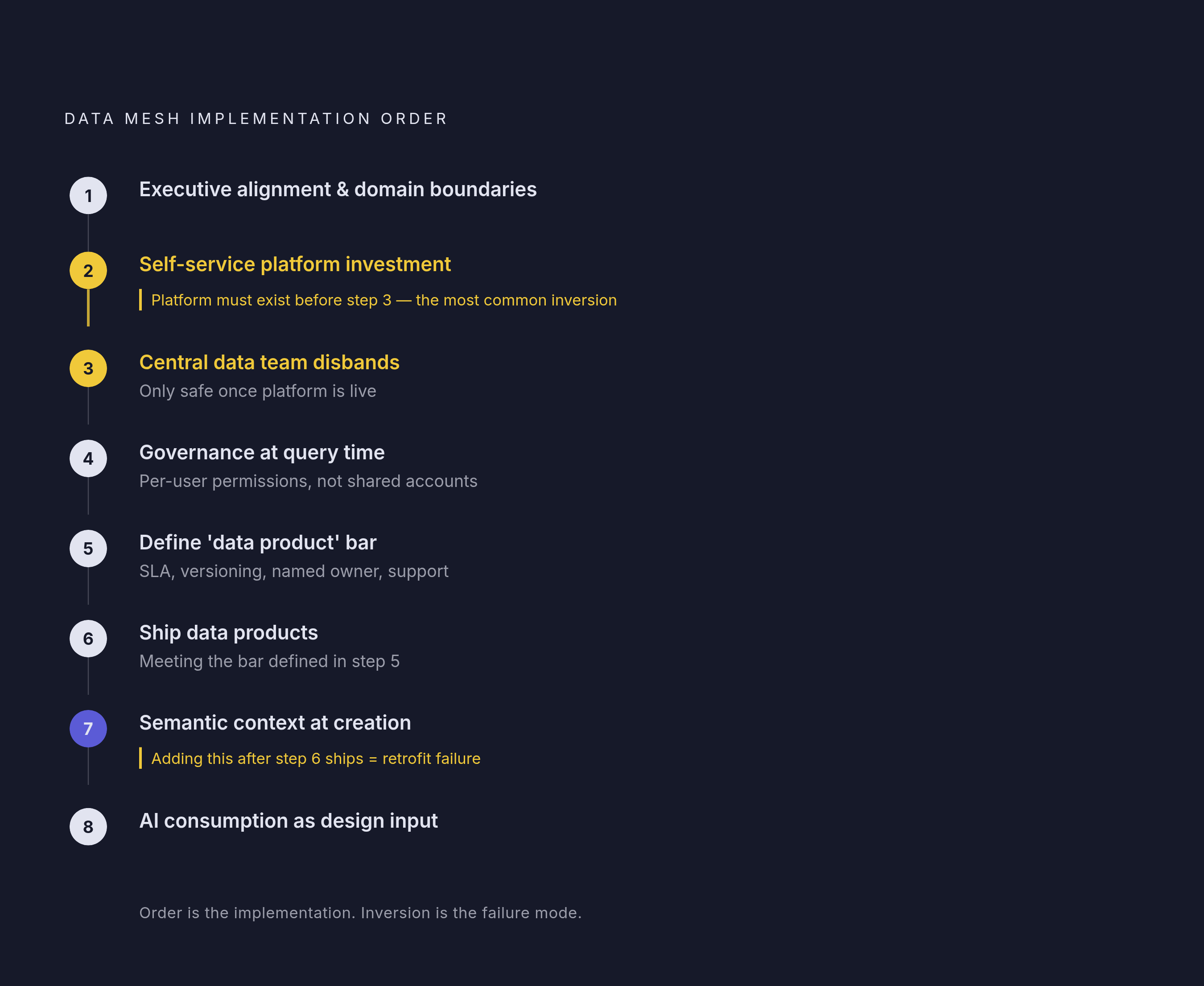
The order matters as much as the components, and it's worth being explicit about why, since it's easy to get backwards on a first pass.
Executive alignment and clear domain boundaries have to come before any decision about platform tooling. The organizational structure should determine what the platform needs to do, never the other way around. Self-service platform investment has to land before the central data team disbands; the platform is what makes decentralization workable instead of chaotic. Enforcement needs to be built into governance from day one, with permissions checked at query time against the actual requesting user, not inherited from a shared service account, because federated standards without teeth default to no standards at all.
A real definition of "data product" (SLA, versioning, named owner, actual support) needs to exist before any team is allowed to ship one. Data product theater starts the moment the first dataset gets relabeled without meeting that bar. Semantic context should get built in as products are created, not bolted on after the fact; retrofitting meaning onto a schema that's already in production is by far the more expensive path. And AI consumption needs to be a design input from the start, because data that's clean enough for a human analyst isn't automatically ready for a machine that has zero tolerance for ambiguity.
New infrastructure should sit on top of what already exists, the warehouses, the pipelines already running, rather than ripping them out. The implementations that got furthest treated mesh as a layer added onto the existing stack, not a replacement of it.
Gartner projects that 60% of AI projects will miss their value targets by 2027 because of governance that's fragmented and reactive rather than built ahead of time. The sequence above is the direct counter to that outcome, and at this point in the cycle, having traced the failures back to their source, it reads less like a recommendation than a record of what actually worked.