AI-Ready Data Layer Platforms for Teams Avoiding Full Migrations
A semantic layer alone won't make enterprise data AI-ready.

Enterprise data can be AI-ready without a full migration. It needs a layer above the systems already in place that gives agents meaning, live query access, and permissions that can be enforced. Buyers need to choose an architecture that can make the data usable and trustworthy without replacing the systems that already hold it.
Why migrating data is the wrong answer to an AI-readiness problem
Copying everything into one warehouse or lakehouse changes where data lives, but it does not explain what the data means or who an agent may access it for. Meanwhile, an enterprise estate can span mainframes, on-prem clusters, cloud warehouses, and SaaS applications. Centralizing those systems can consume years and substantial spending before delivering any AI value.
Some data cannot make that move at all. Data sovereignty rules in the EU, India, and other jurisdictions, together with regulated-industry requirements, can prevent sensitive data from moving to a public cloud. Those constraints do not disappear because an agent needs access. For teams expected to deliver agents and copilots now, migration is therefore the wrong prerequisite. A layer above the existing estate can fill those gaps while keeping source systems where they are.
What AI agents actually need from data that human analysts never required
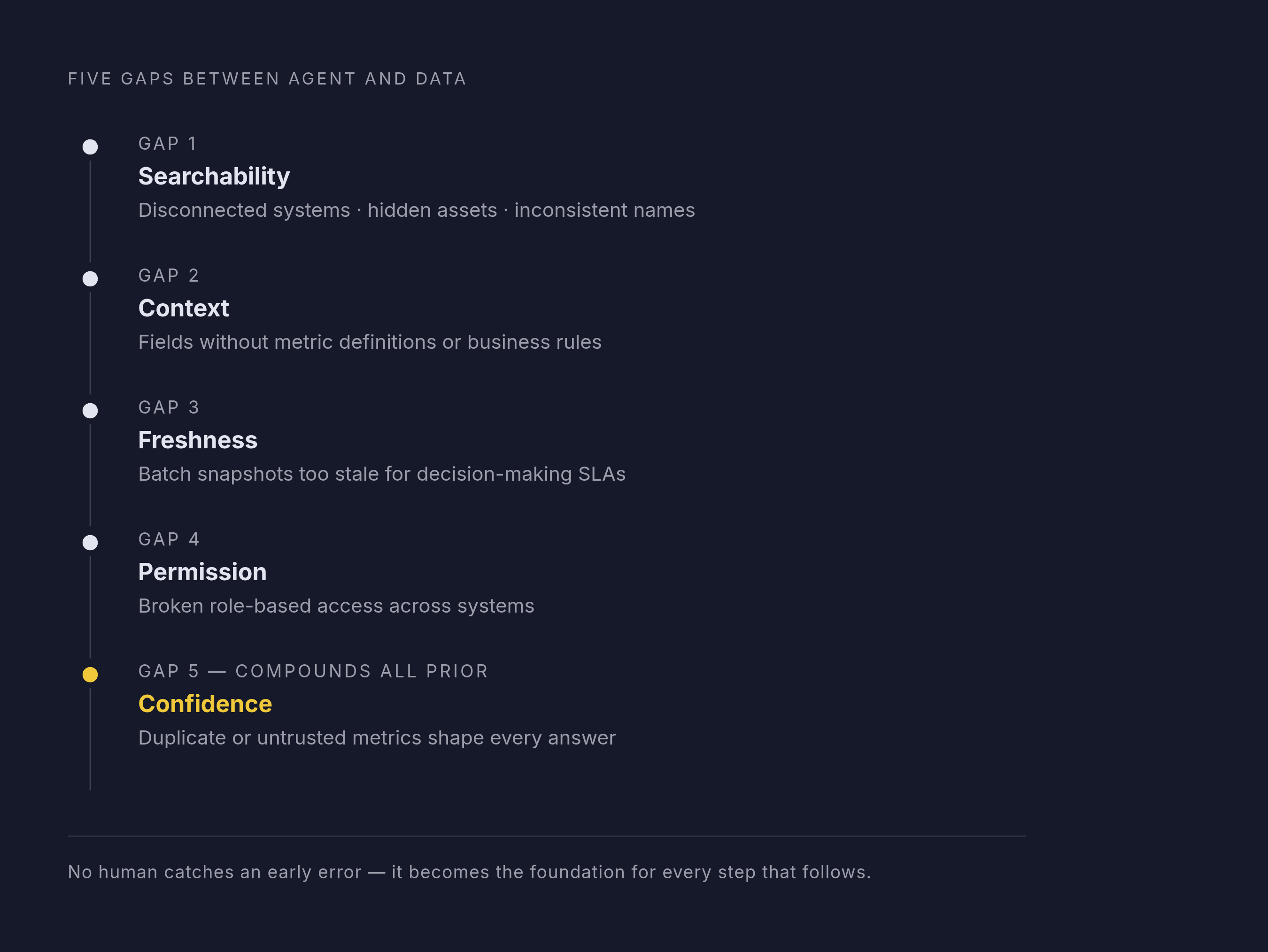
Human analysts knew things that were never part of the schema. They knew which datasets existed, what a metric excluded, and which dashboard was unofficial. Agents have none of that institutional memory. The searchability gap appears first, because disconnected systems, hidden assets, and inconsistent names leave an agent reasoning from only part of the business.
The context gap appears when an agent retrieves a field without its metric definition, exception logic, or business rules. The freshness gap is different but equally important. A snapshot may be acceptable for a dashboard reviewed by a person, yet too old for an agent making a decision. Batch pipelines built around the times when people review data may fall short of agent service-level agreements.
The remaining gaps concern permission and confidence. Agents cross systems faster than human analysts, so broken role-based access propagation can expose data before an audit reveals the failure. They also do not discount unofficial sources the way people do, so duplicate or untrusted metric definitions can shape their answers. These failures compound across a reasoning chain. Removing the person who once caught mistakes means that an early error can become the foundation for every step that follows.
What a genuine AI-ready data layer must do across all five of those gaps
The first requirement is federated query across the full estate, including on-premises and legacy systems. Federation executes queries against underlying engines in place. A layer confined to one cloud ecosystem still leaves agents with a partial view, while live access avoids making a batch snapshot the only available source.
The second requirement is unified identity and policy enforcement. Permissions must be evaluated at query time under the real end user’s identity, across every system involved. A broad service account is not a substitute. Agents must inherit the same role-based access model as human users at every hop, with reads and writes governed separately because changing data creates different risks from retrieving it.
The third requirement is semantic context within the layer. Table descriptions, metric definitions, and entity relationships must be available to agents as part of data access. An open format for sharing that context also reduces the risk that business definitions become trapped inside one platform.
The fourth requirement is open table formats and metadata. Proprietary formats and closed catalogs increase lock-in and make governance more brittle as agents move across systems. Portability must extend beyond the query interface. Otherwise, a team may gain access across its estate while becoming dependent on one vendor’s representation of the data and its rules.
Fifth, the layer needs lineage and audit across the estate that can keep up with the number of queries agents make. Logs must record which table was touched and connect identity, intent, and lineage. Sensitivity also needs evaluation where data is combined, because a join can expose information that individual table policies would not block. These requirements must work together. An unhandled boundary can defeat the protections and context supplied everywhere else.
Why the semantic layer is necessary but not the finish line
The semantic layer solves a real and costly problem. It encodes metric definitions, table relationships, and business rules once, so an agent asking about revenue can use the same definition as a human analyst. Within its defined coverage, it offers more reliable answers than raw model-generated SQL. That boundary is important. Better answers within a governed vocabulary do not amount to unlimited understanding of the estate.
Semantic tooling is becoming more portable and more packaged. The Open Semantic Interchange (OSI) specification, finalized in January 2026, defines a vendor-neutral format for sharing business context between semantic layers and AI consumers. Databricks announced Genie Ontology in preview on June 16, 2026, as an automated context layer. Neither makes meaning a replacement for the rest of the architecture.
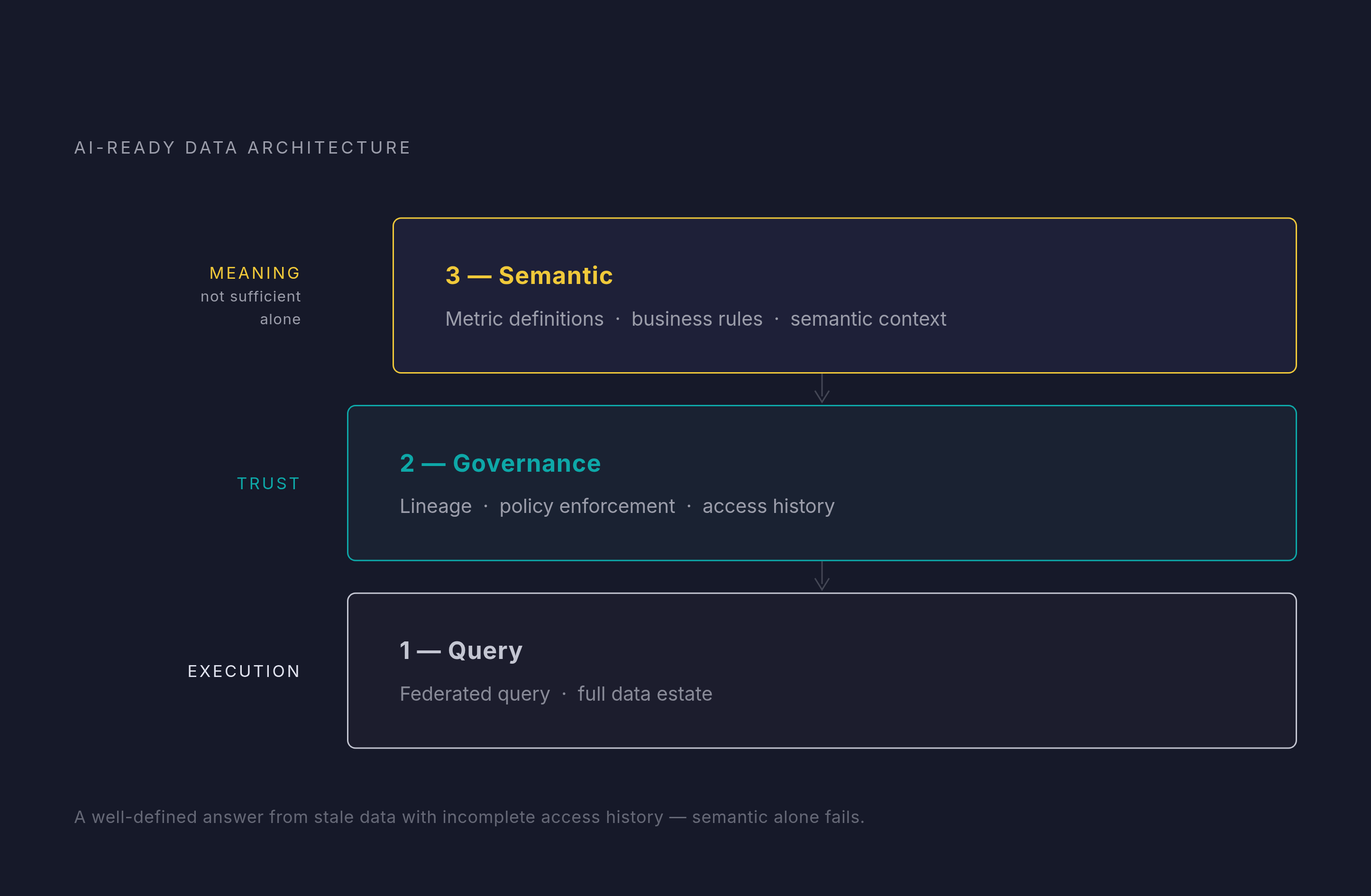
A correct definition does not grant permission to use it. Nor does it refresh an old snapshot or reconstruct a missing cross-system audit trail. A semantic layer can therefore produce a well-defined answer from stale data while leaving its access history incomplete. The full stack needs three layers, namely meaning through semantics, trust through governance and lineage, and execution through federated query. Treating semantics as the finish line leaves the other two jobs undone.
Why governance is where large AI initiatives actually stall
AI needs broad, real-time access across silos, while security teams need least-privilege access. Those needs seem at odds only when access and control are handled as separate projects. Enforcement at the data layer brings them together. An agent can reach multiple systems without gaining unrestricted access to everything inside them. Controls patched into a prompt or model layer cannot provide the same boundary because they can be bypassed.
In practice, authentication, authorization, and retention rules need to be defined once and applied across the estate. Row-level and field-level restrictions must apply before data gets into an agent’s context window. Filtering the answer afterward is too late. Policy must also check data in combination, since a join between two tables that are each permitted can produce a sensitive result. Write permissions require stricter treatment because an agent that changes data or triggers downstream actions creates risks beyond disclosure.
Governance is therefore operating infrastructure. Consider the industry illustration of a major US financial institution handling very high request volumes. Its challenge is not simply to approve an AI use case, but to enforce access rules throughout that workload. The same principle applies to any large initiative. The reach of its agents depends on how consistently its data layer can enforce the rules.
How the data products model solves the reusability problem that governance alone cannot
Permission alone does not make a dataset reusable. Even a well-governed estate can force every team and agent to locate, evaluate, and certify the same data independently. That repeated work is a hidden tax on adoption. Treating data as a product moves documentation, ownership, service-level agreements, and semantic context into the dataset’s interface. The consumer no longer has to assemble those details from a separate wiki and conversations with the team that built it.
Quality and freshness agreements tell an agent whether the data meets its requirements before it queries, while built-in discoverability helps both people and agents find it. Internal data marketplaces provide a place to publish, version, and consume those certified products across teams. Their value is not merely a searchable storefront. They turn federated access, semantic context, and policy enforcement into something consumers can use repeatedly without repeating the certification work.
Architectural approaches teams are using to build this layer without replacing existing systems
Federation over existing engines is the first pattern. Starburst, built on Trino, and Dremio query data in place across on-prem databases, cloud warehouses, and object stores. Dremio’s AI Semantic Layer also combines business context, semantic search, and automatic discovery for people and agents. This pattern fits estates whose main obstacle is siloed query access. Its trade-off is that query flexibility does not, by itself, resolve fragmented governance.
The underlying engine and gateway have different jobs. Trino supports federation across multiple kinds of sources, while Apache Kyuubi routes queries to engines including Trino, Spark, Flink, and Hive. Apache Ranger paired with Keycloak can add centralized policy enforcement across several engines and on-premises databases. Integration still needs care. Native S3 enforcement, for example, needs more integration work than the upstream Ranger project provides.
A governance overlay is the second pattern. Collibra is an option for enterprises that already have multiple data platforms and need a shared layer for policy, catalog, and lineage. The trade-off runs in the opposite direction from a federation-first design. Consistent governance can improve control without solving how an agent will query all the underlying systems.
Pipeline orchestration consolidation is a third approach. Prefect acquired Dagster Labs on July 13, 2026, combining Prefect for execution, Dagster for pipeline definition, and FastMCP for agent access. FastMCP’s role within data governance is access governance. This pattern focuses on getting ready for and running the work that supplies agent-ready data. It does not, on its own, establish that every source is available through live federated query.
The fourth pattern puts semantic context, live query access, and policy enforcement in one interface above the infrastructure already in place. It spans warehouses, SaaS tools, and operational systems rather than treating query access and governance as separate overlays. Peaka is one option built on this pattern, federating existing databases, SaaS tools, and legacy systems while embedding semantic context, enforcing permissions under the real user’s identity at query time, and logging queries with full lineage. The architecture is more complex than either overlay alone.
How to evaluate any platform against the five requirements before committing
First, ask whether the platform queries on-premises systems, legacy databases, and cloud warehouses in place. Request a live demonstration against a system outside the vendor’s native ecosystem. Federation limited to one cloud or a narrow approved source list may leave the hardest parts of the estate untouched.
Second, ask whose identity governs each query across every source. The answer should distinguish individual end-user permissions from broad service-account access and explain whether access can be revoked for a single workload. Source boundaries deserve particular attention. Row-level security that works only for data stored inside the platform does not show that federated sources get the same protection.
Third, ask whether metric definitions, table descriptions, and entity relationships are structured metadata that agents can query. Documentation outside the system does not meet that test. Ask about OSI support or an equivalent open standard for business context portability. Fourth, examine table formats and catalog standards, including Apache Iceberg or an equivalent open format. An open query interface alone does not provide an exit from proprietary storage and metadata.
Fifth, ask whether audit records connect identity, intent, and lineage across federated sources at the volume agents generate. A final-result log is not a traversal history. Lineage that stops at the warehouse boundary leaves the rest of the reasoning chain unexplained, while logging built for human query volumes may not keep pace. Beyond those technical tests, ask whether data products come with owners, service-level agreements, and discoverability or leave each team that uses them to do that work. The commitment should rest on what the platform demonstrates across the existing estate.